Synthetic Data vs Real Data for ML Training Decisions
Swarnava Dutta9 min read
Synthetic Data vs Real DataSynthetic Data For TrainingSynthetic Training Data LLM
Contents

You trained a fraud detector on 200k real transactions, but the model misses 60% of a new fraud pattern because your training data contained twelve examples of it. A colleague suggests generating synthetic samples to fill the gap. That suggestion splits into four separate decisions: accuracy impact, rare-class coverage, privacy leakage, and generation cost. Get any one wrong and you ship a model that's either blind to edge cases or quietly memorizing the source records it was supposed to replace.
Quick answer
Use real data when distribution fidelity and label accuracy matter most. Use synthetic data to expand rare classes, enforce privacy constraints, or bootstrap training before real samples exist. A hybrid mixture - real data as the backbone, synthetic data filling specific gaps - outperforms either extreme in most production settings. Always benchmark downstream task accuracy and measure privacy leakage on the synthetic set before committing to a ratio.
Synthetic Data vs Real Data for Training: Decision Criteria
Real data comes from the process you're modeling - logged transactions, sensor readings, user queries. Synthetic data is generated by a model or algorithm trained on real data. Hybrid mixes both, using real samples as the backbone and synthetic samples to patch gaps like rare classes or privacy-sensitive fields.
| Criterion | Real Data | Synthetic Data | Hybrid |
|---|---|---|---|
| Downstream accuracy | Highest when representative | Degrades under distribution shift | Near-real when mixing ratio is tuned |
| Rare-class coverage | Limited by collection frequency | Can oversample arbitrarily | Best - real anchors + synthetic fill |
| Privacy leakage | High - contains PII by default | Low if generation avoids memorization | Moderate - real subset still needs controls |
| Acquisition effort | Months of collection, contracts, IRB | Hours to days of compute | Moderate |
| Generation cost | Storage and cleaning | GPU/API cost per sample | Combined |
| Labeling control | Noisy, expensive human labels | Perfect labels by construction | Mixed quality |
| Distribution fidelity | Ground truth by definition | Only as good as the generator | Real data keeps fidelity anchored |
| Auditability | Full provenance possible | Generator config is the audit trail | Both trails needed |
Measuring synthetic data quality by how realistic it looks tells you nothing useful. A GAN can produce convincing tabular rows that shift joint distributions enough to drop downstream F1 by double digits [1]. The only reliable utility test is model performance on a held-out real test set.
Benchmark Synthetic Data for Training with SDV
Split your real dataset before touching a synthesizer. Reserve 20% as a held-out real test set that no generator ever sees. Fit your synthesizer only on the 80% training partition, then generate synthetic rows from that fitted model.
Train three identical downstream models with fixed seeds, identical preprocessing, and the same hyperparameters:
- Real-only: trained on the 80% real training split
- Synthetic-only: trained on the same number of synthetic rows
- Mixed: real training rows plus synthetic rows filling a specific gap
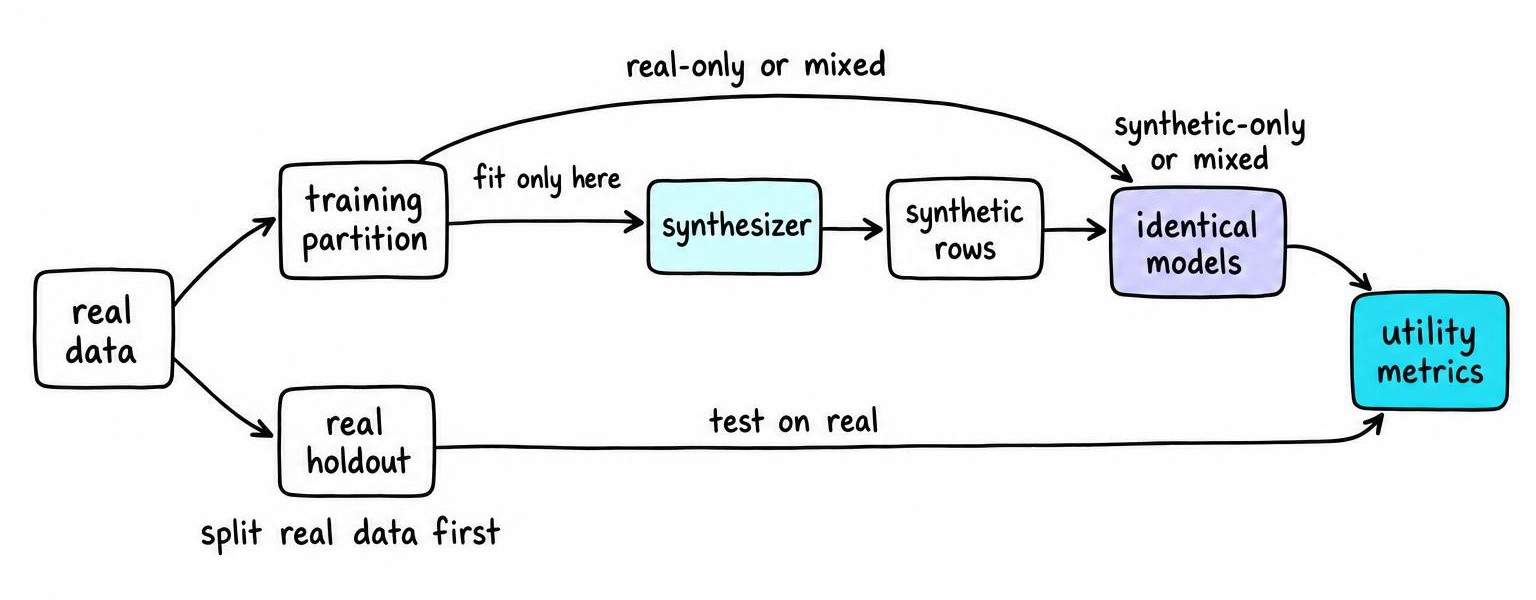
Evaluate all three against the same real holdout set using task-appropriate metrics: F1, AUROC, calibration error, RMSE, or MAE. The synthetic-only model's score relative to real-only gives you a concrete utility gap number.
from sdv.single_table import GaussianCopulaSynthesizer
from sdv.evaluation.single_table import evaluate_quality
from sdv.metadata import Metadata

metadata = Metadata.detect_from_dataframe(data=train_real)

synthesizer = GaussianCopulaSynthesizer(metadata)
synthesizer.fit(train_real)
synthetic_df = synthesizer.sample(num_rows=len(train_real))

quality_report = evaluate_quality(train_real, synthetic_df, metadata)
print(quality_report.get_properties())
SDV's QualityReport catches gross generator failures - collapsed categories, broken correlations - but a synthesizer can score 95% on column-pair similarity and still produce a model that underperforms by five F1 points because conditional relationships in the tails were smoothed away. Fidelity scores help you triage; task accuracy decides which generator ships. For building safe generation pipelines around this workflow, see the synthetic training data pipeline guide.
Test Accuracy, Rare-Class Coverage, and Distribution Shift
Overall F1 hides synthetic-data failures. A fraud model trained on a mixed dataset can report 0.94 F1 while recall on a specific rare fraud type sits at 0.31. Break every evaluation into per-class precision, recall, and a full confusion matrix.
Conditional generation can boost rare-class recall, but only if generated records respect feature correlations. A CTGAN asked to oversample a rare medical diagnosis may produce lab-value combinations that never occur clinically. Check synthetic minority samples against real minority marginals and flag any feature pair whose correlation diverges by more than 0.15.
Slice your evaluation beyond class labels across demographic, geographic, temporal, and operational dimensions. Temporal splits deserve extra attention - synthesizers reproduce historical bias and miss emerging patterns.
A model trained on synthetic data from 2023 transactions will underperform on 2024 fraud vectors exploiting a new payment rail [2]. Always hold out a forward-looking real test set that post-dates the generator's training window.
Measure Privacy Leakage Instead of Assuming Anonymity
Synthetic records are not anonymous by default. Generators memorize outliers - a patient with a rare disease combination, a high-net-worth individual with unique transaction patterns. When the training set contains small subgroups, a well-fitted synthesizer can reproduce near-exact copies of real records.
Four empirical tests catch this:
- Nearest-neighbor distance: flag synthetic-real pairs below a threshold derived from the real-real distance distribution
- Exact-match rate: count synthetic rows duplicating a real row on all quasi-identifiers
- Membership inference: train an attacker to distinguish training-set records from holdout records; accuracy meaningfully above chance (e.g., 55% on a balanced test) suggests memorization [3]
- Attribute inference: predict sensitive attributes from partial synthetic rows and compare to a no-access baseline
Formal mechanisms like differential privacy (DP-SGD during CTGAN training) provide mathematical guarantees but reduce utility. In published tabular benchmarks, DP typically costs several F1 points depending on the privacy budget ε. Treat DP as a complement to empirical testing, not a replacement.
The generator's privacy story starts with the real data. Consent must cover downstream synthesis, provenance must link real records to generator checkpoints, and retention limits apply to source data independently of synthetic output.
Synthetic Data Generation Methods and Their Tradeoffs
| Method | Best for | Fidelity | Key failure mode |
|---|---|---|---|
| Statistical sampling (SMOTE) | Small tabular, quick baselines | Low | Ignores feature correlations |
| Copula models (SDV) | Tabular with moderate correlations | Medium | Smooths tail dependencies |
| GANs (CTGAN) | Tabular, time-series | Medium-High | Mode collapse drops rare classes |
| VAEs | Tabular, images | Medium | Posterior collapse |
| Diffusion models | Images, audio, video | High | Compute scales with resolution |
| Simulators / rule engines | Robotics, physics-governed domains | Domain-specific | Sim-to-real gap |
| LLM generation | Text, NLP augmentation | High surface realism | Hallucinated facts, style collapse [4] |
When your domain has well-understood constraints - physics equations, financial settlement rules, network protocols - a simulator often outperforms a learned generator because it guarantees constraint satisfaction rather than approximating it. A diffusion model produces photorealistic images but gives you limited control over semantic attributes without fine-grained conditioning; a rule engine lets you dial rare-event frequency to exactly 5% and know every generated record is valid. Match the generator to the constraint that will bite you hardest in deployment.
Synthetic Training Data for LLMs: Benefits and Failure Modes
When an LLM generates training examples, it produces tokens autoregressively. Temperature, top-p, and source context shape the output. Narrow temperature yields repetitive text; wide temperature introduces hallucinated facts.
Useful applications where LLM-generated examples earn their cost:
- Instruction tuning and format transformations: generate prompt-completion pairs, convert unstructured text into structured JSON or SQL
- Multilingual expansion: translate and localize seed examples across languages
- Adversarial and tool-use examples: synthesize edge-case inputs or function-call traces for agent fine-tuning
The failure modes are predictable. Hallucinated labels poison supervised training silently. Style collapse narrows linguistic diversity.
Training a student model on teacher output and repeating the cycle triggers model collapse, where tail distributions vanish over generations [5]. Benchmark contamination occurs when generated examples reproduce test-set questions.
Mitigations are operational. Tag every synthetic example with the generator checkpoint and prompt template. Deduplicate against real training and evaluation sets.
Filter by confidence score or a verifier model. Route 5-10% of synthetic examples through human review, prioritizing edge cases. Evaluate exclusively on real prompts from the target environment.
Choose Synthetic Data vs Real Data for Production Training
Cost comparisons that only count generation compute miss most of the bill. Map every line item: collection contracts, labeling hours, licensing, cleaning pipelines, generator training, per-sample inference, privacy validation, storage, and monitoring. For LLM or diffusion generators at scale, add GPU-hour energy draw and cooling.
Three regimes simplify the choice:
- Real-only when authentic behavioral signals and defensible ground truth dominate (clinical trials, safety-critical labeling)
- Synthetic-only for simulation-friendly domains where real collection is impossible (autonomous driving corner cases, pre-launch products)
- Hybrid when targeted rare-class or privacy gains justify added validation - most production tabular and NLP tasks
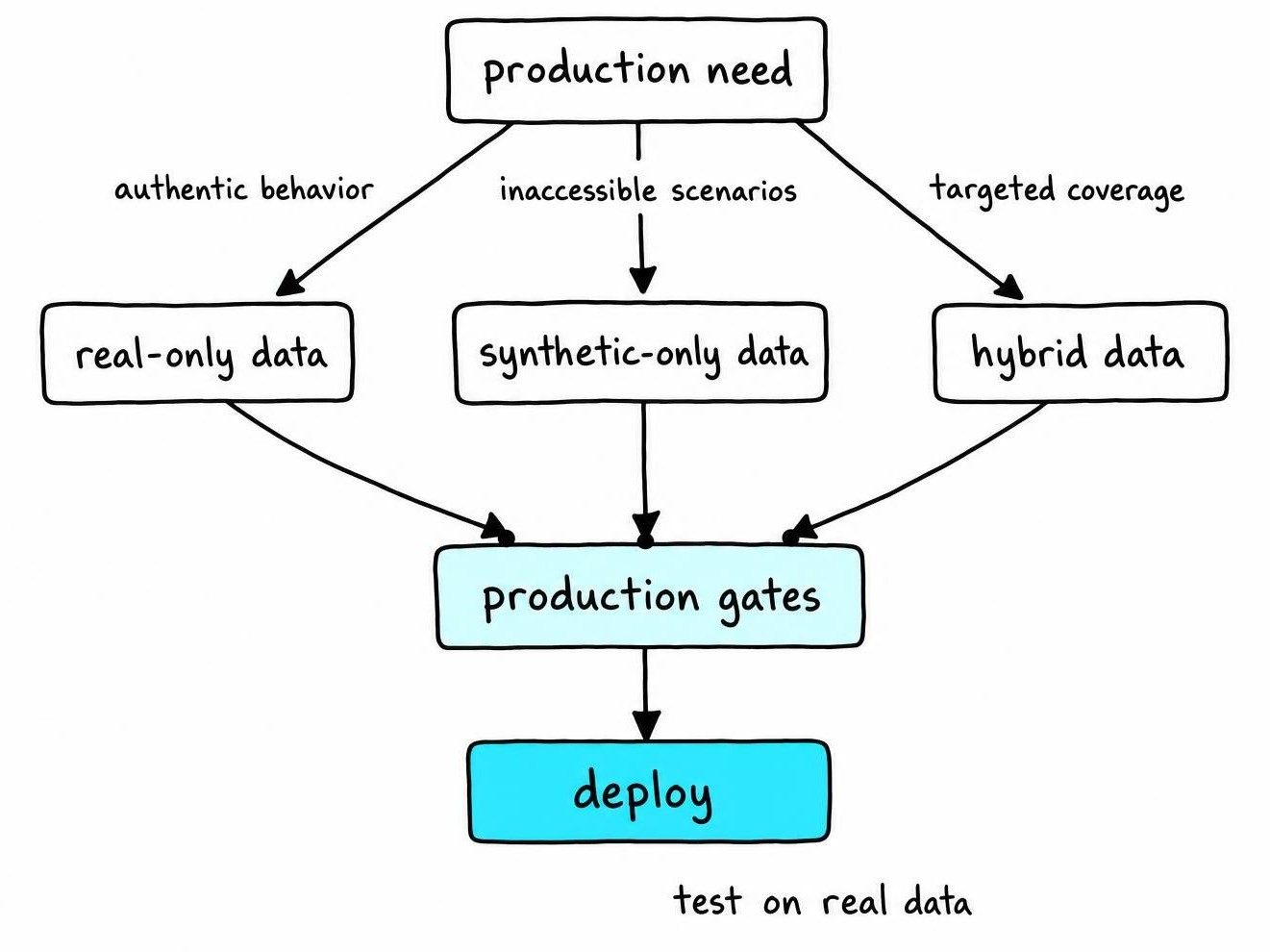
To find the right mix, start at 0% synthetic, step up in 10-point increments, and evaluate each mixture on your real holdout set across utility, privacy, and per-subgroup fairness. Pick the lowest-cost mixture that clears all three thresholds.
Set production gates before deployment: drift detection on incoming real data versus the generator's training window, membership-inference regression tests on every new synthetic batch, subgroup performance floors, provenance logging, and a retraining schedule that refreshes the generator on fresh real data. That last gate prevents synthetic feedback loops - training a new generator on data already containing previous synthetic output.
FAQ
When should I use synthetic data instead of real data?
Use synthetic data when real samples are scarce, expensive, or privacy-restricted, and when you can validate downstream model performance on a real held-out test set. Common triggers include rare-class shortages below a few dozen examples, regulatory constraints blocking data sharing, and cold-start scenarios where no production data exists yet.
How do I measure synthetic data quality?
Measure downstream task accuracy on a real held-out test set - not synthetic realism scores alone. Complement with statistical fidelity checks (marginal distributions, pairwise correlations) and privacy leakage tests (nearest-neighbor distance, membership inference). A synthetic dataset that scores well on fidelity metrics but drops F1 on the real test set is not production-ready.
Does synthetic data solve privacy problems?
Synthetic data reduces but does not eliminate privacy risk. Generators can memorize outliers and small subgroups, reproducing near-exact copies of real records. Run empirical privacy tests - nearest-neighbor distance, membership inference, attribute inference - on every synthetic batch. Combine with differential privacy mechanisms when formal guarantees are required, accepting the utility cost.
References
- Privacy Measurement in Tabular Synthetic Data: State of the Art and Future Research Directions - Alexander Boudewijn, Andrea Filippo Ferraris, Daniele Panfilo et al. (2023)
- Privacy Measurement in Tabular Synthetic Data: State of the Art and Future Research Directions - Alexander Boudewijn, Andrea Filippo Ferraris, Daniele Panfilo et al. (2023)
- Privacy Measurement in Tabular Synthetic Data: State of the Art and Future Research Directions - Alexander Boudewijn, Andrea Filippo Ferraris, Daniele Panfilo et al. (2023)
- Privacy Measurement in Tabular Synthetic Data: State of the Art and Future Research Directions - Alexander Boudewijn, Andrea Filippo Ferraris, Daniele Panfilo et al. (2023)
- IVOA Recommendation: Spectrum Data Model 1.1 - Jonathan McDowell, Doug Tody, Tamas Budavari et al. (2012)