Synthetic Training Data for AI: A Safe Pipeline Guide
Swarnava Dutta12 min read
Synthetic Training Data
Contents

A fine-tuning run can finish with a clean loss curve and still leave the model confidently worse on the rare cases you care about. Synthetic training data for AI is the usual way to expand a thin dataset, but a generator that keeps recycling familiar patterns quietly flattens unusual ones.
The dashboard looks healthy. An untouched evaluation set exposes the damage: routine answers stay polished, while uncommon intents drift toward the same generic response.
Synthetic examples can fill coverage gaps, target edge cases, and reduce direct exposure to sensitive records. Yet repeated training on generated outputs can reinforce existing errors and reduce coverage of distribution tails [1].
The answer isn’t to reject generated data or pour it indiscriminately into a foundation-model corpus. I treat it as an engineered data product: define the missing behavior, preserve real-data anchors, filter aggressively, and earn every mixture change through real-world evaluation.
Quick answer
Safe synthetic training data for AI comes from an eight-step versioned release process bounded by a real-only baseline and untouched real holdouts. The middle gates check factual support, deduplicate against evaluation sets, and screen for privacy leakage and contamination. Candidates come from generator families such as GPT, Claude, and Llama. A real-data anchor stays in place, because recursive training that replaces real evidence with generated outputs causes model collapse.
What Synthetic Training Data for AI Is - and Where Foundation Models Fit
Synthetic training data for AI includes generated examples, labels, interactions, or environments designed to preserve useful properties of real observations. That might mean instruction-response pairs for a language model, labeled images for a vision model, or aligned image-text examples for a multimodal system.
Foundation models learn reusable representations from broad datasets and then adapt to tasks such as classification, generation, retrieval, or tool use. Synthetic data for foundation models supplements sources that are scarce, expensive to annotate, restricted, privacy-sensitive, or too inconsistent to use directly.
I separate generated datasets by how much observed data remains:
- Fully synthetic: Every record and label comes from a generator.
- Partially synthetic: Generated fields complete or replace parts of real records.
- Augmented: Controlled transformations or new annotations extend real examples.
- Model-generated: An AI model creates examples, labels, critiques, conversations, or reasoning traces.
This distinction matters when debugging. A generated label attached to a real document has different risks from a fully generated conversation, even if both end up in the same JSONL format.
Synthetic Data vs Simulated Data: The Practical Difference
In the synthetic data vs simulated data distinction, simulation data comes from an explicit rules-based environment, digital twin, or physical model. Synthetic data is the broader category; statistical methods, generative models, rules, and simulators can all produce it.
Rendered driving scenes and robotic manipulation environments are simulations. LLM-generated instruction pairs and counterfactual tabular records are synthetic, but they aren’t necessarily simulated.
The label determines how I validate the output. A simulator needs checks against physical behavior and domain assumptions, while model-generated data needs factuality, duplication, bias, and leakage tests.
How Synthetic Data Generation for LLMs Works
Operationally, synthetic data generation for LLMs is a controlled pipeline: specify the target behavior, select seeds, generate candidates, filter them, verify labels, deduplicate records, and version the accepted dataset. Every stage should emit inspectable artifacts rather than hiding everything inside one final file.
Common methods include:
- Self-instruction: A model proposes tasks and answers based on seed examples.
- Teacher distillation: A stronger model supplies supervision for a smaller target.
- Prompt variation: Templates vary language, format, difficulty, or persona.
- Retrieval-grounded generation: Trusted documents constrain facts and labels.
- Adversarial generation: A generator creates hard negatives or failure-seeking inputs.
- Simulation: Rules govern interactions, rewards, state changes, or tool behavior.
- Human-in-the-loop generation: Reviewers author seeds, correct labels, or adjudicate uncertain outputs.
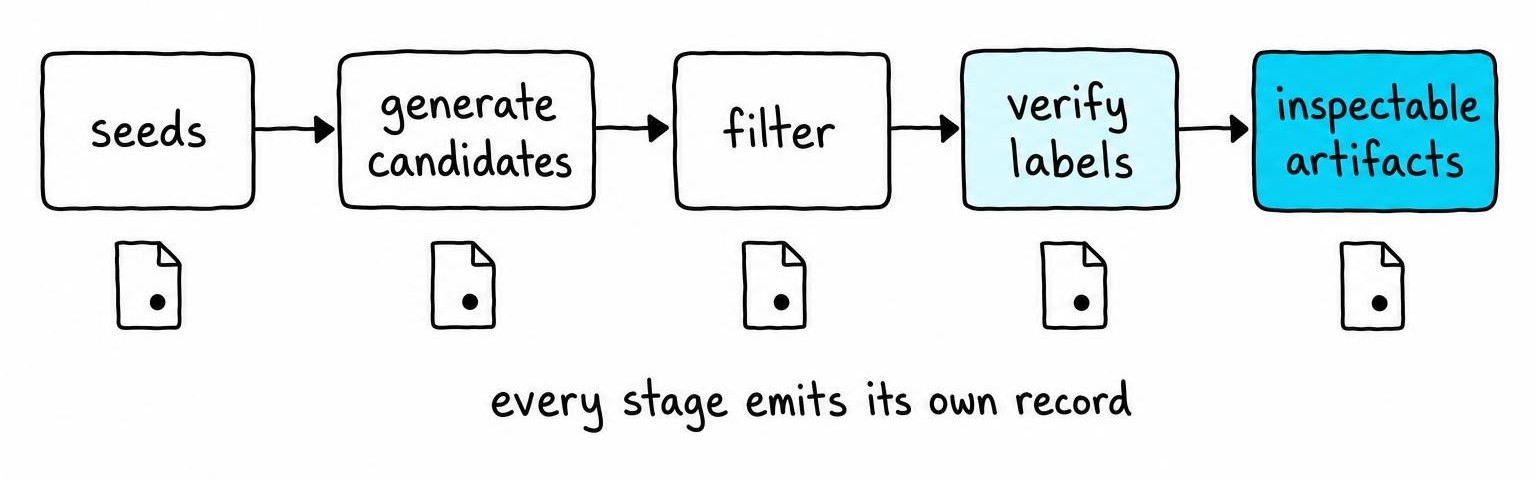
Temperature and sampling strategy trade repetition for variance. More variation may improve coverage, but it also creates malformed, irrelevant, contradictory, or unsupported examples.
Volume proves only that inference ran. Acceptance gates determine whether an example deserves training influence.
Choosing Generators, Seeds, and Grounding Sources
Using the target model as its own generator can be inexpensive and distribution-matched, but it also reinforces that model’s blind spots. A stronger teacher may provide better supervision, while multiple generators reduce dependence on one model’s phrasing and preferences.
Rules and simulators work well where constraints are explicit. I prefer them for tasks such as structured transformations, tool-state transitions, and arithmetic checks because I can independently calculate whether an answer is valid.
Representative seeds define the neighborhood the generator explores. If the seeds omit short queries, code-switched language, or ambiguous requests, prompt variation rarely discovers those missing modes by accident.
Grounding sources matter just as much. Trusted documents, databases, and tool outputs reduce unsupported labels, but the retrieval layer can still inject bad context. Answers in a generated QA batch look wrong when overlapping chunks split critical qualifications away from their headings, and in that case the generator is fine - the indexing setup needs a better RAG chunking strategy.
For reproducibility, record prompt templates, model versions, sampling settings, seed identifiers, source passages, licenses, filter decisions, and dataset revisions. If you can’t reproduce a row or explain why it passed, don’t train on it.
Where Synthetic Data Beats Real Data - and Where It Does Not
The strongest benefits are speed, flexible coverage, and control over which cases appear. Generating a candidate for a rare event can be easier than waiting to observe, collect, and label that event - especially when it is dangerous, private, or genuinely uncommon.
High-value uses include:
- Language: Instruction tuning, multilingual expansion, hard negatives, safety conversations, and tool-use traces.
- Vision: Manufacturing defects, unusual poses, lighting conditions, and occlusions.
- Healthcare: Pipeline development with patient-like records or augmented scans, subject to domain review.
- Finance: Fraud scenarios, document variants, and stress-testing inputs.
- Robotics and autonomy: Collisions, sensor failures, weather conditions, and manipulation tasks that are unsafe to stage physically.
Generated coverage isn’t observed reality. Teacher-written explanations may contain invalid reasoning, translated prompts can miss cultural nuance, and synthetic fraud records may preserve correlations without reproducing the processes that create real fraud.
Real observations remain indispensable for authentic human behavior, current facts, changing language, clinical outcomes, market reactions, and long-tail patterns the generator doesn’t know exist. I use real data as an anchor and generated examples as targeted probes or extensions.
Synthetic generation can reduce how often developers handle sensitive source records, but synthetic does not mean anonymous. Generative models can reproduce memorized details or preserve identifying relationships, so privacy claims require testing rather than assumptions [2][3].
Legal treatment also varies by source material, license, intended use, and jurisdiction. I send uncertain provenance, consent, and licensing questions to qualified counsel instead of treating generation as a way around source restrictions.
Synthetic Data Quality Evaluation: Metrics and Acceptance Gates
Synthetic data quality evaluation needs a scorecard, not one aggregate score. I measure validity, factuality, label correctness, diversity, coverage, novelty, task utility, safety, and privacy because a fluent record can still carry the wrong supervision.
I split validation into three layers:
- Record-level: Schema checks, deterministic rules, references, model judges, and sampled expert review.
- Distribution-level: Embedding analysis, feature summaries, cluster coverage, and duplication measurements.
- Downstream: Controlled training runs evaluated on untouched real examples and deployment-relevant slices.
A batch can pass schema validation, citation formatting, and an automated judge and still be unusable. Spot review against the provenance artifact surfaces answers supported by the wrong retrieved passage - the document title matches, but the passage describes a different product version.
The gate that catches this compares each claim against the exact retrieved span rather than the document-level metadata. My rule follows from that: model judges can prioritize review, but they don’t replace evidence checks.
Thresholds should reflect the cost of false acceptance and the intended training stage. I may permit lower-confidence, clearly tagged material in an early experiment, but high-impact supervised tuning requires stronger references and human adjudication.
Detecting Duplication, Contamination, and Privacy Leakage
Against seeds, source corpora, evaluation sets, and previous synthetic batches, run exact hashes, fuzzy matching, semantic nearest-neighbor searches, and code-aware normalization. Ordinary string matching misses paraphrased benchmark answers, reformatted code, and records with superficial field changes.
Keep benchmark and production evaluation data out of generation prompts, retrieval indexes, and seed pools. Otherwise, the pipeline may manufacture convincing “improvements” by teaching the model the evaluation answers.
For higher-risk datasets, add:
- Canary records that expose unexpected reproduction.
- Nearest-neighbor inspection against protected corpora.
- Membership-inference testing where the threat model warrants it.
- Secret and personal-information scanners.
- Provenance audits for suspiciously familiar passages.
- Quarantine rules for records with unexplained source overlap.
A hit should stop the batch, not merely lower its average quality score. Privacy leakage and benchmark contamination are release-blocking failures.
How to Mix Real and Synthetic Training Data for AI
There’s no universally safe synthetic data ratio. The right mixture depends on the task, generator quality, training stage, deployment risk, and how well trusted real data covers actual use.
I start with a real-data anchor, add generated examples incrementally, and choose the mixture using untouched real-world performance, which in practice means scoring real-only, synthetic-only, and mixed runs against the same real holdout. Validation data created by the same generator cannot provide an independent verdict.
Stratify ratios by domain, language, difficulty, source quality, and risk instead of setting one global percentage. A weak multilingual slice may benefit from targeted expansion even when a well-covered English slice gains nothing.
Useful curriculum patterns include:
- Synthetic pretraining, real refinement: Develop broad behavior, then correct it with curated observations.
- Interleaved batches: Mix observed and generated records throughout training.
- Targeted oversampling: Add synthetic records only to weak or rare slices.
- Confidence weighting: Give lower-confidence generated examples less influence.
- Stage-specific mixtures: Use different policies for pretraining, instruction tuning, and safety alignment.
Track marginal gains at every increase. Stop adding generated data when real-world utility, calibration, diversity, or tail performance deteriorates, even if synthetic validation scores continue rising.
Ablations That Reveal Whether Synthetic Data Helps
A useful dataset ablation compares real-only, synthetic-only, and several mixed-ratio baselines under the same optimization settings. Keep token and compute budgets controlled so a larger training run doesn’t masquerade as a better data strategy.
Evaluate each run on untouched real-world holdouts, rare slices, adversarial inputs, calibration tests, and out-of-distribution tasks. Aggregate scores can hide exactly the uncommon cases synthetic data was supposed to improve.
I also compare examples accepted and rejected by each filter. If training on the rejected partition produces the same gains, the filter may be decorative; if one generator consistently harms a slice, I remove that source instead of tuning around it.
Preventing Model Collapse, Bias, and False Confidence
Synthetic data model collapse occurs when recursive training lets generated outputs progressively replace evidence from the real distribution. Common patterns dominate, inherited mistakes become supervision, and rare modes receive less representation.
Total failure isn’t the only warning sign. Earlier symptoms include homogenized writing, reduced vocabulary or topic diversity, weaker rare-class recall, and higher confidence on incorrect answers.
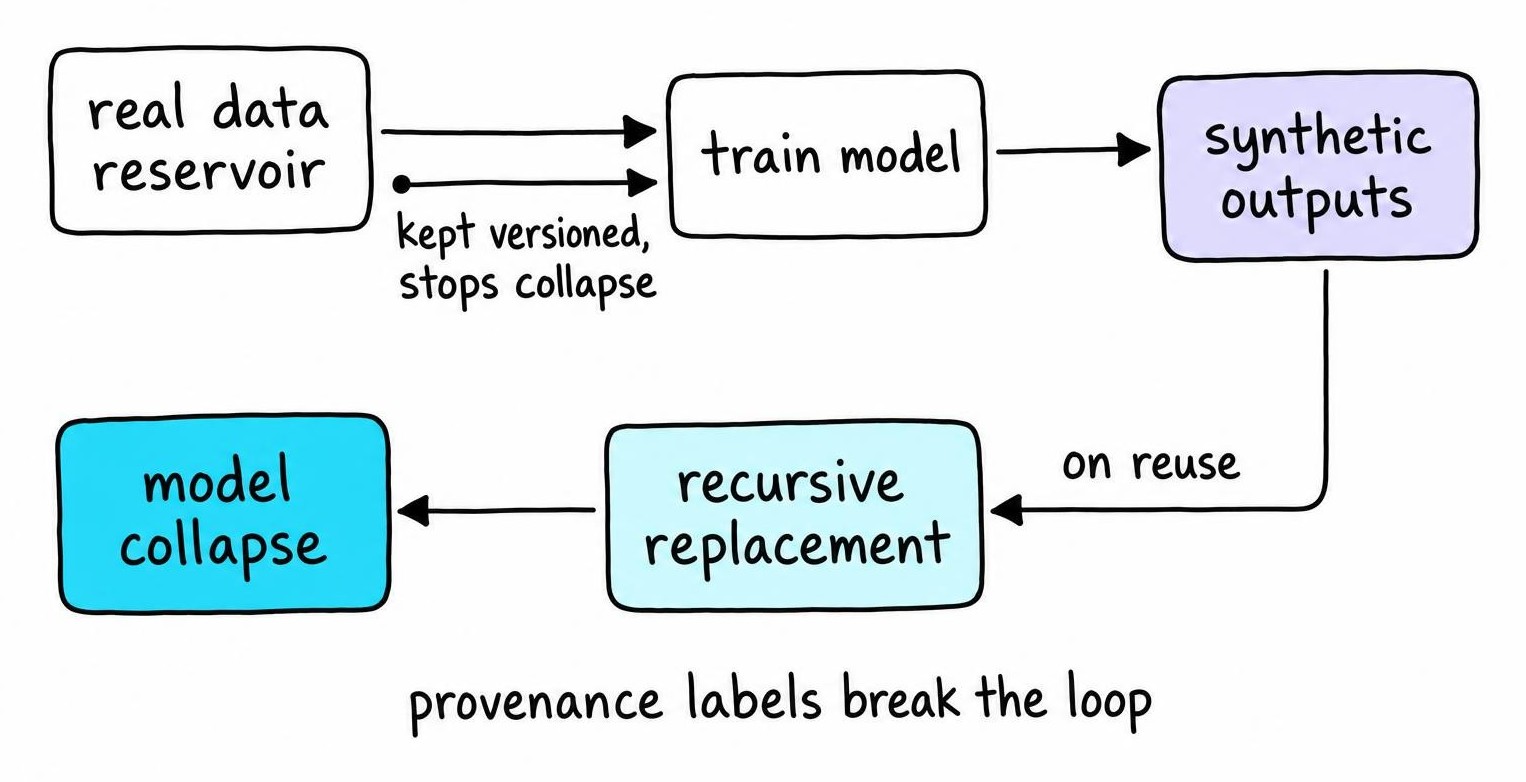
Bias amplification follows a similar loop. Skewed seeds shape generator outputs, filters remove unfamiliar but valid cases, and judge models reward responses that resemble their own assumptions.
Polished nonsense creates a particularly expensive failure mode. Fluent answers often pass schema checks and superficial judging while teaching unsupported facts or invalid reasoning.
Controls for Recursive Training and Generator Bias
Model-collapse prevention starts with a versioned reservoir of high-quality real data that generated batches cannot silently replace. Every synthetic record should carry provenance labels linking it to seeds, grounding sources, generator versions, filters, and dataset generations.
I combine several controls:
- Use multiple generator families rather than one teacher.
- Apply confidence weighting and rejection sampling.
- Route disputed, rare, and high-impact slices to human review.
- Compare each dataset generation with untouched real observations.
- Track entropy, vocabulary, topics, calibration, subgroup behavior, and rare-class recall.
- Retire batches whose source lineage or relevance can no longer be verified.
Model architecture and inference efficiency don’t fix poor data, although they affect whether generation is economically practical. When comparing transformer alternatives, I keep those operational questions separate from the data-quality decision; this transformers and state space models comparison explains the architectural trade-offs.
Refresh grounding sources as facts and deployment behavior change. Never let yesterday’s synthetic answers become tomorrow’s unquestioned source of truth.
A Production Pipeline for Trustworthy Synthetic Training Data
I run a synthetic data pipeline as a versioned release process:
- Define the capability gap and affected deployment slices.
- Establish real-only baselines on isolated evaluation data.
- Generate candidates from approved seeds and sources.
- Validate schemas, labels, factual support, and diversity.
- Deduplicate against sources, previous batches, and evaluation sets.
- Test privacy, safety, bias, licensing, and contamination risks.
- Train controlled mixtures under comparable budgets.
- Evaluate downstream behavior and approve or reject the release.
A release can reach the final gate before a provenance diff reveals that an evaluation file entered a temporary retrieval index on a staging box. The recovery is to quarantine the dataset, delete the contaminated generation run, rotate the index, and regenerate from the last clean version rather than trying to subtract suspicious rows after the fact.
Regenerating costs time, but it preserves the only result that matters: an evaluation you can still trust. I treat retrieval-index manifests as release artifacts, not infrastructure trivia.
Before a dataset enters foundation-model training, require measurable gates for utility, subgroup behavior, safety violations, privacy exposure, benchmark overlap, and generation cost. Missing evidence means failure, not provisional approval.
Version generator models, prompts, source identifiers, filters, reviewer decisions, evaluation results, and mixture recipes. Complete lineage lets you identify the failing component and roll back affected models.
Monitoring continues after training. Convert production failures into tagged tests and narrowly targeted generation requests instead of using every incident to justify more synthetic volume.
Finally, assign owners for dataset approval, incident response, retention, licensing review, and periodic revalidation. Every released batch needs an accountable decision-maker, a review date, and a documented removal path.
FAQ
What is an example of a foundation model?
Llama is an example of a foundation-model family: its pretrained language representations can support chat, summarization, extraction, classification, and other downstream tasks. Foundation models can also span images, audio, video, or multiple modalities.
Why are LLMs called foundation models?
LLMs are called foundation models when broad pretraining creates a reusable base for many downstream applications. Teams adapt that base through prompting, retrieval, fine-tuning, tool use, or task-specific components rather than training a separate language model from scratch for every task.
What are the most popular foundation models?
There is no stable, vendor-neutral popularity ranking; download counts, API usage, developer surveys, and enterprise adoption measure different things and change quickly. Widely available families include GPT, Claude, Gemini, Llama, Mistral, and Qwen, but I compare them by licensing, deployment constraints, modality support, context handling, cost, and workload-specific evaluations rather than treating availability as a quality ranking.
References
- Tech companies are turning to 'synthetic data' to train AI models
- Privacy Measurement in Tabular Synthetic Data: State of the Art and Future Research Directions - Alexander Boudewijn, Andrea Filippo Ferraris, Daniele Panfilo et al. (2023)
- Examining synthetic data: The promise, risks and realities