How to Evaluate Multi-Agent Systems: 7 Production Tests
Swarnava Dutta9 min read
Multi-Agent EvaluationAgent EvaluationLLM-as-a-Judge
Contents

A three-agent pipeline can nail every demo and still come apart on real traffic. Routing agent picks the right specialist, specialist calls the tool, summarizer packages the result, and the happy path hides everything that matters. Point that same pipeline at a batch of real tickets and one agent silently swallows errors while another loops five times before timing out, yet the final answer still reads as plausible. That gap is what makes how to evaluate multi-agent systems a different problem from testing a single model: you can't just test the final answer - you have to instrument every handoff, every tool call, every routing decision individually.
Quick answer
Evaluating multi-agent systems requires testing each agent in isolation, then testing agent-to-agent handoffs, and finally testing the end-to-end workflow as a single unit. Core metrics include task success rate, tool-calling accuracy, handoff fidelity, coordination overhead, cost per run, and end-to-end latency. Failures hide at interaction boundaries, so evaluation must trace which specific agent or routing decision caused each breakdown rather than only checking final output correctness.
How to Evaluate Multi-Agent Systems by Architecture
A multi-agent system is a workflow where specialized agents communicate, delegate, call tools, or review each other's work to complete a shared objective. The architecture dictates where failures hide, so your evaluation strategy must match the orchestration pattern you actually ship.
Sequential pipelines need different tests than supervisor-worker hierarchies. Peer-to-peer collaboration surfaces different bugs than debate loops or dynamic routing. Each pattern promises real benefits - specialization, parallelism, fault isolation - but every added agent creates a new interface and a new failure mode. If you've already built your agent orchestration, you know the wiring is half the work. Evaluating that wiring is the other half.
How Agents, Orchestrators, and Shared State Work Together
Trace a single request through its lifecycle: the orchestrator receives input, makes a routing decision, dispatches to an agent, that agent fires tool calls, writes to shared state, hands off to the next agent, and eventually something assembles the final response. Each step produces observable artifacts you need for evaluation - routing decisions, prompts each agent actually saw, tool arguments and results, state mutations with timestamps, retry counts, and token consumption.
Without these traces, you're grading a black box. Instrument early. Skipping trace IDs on handoff messages during initial development burns entire debugging sessions later, because nothing in the logs reconstructs which agent saw what.
Choose an Evaluation Unit That Matches the Architecture
Four evaluation units matter. Agent-level checks whether a single agent produces correct output given known input. Interaction-level tests whether the handoff between two agents preserves intent and context. Trajectory-level grades the full sequence of decisions against a reasonable plan. End-to-end asks whether the final output satisfies the user's goal.
Final-answer grading alone can't tell you whether a wrong result came from bad planning, a routing mistake, a malformed tool call, or a synthesis error [1]. You need all four units to pinpoint the broken link.
Build the Evaluation Set and Success Criteria First
Define what "pass" means before you run a single test. For each task category, lock down output quality thresholds, required intermediate actions (e.g., "must call the billing API"), prohibited behavior, maximum retries, latency budgets, and cost ceilings.
Your task taxonomy needs breadth: routine requests, ambiguous inputs, long-horizon multi-step work, tool-dependent tasks, parallelizable subtasks, and cases that should not invoke multiple agents. That last category catches over-routing, which burns tokens on single-agent problems that get dispatched to three specialists for no reason.
Build the evaluation set from three sources:
- Expert-labeled production traces - anonymized real traffic with ground-truth annotations
- Synthetic edge cases - malformed inputs, missing fields, conflicting instructions
- Adversarial scenarios - prompt injections, impossible requests, deliberate ambiguity
Hold out a portion of examples so your model-based judges don't overfit. Instrument every run with a trace ID, agent-level spans, versioned prompts, and state transitions. Use human review to calibrate any LLM-as-judge scoring, especially for subjective quality and high-risk decisions where guardrails should fire.
Multi-Agent Evaluation Metrics That Expose Weak Links
Six metric families expose where multi-agent systems break.
Task success. Use exact-match checks where ground truth exists and rubric-based scoring where quality is subjective. Report both average quality and hard-failure rate - imagine a strong average that still hides a long tail of zero-score outputs nobody notices until a customer does.
Routing accuracy. Track agent-selection correctness and unnecessary delegation rate. Over-escalation wastes senior agents; under-escalation produces wrong answers.
Handoff fidelity. Score each handoff on destination correctness, context preservation, and instruction completeness [2]. The most revealing metric: how often the receiving agent must re-derive information the sender already had.
Tool calling accuracy. Measure tool-selection correctness, argument validity, execution success rate, and whether the agent grounds its response in actual return values. Fabricated-result rate - the agent pretending a tool returned data it never did - is the silent killer, and it typically surfaces only through trace-level diffs.
Coordination efficiency. Duplicate-work rate, message count, loop frequency, and convergence rate. High message counts with low information gain signal agents talking past each other.
Cost and latency distributions. Averages lie. Report tokens and dollars per successful task, p50 and p95 latency, and budget-exceedance rate.
Why Multi-Agent Systems Fail: Run These 7 Tests
Multi-agent coordination failures cluster around seven predictable categories.
Test 1 - Single-agent baseline. Route every task through one capable agent first. If orchestration doesn't measurably beat it, you're paying complexity tax for nothing. Impressions are poor evidence here: in a randomised trial of experienced developers, self-assessed AI speedups ran well ahead of the measured result.
Test 2 - Routing confusion. Feed ambiguous requests that could plausibly go to multiple specialists. Track incorrect delegation rates.
Test 3 - Lossy handoff. Strip or contradict context between agents. The receiver should detect missing information, not silently hallucinate a replacement.
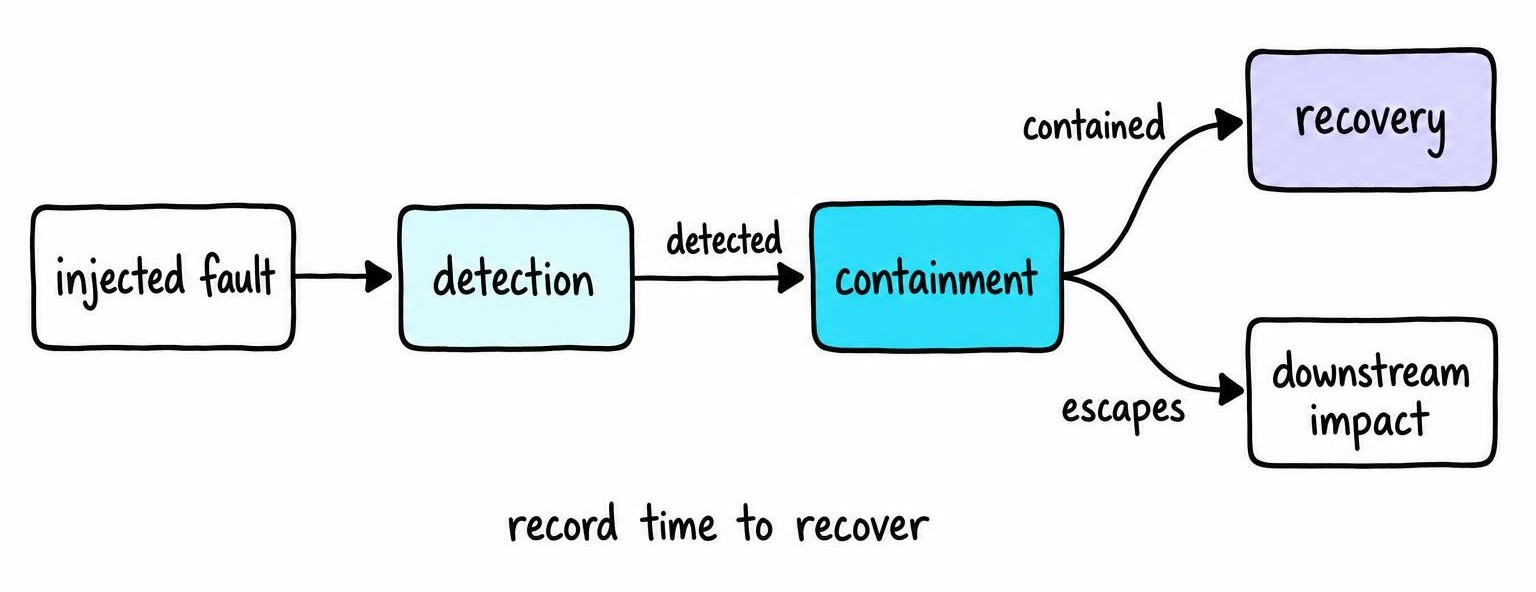
Test 4 - Tool failure. Inject timeouts, permission errors, and malformed responses. Verify retries, fallback behavior, and honest failure reporting [3].
Test 5 - Coordination conflict. Force two agents to produce incompatible conclusions. Evaluate whether arbitration uses evidence or just picks the last response.
Test 6 - Loop and duplication. Trigger circular delegation and redundant tool calls. Confirm bounded retries and termination rules fire before token budgets explode.
Test 7 - Load and budget pressure. Constrain time, tokens, and spend simultaneously. Watch for graceful degradation versus silent quality collapse.
For every injected fault, record detection rate, containment rate, recovery rate, downstream impact, and cost-to-recover.
Use Hierarchical Evaluation From Agents to the Full Workflow
Layer your evaluation bottom-up.
Tier 1 - Single-agent checks. Run deterministic tests for each agent: system instruction compliance, valid structured outputs, safety boundaries, tool permissions. These are fast, cheap, and catch regressions before anything else runs.
Tier 2 - Pairwise interactions. Test each agent-to-agent boundary as its own unit. Router-to-specialist delegation accuracy. Reviewer feedback quality. Executor-to-synthesizer evidence transfer fidelity. Every pair gets its own small eval set because failures at boundaries compound downstream.
Tier 3 - Trajectory and end-to-end. Grade full runs on step ordering, state consistency, policy compliance, and whether the final answer traces back to intermediate evidence. A correct final answer built on hallucinated intermediate steps is a time bomb.
Keep diagnosis separate from release decisions. Component scores tell you where something broke. End-to-end metrics tell you whether a version ships. And always compare against a single-agent or simpler alternative - if the multi-agent version doesn't beat it on at least one axis that matters, the added complexity isn't earning its keep.
Turn Multi-Agent System Benchmarks Into Regression Tests
Public multi-agent system benchmarks give directional signal but can't predict production behavior. Your actual tools, policies, and failure costs don't exist in any public dataset. Build an internal benchmark that mirrors real traffic.
Version everything: datasets, prompts, models, tools, orchestration code, evaluator rubrics. When a score drops, you need to diff exactly one variable.
Structure your multi-agent testing framework into tiers:
- Smoke tests - ten critical paths, every commit
- PR checks - component-level evals against the changed agent
- Nightly runs - full trajectory and end-to-end suite
- Adversarial sweeps - weekly fault-injection from your seven failure tests
- Pre-release load tests - concurrent traffic with budget constraints
Every production incident becomes a permanent regression case. Store the complete trace, label the failure, add it to the appropriate tier. Set confidence intervals and minimum sample sizes per suite - and flag rare catastrophic failures individually, because a single runaway loop won't move your average but will move your invoice.
Set Production Gates for Quality, Cost, Latency, and Safety
Don't collapse everything into one blended score. A scorecard with independent thresholds per task class keeps a quality improvement from masking a safety regression.
For each task class, set explicit gates: minimum success rate and handoff fidelity, maximum critical-failure rate, p95 latency ceiling, and cost per successful task. Roll out in stages - offline replay first, then shadow traffic, then canary at low percentage with matched-request comparison, then full exposure.
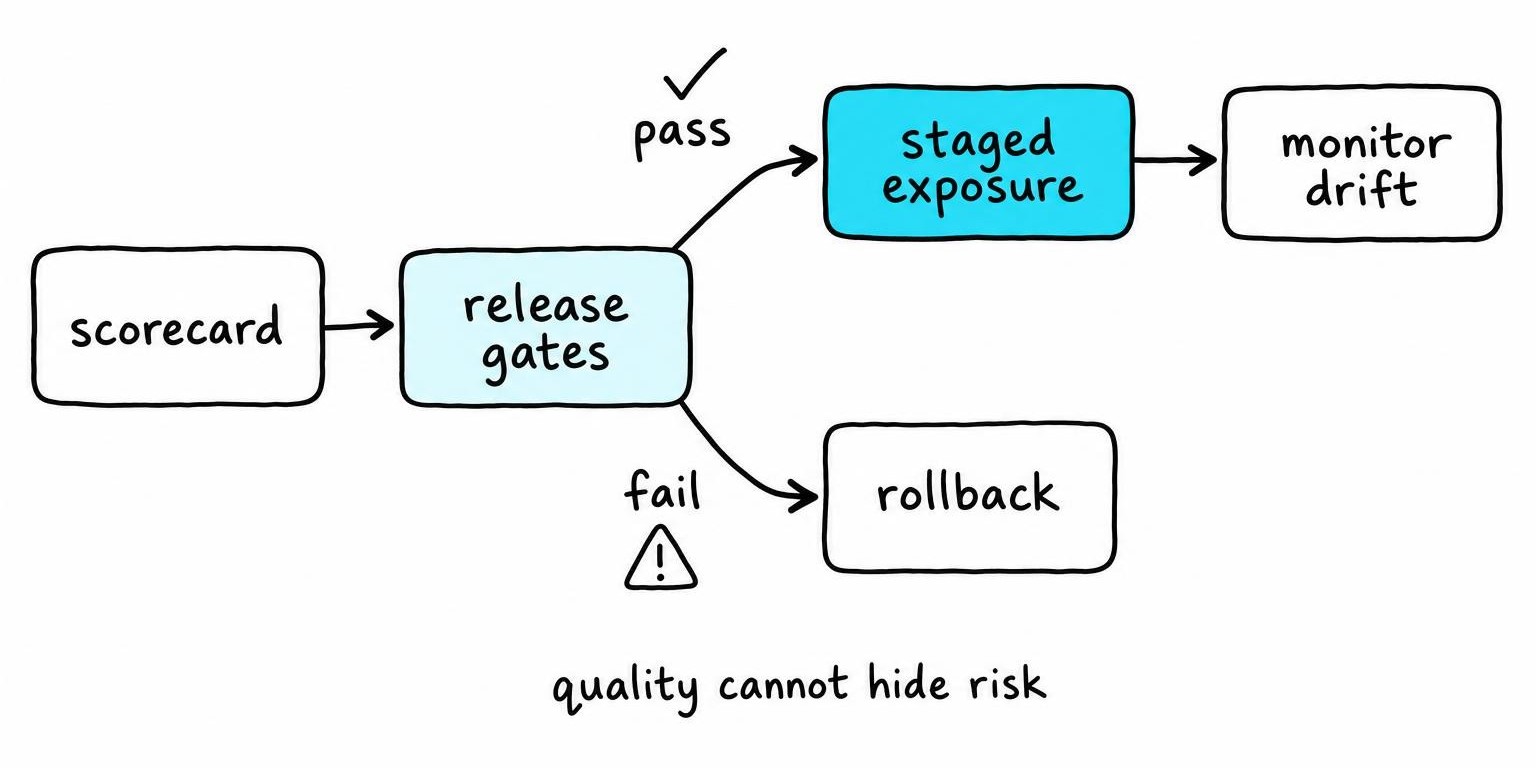
After deployment, monitor drift weekly. Routing distribution shifts, rising tool error rates, loop frequency creeping up, token consumption trends - all signal degradation before end-to-end scores move. Routing drift is slow enough to inflate token spend for weeks while task success still reads as healthy. I track routing distribution as a first-class metric for that reason, rather than as something you pull up after the bill arrives.
Assign clear ownership: who rolls back when a gate fails, who arbitrates evaluator disagreements, who owns incident review when a model provider ships a silent update. Unowned gates are decorative.
FAQ
How to evaluate multi agent systems
Test each agent in isolation first, then test every agent-to-agent handoff as a separate unit, and finally score end-to-end task completion. Track routing accuracy, tool-calling correctness, handoff fidelity, coordination overhead, cost, and latency independently. Compare results against a single-agent baseline to confirm the multi-agent design earns its complexity.
How multi agent system works
Multiple specialized agents receive subtasks from an orchestrator, execute them using tools or LLM reasoning, write results to shared state, and hand off to the next agent. The orchestrator routes requests, manages sequencing, and assembles final output. Communication happens through structured messages or shared memory rather than free-form conversation.
What are multi agent systems
Architectures where two or more autonomous agents - each with distinct instructions, tools, and responsibilities - collaborate to complete tasks no single agent handles well alone. Common patterns include sequential pipelines, supervisor-worker hierarchies, and peer review loops. The value comes from specialization and modularity; the cost comes from coordination complexity at every boundary.
How to build multi agent systems
Start with a single capable agent, then split responsibilities only when measurable quality, cost, or coverage gains justify added complexity. Define each agent's role, tools, and output schema. Wire an orchestrator to handle routing and state. Instrument every boundary for observability, and build your evaluation set before scaling beyond two agents. Anthropic recommends the same incremental approach: begin with a single LLM call with tools, add prompt chaining or routing only when needed, and validate each addition against the simpler baseline [4].
References
- A Survey of Multi-Agent Deep Reinforcement Learning with Communication - Changxi Zhu, Mehdi Dastani, Shihan Wang (2022)
- A Survey of Multi-Agent Deep Reinforcement Learning with Communication - Changxi Zhu, Mehdi Dastani, Shihan Wang (2022)
- Orthogonal Fault Tolerance for Dynamically Adaptive Systems - Sobia K Khan (2014)
- A Survey of Multi-Agent Deep Reinforcement Learning with Communication - Changxi Zhu, Mehdi Dastani, Shihan Wang (2022)