AutoGen vs OpenAI Agents SDK: Production Guide 2026
Swarnava Dutta11 min read
Autogen vs Agents SdkOpenai Agents Sdk vs AutogenAutogen vs Agent Framework
Contents

An AutoGen group chat with no stop condition will loop between the critic and the coder, dozens of messages deep, long after anyone stopped watching the token bill. That failure mode is why agent frameworks are an operations decision rather than a demo-day decision. The AutoGen vs Agents SDK debate gets framed online as a feature checklist, but the real question is much narrower: how does each framework behave when a tool call hangs, a model returns malformed JSON, or three agents disagree about who owns the next step?
This guide skips the "build a two-agent chatbot" tutorial you've already read five times. Instead it covers orchestration models, tool execution boundaries, state and memory, tracing, deployment, and what an actual AutoGen-to-Agents-SDK migration requires - so you can pick the right framework once, not twice.
Quick answer
The OpenAI Agents SDK is the safer default for production teams in 2026, offering explicit handoffs, typed function tools, built-in sessions, native tracing, and native MCP server support. AutoGen, built on a Core event-driven runtime and an AgentChat layer, wins for research and heterogeneous agent swarms across providers. Migrating from AutoGen to the Agents SDK is a redesign of orchestration and state boundaries, not a package swap.
AutoGen vs Agents SDK: the production decision snapshot
Before the deep dive, here's the shape of the decision:
| Dimension | AutoGen | OpenAI Agents SDK |
|---|---|---|
| Orchestration style | Message-driven group chat | Explicit runner + handoffs |
| Multi-agent primitives | Teams, selectors, custom speaker logic | Agents-as-tools, handoffs |
| Tool execution | Flexible, function-based | Structured, typed, approval hooks |
| Model flexibility | Broad, model-agnostic | OpenAI-first, expanding |
| State/memory | DIY-heavy, teachable agents | Sessions, built-in patterns |
| Tracing | Community/OTel add-ons | Native tracing dashboard |
| Deployment burden | Higher, more moving parts | Lighter, opinionated |
| Best fit | Research, heterogeneous agent swarms | Production apps, tighter control |
If you need experimental freedom and don't mind wiring your own guardrails, AutoGen still wins. If you want a smaller, opinionated toolkit built for shipping and native OpenAI model integration, the Agents SDK is the safer default in 2026.
Both projects move fast enough that minor-version upgrades change available primitives, so validate current package behavior against your own staging environment before locking in an architecture.
What AutoGen and the OpenAI Agents SDK are built to do
AutoGen is a general-purpose multi-agent programming framework: a set of building blocks for wiring arbitrary agents, tools, and conversation patterns together. The OpenAI Agents SDK is narrower by design - a lightweight toolkit for agents, runners, tools, handoffs, guardrails, sessions, and tracing. Neither is "better" in the abstract; they optimize for different failure modes, which is the lens I use for the rest of this comparison.
AutoGen architecture: Core, AgentChat, and version differences
AutoGen ships as layers: Core provides the event-driven runtime, AgentChat sits on top with conversational agents, teams, messages, and termination conditions. If you learned AutoGen from an 0.2-era tutorial, expect friction - the API surface for agents, group chats, and runtimes changed enough between major versions that old code often just breaks on upgrade. Custom runtimes let you control message routing yourself, which is powerful and also where most production pain starts.
OpenAI Agents SDK architecture: agents, runners, and handoffs
The SDK centers on a handful of primitives: an Agent, a Runner that executes it, tools, guardrails, sessions for conversation state, and handoffs. Using an agent as a tool means it returns a result to the caller; a handoff transfers control outright, changing who owns the conversation next.
Multi-agent framework comparison: teams, handoffs, and control flow
The core split is deterministic orchestration versus model-directed delegation. AutoGen leans toward the latter - agents converse, a selector picks the next speaker, and control emerges from message content rather than a fixed graph. The Agents SDK leans deterministic: you write handoffs and tool calls explicitly, so routing is code you can read, not a conversation you have to interpret.
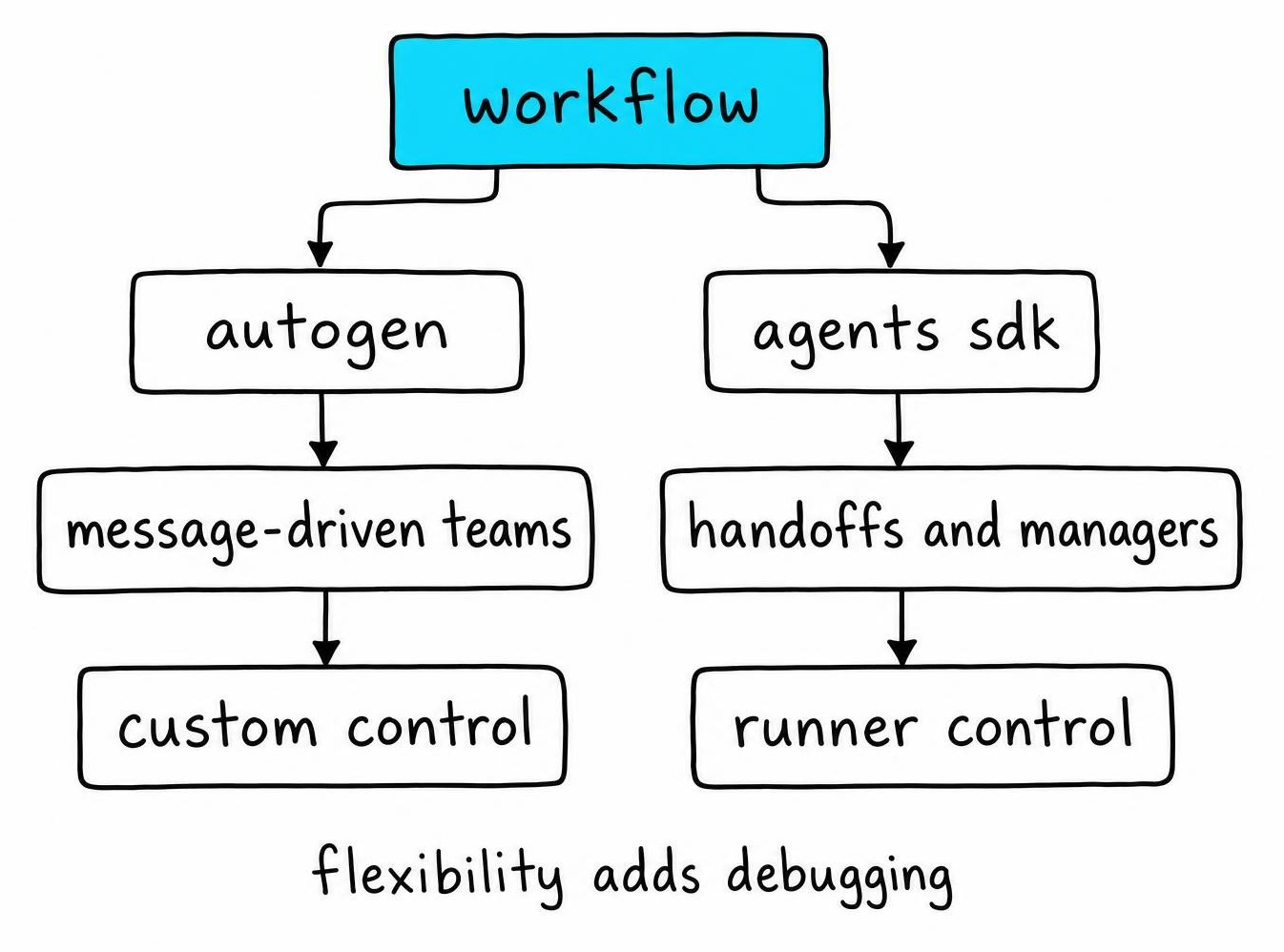
AutoGen teams and message-driven orchestration
A typical AutoGen team looks like a coordinator, a researcher, an executor, and a reviewer sharing a group chat, with a selector function or model deciding who speaks next based on message history. Termination conditions - max turns, a stop phrase, an external signal - are what save you from the runaway critic-coder loop described at the top. This topology handles messy, exploratory work well, but debugging "why did the reviewer never get called" means reading transcripts, not stack traces.
Agents SDK handoffs, managers, and agents as tools
The Agents SDK gives you two clean patterns: keep a specialist as a callable tool the manager invokes and gets a result back from, or hand off full ownership so the specialist becomes the active agent. Typed handoff inputs carry structured context instead of a raw chat log, which cuts down on silent context loss. Set recursion limits deliberately - uncontrolled handoff loops are the Agents SDK's version of AutoGen's runaway group chat.
AutoGen vs agent framework features: models, tools, MCP, and streaming
| Feature | AutoGen | Agents SDK |
|---|---|---|
| Model clients | Pluggable model-client abstraction, broad provider support | OpenAI-first, growing third-party routes |
| Messages | Rich message types, custom message classes | Typed input/output items |
| Structured outputs | Via model client + schema | Native structured outputs on agent boundary |
| Function tools | Decorator-based, flexible signatures | Typed tool schema, auto-generated |
| Agent-as-tool | Manual wiring | First-class pattern |
| MCP servers | Supported via extensions | Native MCP server support |
| Streaming | Event stream via runtime | Built-in streaming events |
| Custom agents | Fully open subclassing | Constrained but consistent |
Don't assume identical behavior across models just because both frameworks claim tool-calling support - schema strictness and function-calling reliability still vary by provider underneath.
Tool execution and approval boundaries
Both frameworks generate schemas from function signatures, but AutoGen leaves dependency injection and async handling more to you. Gate anything destructive - refunds, deletes, external writes - behind explicit approval steps, and make those tools idempotent so retries don't double-charge anyone.
Streaming, messages, and structured outputs
Don't copy transcripts between frameworks assuming message shapes match; map event types first. Validate structured outputs at each agent boundary, not just at the final response.
State, memory, guardrails, and observability compared
Five things get conflated under "state" and it bites people: run context (this call's inputs), conversation history (the message log), durable session state (survives across turns), long-term memory (facts that persist across sessions), and your own business data sitting in a database somewhere. AutoGen's teachable agents patterns handle long-term memory reasonably well but expect you to wire persistence yourself. Agents SDK sessions give you save-and-resume out of the box, but they're conversation state, not a memory layer - don't confuse the two when you're debugging why an agent "forgot" a customer preference.
Context-window management is still your job either way; neither framework automatically summarizes a runaway history for you.
On observability, native tracing in the Agents SDK gives you spans, tool-call visibility, and handoff tracking without extra plumbing. AutoGen relies more on community OpenTelemetry integrations, which work but need setup. Guardrails in both frameworks filter input/output and validate tool arguments - they are not authorization or sandboxing, so keep real access control outside the agent loop.
Production operations: deployment, testing, security, and cost
Neither framework runs your workers, queues, or autoscaling for you. Both give you an agent runtime; you still own process supervision, retry policy, and horizontal scaling behind a load balancer.
For testing, don't just eyeball transcripts. Build a regression suite that replays traces and asserts on routing decisions, tool selection, and termination behavior, not just final text output - that's the only way to catch a handoff silently misfiring after a dependency bump.
Security is identical in principle across both: least-privilege tool scopes, secrets pulled from a vault rather than baked into prompts, tenant isolation between agent sessions, and audit logs on every tool call. Treat every tool input as untrusted - prompt injection through retrieved documents or tool outputs is still the most common way these systems get walked off their rails.
Cost control means turn limits, timeout policies, response caching, and routing cheaper models to low-stakes steps. Runaway-loop protection isn't optional - it's the difference between a bug and a bill.
Version churn is real operational risk: AutoGen's faster API evolution means more frequent breakage; the Agents SDK's narrower scope trades flexibility for stability.
How to migrate AutoGen to OpenAI Agents SDK safely
The moment you treat "migrate AutoGen to OpenAI Agents SDK" as a find-and-replace on imports, you're already in trouble. It's a redesign of your orchestration and state boundaries, not a package swap. Microsoft's own migration guidance treats it that way too, mapping concepts rather than syntax [1].
Before writing a line of new code, inventory what you actually have: agents, prompts, model clients, tools, team topology, termination rules, any stored state, and whatever observability you've bolted on. Migrate one workflow slice at a time - pick your lowest-risk agent pair first - behind contract tests that compare quality, latency, cost, and failure behavior against the AutoGen baseline. If the new slice can't beat or match the old one on all four, don't cut over yet.
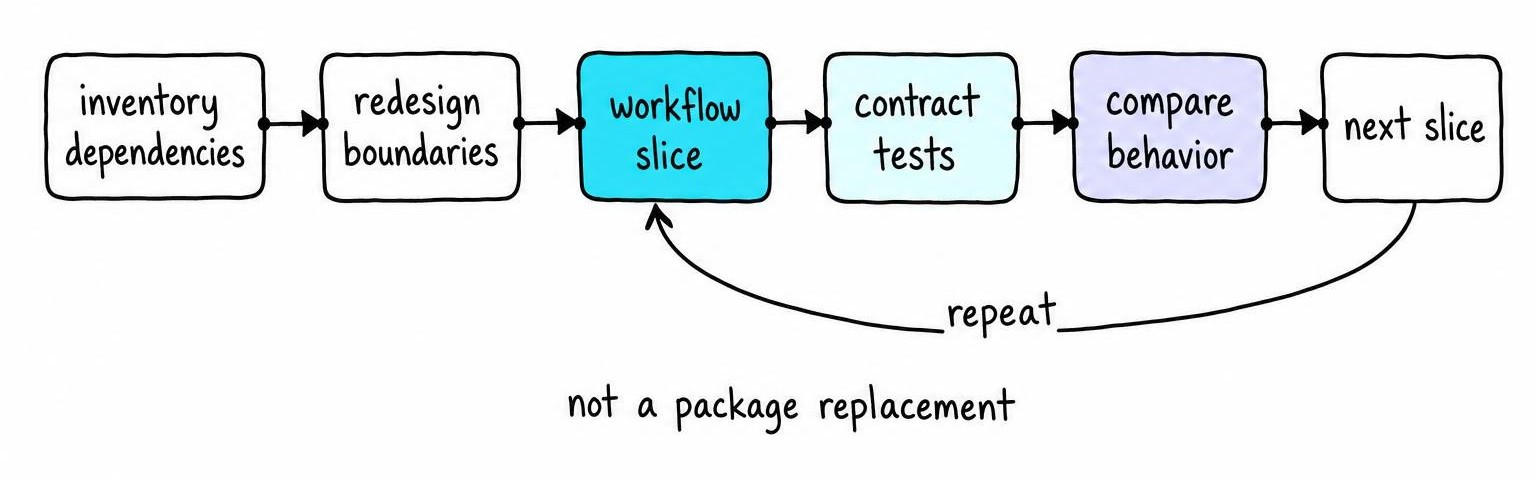
Watch for blockers early: custom runtimes, provider-specific models the SDK doesn't route to natively, group chats with emergent selector logic nobody fully documented, and serialized state that doesn't deserialize cleanly into sessions.
AutoGen-to-Agents-SDK feature mapping
Rough equivalences that hold in practice:
- AutoGen agents → Agents SDK
Agentinstances - Team selector logic → manager pattern or explicit handoffs
- Registered functions → typed function tools
- Termination conditions → runner limits or application-level checks
- Message history → typed input/output items, remapped
- External state stores → sessions, adapted
Streaming events, tracing hooks, and multi-model clients all need adaptation layers, not copy-paste. Some patterns - fully emergent group chats, dynamic runtime subclassing - have no clean equivalent, and you'll keep custom orchestration code around for those, same as you would if you were doing a state space models vs transformers tradeoff: pick the tool for the job, not the migration path of least resistance.
Which framework should your team choose in 2026?
Pick AutoGen if you need customizable multi-agent topologies, event-driven runtimes, or model experimentation across providers - research teams and anyone building genuinely novel agent swarms still get more raw flexibility here. Pick the OpenAI Agents SDK if you want a smaller API surface, native handoffs, built-in tracing, and tight alignment with OpenAI's platform - most production teams shipping a defined workflow fit this profile better.
Run the decision through a weighted checklist rather than gut feel:
- Provider strategy: locked into OpenAI, or need multi-model flexibility?
- Orchestration complexity: fixed workflow, or emergent multi-agent negotiation?
- State ownership: fine building your own persistence, or want sessions out of the box?
- Observability: need native tracing now, or can you wire OpenTelemetry later?
- Deployment constraints: how much operational surface can your team actually own?
- Team expertise: who already knows which framework's mental model?
- Migration cost: what does switching later actually cost you?
Before standardizing, run a time-boxed proof of concept - same workflow, same production acceptance criteria - on both. Whichever survives the loop-detection test wins.
FAQ
What is AutoGen?
AutoGen is Microsoft's open-source multi-agent programming framework, built around a Core event-driven runtime and an AgentChat layer for conversational agents, teams, and group chats. It's designed for building systems where multiple agents collaborate, critique, and delegate work through message passing rather than a fixed control-flow graph. Teams use it heavily for research and exploratory agent swarms where topology needs to stay flexible.
How do AutoGen and the OpenAI Agents SDK differ?
AutoGen favors message-driven, emergent orchestration where a selector or model decides who speaks next; the Agents SDK favors explicit, code-defined handoffs and runners. AutoGen is model-agnostic with a pluggable client abstraction, while the Agents SDK is OpenAI-first with native tracing and structured outputs. The practical difference shows up in production: AutoGen gives more freedom, the Agents SDK gives more predictability.
Which framework is better for multi-agent workflows?
Neither is universally better - AutoGen suits heterogeneous, exploratory agent swarms where control flow can't be fully specified upfront. The Agents SDK suits defined workflows where you want handoffs, tool calls, and termination behavior written as reviewable code. Pick based on whether your orchestration is genuinely emergent or just complex.
Can an AutoGen application be migrated to the OpenAI Agents SDK?
Yes, but treat it as a redesign of orchestration and state, not a mechanical port. Map agents, team logic, tools, and state stores to their Agents SDK equivalents one workflow slice at a time, validating each against contract tests before cutover.
How do the frameworks compare for tools, handoffs, memory, tracing, and model support?
AutoGen offers flexible, decorator-based tools and DIY memory but weaker native tracing; the Agents SDK offers typed tools, first-class handoffs, built-in sessions, and native tracing, at the cost of narrower model support. Choose based on which gaps you're willing to build yourself.
References
- Cloud Migration Process A Survey Evaluation Framework and Open Challenges - Mahdi Fahmideh, Graham Low, Ghassan Beydoun et al. (2020)