How LLM Guardrails Work: Architecture & Testing Guide
Swarnava Dutta11 min read
LLM Guardrails Limitations
Contents

A support bot will cheerfully quote a customer's own API key back to them if a system log carrying that key ended up in the RAG index. Nothing told the model not to, and the quiet assumption that it wouldn't is the entire failure. Closing that gap is what LLM guardrails actually do, and it looks nothing like the single "safety toggle" most teams picture when they start building.
Guardrails aren't one filter bolted onto a chatbot. They're a layered production system: input checks that catch prompt injection and PII before a token ever reaches the model, policy enforcement that decides what the model is even allowed to attempt, tool-use constraints for agents that can take real actions, and output validation that catches leakage, toxicity, or bias before a response leaves the building.
This guide walks through that architecture end to end - how each layer gets implemented, how you actually test guardrails instead of just hoping they hold, and where they still fail. If you're shipping LLM applications past a demo, this is the map worth having before a leak forces you to draw it yourself.
Quick answer
LLM guardrails work as staged checks in application code outside the model weights. Input validation rejects prompt injection and PII before inference. Policy enforcement combines four mechanisms: deterministic rules, statistical classifiers, embedding similarity checks, and LLM-as-a-judge verdicts. Tool authorization sits outside the model's own judgment, and output validation catches leaked secrets, toxicity, and bias. Testing spans unit tests per guard, integration tests, and red-team exercises.
How LLM Guardrails Work as a Layered Architecture
So what is LLM guardrails, technically? It's not a capability baked into the model - it's the set of controls wrapped around it, sitting outside the weights entirely. That distinction matters because it means guardrails live in your application code, not in a prompt tweak.
Trace a single request and you'll see the whole lifecycle: user input arrives, gets validated, context gets retrieved, a policy layer decides what's even permissible, the model infers a response, any tool calls get checked against permissions, output gets validated, and everything gets logged for review. Each stage is a chokepoint where something can be blocked, rewritten, or flagged.
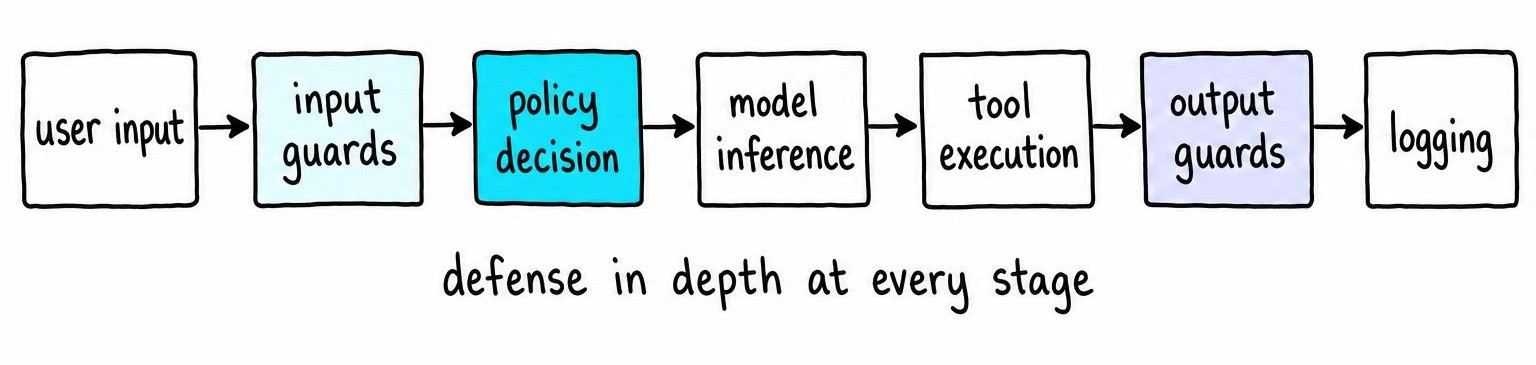
Defense in depth means no single layer carries the whole job. Deterministic rules catch obvious cases fast and cheap, classifiers catch fuzzier patterns, LLM-based judges catch nuance, permission systems cap blast radius, and human review catches what automation misses [1].
Guardrails vs. Evaluations, Metrics, and Model Alignment
Runtime guards block or transform a live request; evaluations measure behavior offline, after the fact. Alignment training reduces a model's baseline tendency toward harm, but it doesn't know your data schema or your compliance obligations - that's your job. Evaluation metrics feed back into the system as release gates, alerting thresholds, or evidence to tighten a policy rule.
Input Guards for Prompt Injection, Privacy, and Abuse
Everything starts with structural validation, and it's the least glamorous layer that still catches the most garbage. Check length, encoding, file type, required fields - reject malformed input before it burns a single model token.
Then comes the harder part: detecting prompt injection. Direct injection is a user typing "ignore previous instructions"; indirect injection is worse - it's an untrusted PDF, webpage, or retrieved chunk that carries hidden instructions the model reads as if they came from you. The indexed API key described at the top is exactly this - a log line masquerading as harmless context, no jailbreak attempt required.
Input guards also flag jailbreak patterns, code injection attempts, toxic language, off-topic abuse, and PII like emails or card numbers, each with its own confidence threshold. Depending on risk and score, the guard sanitizes, redacts, rejects outright, rate-limits the caller, or routes to a stricter model tier.
The rule that matters most: treat every retrieved document, tool output, or pasted URL as untrusted input, never as privileged instruction - no matter how deep in your pipeline it lives.
Policy Enforcement with Rules, Classifiers, and LLM Judges
Somewhere between "user typed something weird" and "model wrote something bad" sits the layer nobody diagrams well: policy enforcement. This is where your acceptable-use document stops being a PDF legal skimmed once and becomes actual code - explicit rules, severity levels (warn, block, escalate), named exceptions, and a defined response action for each.
Four enforcement mechanisms do the work, each with different tradeoffs:
- Deterministic rules - regex, keyword lists, schema checks. Cheap, instant, zero ambiguity, but brittle against paraphrase.
- Statistical classifiers - fast, cheap at scale, decent recall on known categories, weaker on novel phrasing.
- Embedding similarity checks - catch semantic near-matches to known bad prompts, useful but noisy near the threshold.
- LLM-as-a-judge - best nuance and reasoning, highest latency and cost, and inconsistent unless constrained.
That inconsistency is the trap. Judge models flip verdicts on identical input across runs when the temperature is not pinned and structured output is not enforced. Fix it with calibrated thresholds, a judge that returns a fixed schema (verdict, confidence, reason) instead of free text, a judge model separate from the generating model, and a defined fallback - usually "block" - when confidence sits near the line. Policies also need to stay aligned across your system prompt, guard configs, business rules, and whatever regulation applies, or one layer quietly contradicts another.
Output Guards for Data Leakage, Toxicity, and Bias
Input guards protect the model from the world; output guards protect the world from the model. Before any response leaves your system, scan it for secrets it shouldn't have surfaced - API keys, credentials, internal hostnames, anything that looks like PII pulled from context - plus toxicity, bias, and plain policy violations like unsafe instructions dressed up as helpful advice.
When correctness matters, output guards do more than tone-check. Validate facts against retrieved sources, check citations actually point somewhere real, enforce a JSON schema before a downstream service parses it, and lint generated code before it runs anywhere near production.
Once a guard flags something, you've got options beyond a flat block: redact the offending span, trigger a regeneration with a stricter prompt, attach a warning label, escalate to a human, or fall back to a canned safe response. Which one you pick depends on severity and latency budget, not just policy.
Streaming makes this harder. Token-by-token delivery means you're often committed before a full-response check finishes, so teams either buffer a few hundred tokens before release or run lightweight token-level monitors that can kill the stream mid-sentence if something crosses a threshold.
Tool-Use Guardrails for Agents and High-Impact Actions
Agents change the risk calculus completely. A chatbot that says something wrong is embarrassing; an agent that wires money or deletes a database is a incident report. The core rule: never let the model itself decide what it's authorized to do - authorize tools independently, and hand the agent only the minimum permissions its current task actually needs.
Every tool call deserves the same scrutiny you'd give raw user input. Validate the tool name against an allowlist, check arguments against the tool's JSON Schema, cap transaction limits, and confirm the requested state transition is even legal from where the workflow currently sits.
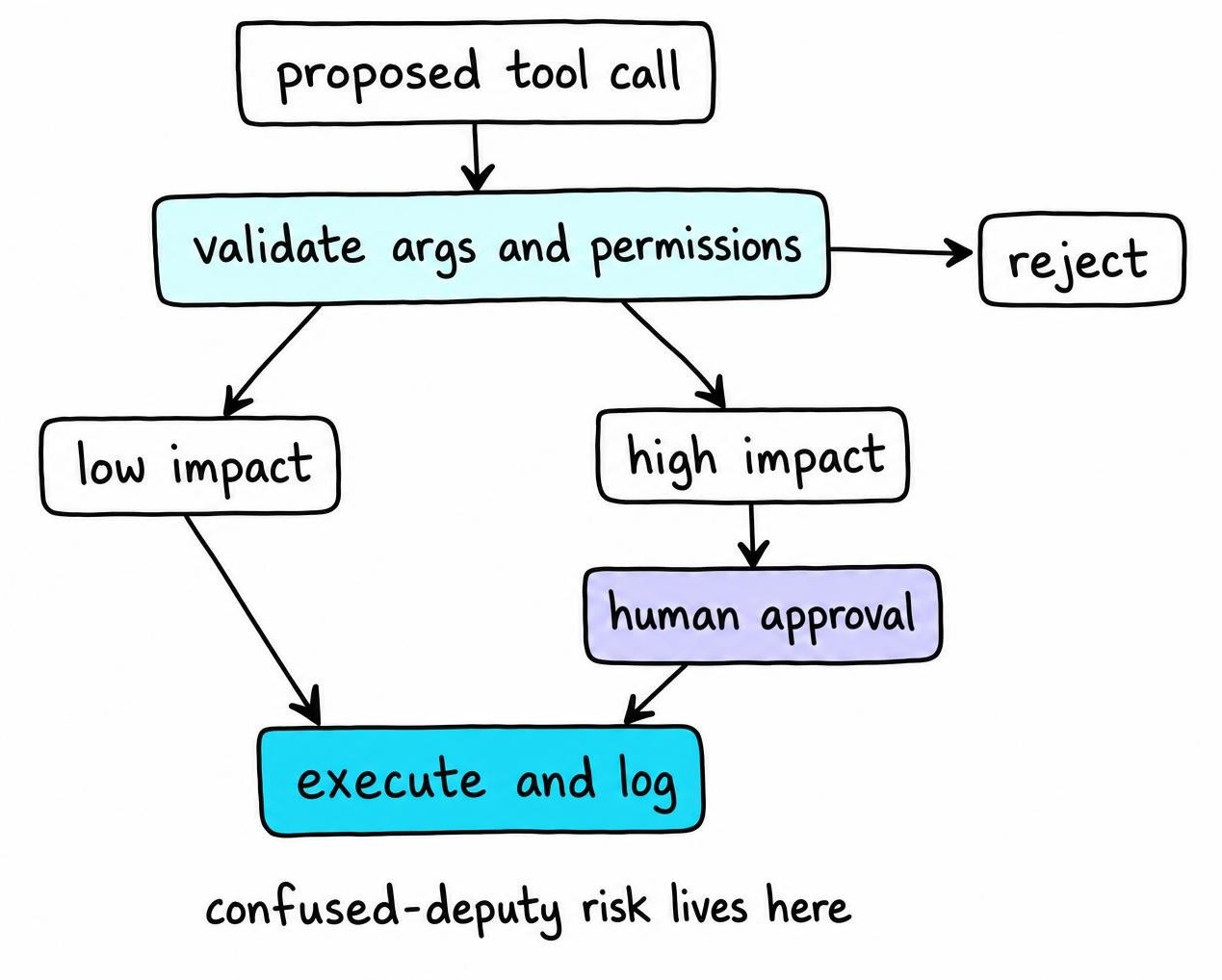
Irreversible or externally visible actions - sending an email, moving funds, deleting a record - need a human or a stricter policy gate in the loop before execution, not after. This also guards against confused-deputy attacks, where injected content in a document tricks the agent into treating attacker text as an authorized instruction; keeping untrusted content structurally separate from system instructions and auth context is what stops that.
Log every proposed action, the policy verdict, the tool result, and any approval event. When something goes wrong at 2 a.m., that log is the only thing that tells you which layer failed.
How to Implement LLM Guardrails in Production
Before you pick a single tool, build a threat model. List your users, your data sources, the models in play, everything you retrieve from, every tool an agent can call, and what actually breaks if each one fails.
From there, map risks to controls at three points: preventive (block before it happens), detective (catch it as it happens), and recovery (contain the damage after). A prompt-injection risk might get a preventive input scan, a detective classifier on output, and a recovery step that revokes a session token.
Choosing guards is a tradeoff exercise, not a shopping list. Weigh risk coverage against false-positive tolerance, latency budget, cost per call, how explainable a verdict needs to be for audit, and whether the guard can even deploy in your stack.
Decide fail-open versus fail-closed deliberately, per guard - a PII scanner timing out shouldn't silently pass, but a low-stakes toxicity check might. Set explicit timeouts, retries, and a human-escalation fallback for the ambiguous middle.
Version guard configs alongside prompts, models, and retrieval pipelines in the same repo - a policy change without a corresponding model or prompt version is how "it worked yesterday" incidents happen.
Reference Request Flow and Enforcement Points
Trace one request: auth, input validation, retrieval filtering, prompt assembly, inference, output checks, delivery. Keep policy decision points separate from enforcement points - the "should we block this" logic shouldn't live inside the code that actually blocks it, or you can't test or swap either independently.
Log trace IDs, guard verdicts, confidence scores, and transformations applied, but skip storing the sensitive payload itself wherever you can avoid it.
How to Test LLM Guardrails and Monitor Failures
Guardrails you haven't tested are just assumptions with better formatting. Build your test set from real production traffic, hand-crafted policy edge cases, multilingual prompts, known adversarial jailbreaks, and - critically - every past incident, turned into a regression case that never gets to repeat itself.
Track more than pass/fail: attack success rate, unsafe pass rate, false-positive rate, false-negative rate, added latency, cost per request, and whether the guard is tanking legitimate user task completion in the process.
Layer your testing the way you layered the guards: unit tests per guard in isolation, integration tests across the full request pipeline, and red-team exercises where a human or adversarial model actively tries to break the assembled system, not just one component.
Bypass attempts rarely repeat the obvious jailbreak - they hide in base64 encoding, homoglyph obfuscation, instructions spread across multiple turns, poisoned retrieved content, or a tool's own output smuggling a new instruction back into context. Test all of those paths explicitly, not just the front door.
Production drift is guaranteed, not hypothetical - user behavior shifts, models get swapped, new attack patterns appear. Feed every reviewed failure straight back into your policies, datasets, thresholds, and regression suite; this closed loop is the actual difference between guardrails and a checkbox, and it pairs naturally with whatever evaluation pipeline already generates your test data.
LLM Guardrails Benefits, Limitations, and Trade-Offs
Done well, guardrails buy you real things: fewer successful misuse attempts, tighter privacy handling, consistent policy enforcement across every user session instead of whatever the model felt like that day, safer agent automation, and an audit trail you can actually hand to a regulator or a worried exec.
None of that means "safe." Every detector here is probabilistic, and attackers adapt faster than your last red-team run - a classifier tuned against last month's jailbreaks won't catch next month's homoglyph trick. False positives block legitimate users; false negatives let real harm through, and you rarely get to tune both to zero at once.
The operational costs are real too: every guard adds latency and API spend, aggressive filtering degrades the user experience, judge models carry their own bias, multilingual coverage lags badly behind English, and someone has to maintain all of it as models and policies drift.
Guardrails also can't fix bad architecture. Excessive permissions, insecure system design, sloppy data governance, or no human in the loop for high-stakes actions - no output filter compensates for any of that.
The practical framework: rank risks by impact and likelihood, spend your latency and cost budget on the highest-impact ones first, and accept lighter checks where a false positive costs more than the risk it prevents.
FAQ
What are LLM Guardrails?
LLM guardrails are the layered controls wrapped around a model in production - input validation, policy enforcement, tool-use permissions, and output filtering - that decide what a request can do before, during, and after inference. They live in your application code, not in the model weights, which is why the same model can behave very differently across two systems with different guardrail setups. Think of them as the airport security around a plane, not a feature of the plane's engine.
How to implement LLM guardrails?
Start with a threat model covering users, data sources, tools, and failure modes, then map each risk to preventive, detective, and recovery controls. Layer deterministic rules, classifiers, and LLM judges rather than relying on one mechanism, and version guard configs alongside prompts and models so a policy change never ships untracked. Decide fail-open versus fail-closed per guard, and log every verdict for audit and debugging.
What are the limitations of LLM guardrails?
Every detection layer is probabilistic, so false positives and false negatives are both guaranteed outcomes, not edge cases. Attackers adapt faster than most teams re-test, multilingual coverage lags English badly, and guardrails can't fix underlying issues like excessive permissions or sloppy data governance. They reduce risk; they don't eliminate it.
What are the benefits of using LLM guardrails?
Well-implemented guardrails reduce successful misuse and data leakage, enforce consistent policy across every session, make agent automation safer to run, and produce an audit trail you can hand to a regulator. That consistency and traceability is usually the difference between a demo and something a compliance team will actually sign off on.
References
- Compliance-Scored Best-of-N Guardrail Orchestration for Multimodal Document Generation in Payments Dispute Defense - Nataraj Agaram Sundar, Tejas Morabia (2026)