CrewAI vs LangGraph: 7 Production Tradeoffs Before You Build
Swarnava Dutta9 min read
Crewai vs LanggraphLanggraph vs Crewai
Contents

Build the same three-agent research workflow in both frameworks and the interesting differences don't show up in the happy path. They show up when a partial failure leaves orphaned state in a checkpoint store. The crewai vs langgraph decision looks trivial from the docs, then a reviewer-rejection loop in CrewAI triggers a delegation cascade nobody asked for, and a LangGraph checkpoint schema stops loading because a field was added to the state object after the first run.
Quick answer
CrewAI organizes agents by role and delegates task sequencing to a Crew object, making it faster for prototyping role-based pipelines. LangGraph models workflows as explicit nodes and edges with serializable state, giving finer control over branching, human-in-the-loop interrupts, and failure recovery. CrewAI suits rapid multi-agent prototypes; LangGraph suits stateful production workflows where each transition must be observable and resumable.
CrewAI vs LangGraph: How Their Orchestration Models Differ
CrewAI thinks in roles. You define an Agent with a backstory and goal, assign it a Task, then hand both to a Crew that decides execution order. The framework handles delegation so you focus on who does what.
LangGraph thinks in graphs. Each step is a node (a Python function), edges define transitions, and a TypedDict state object travels through the graph. You control every branch and loop explicitly.
Both support tools, memory, and human oversight. CrewAI pushes orchestration behind its Crew abstraction - great for fast composition, opaque when you need to inspect a single transition. LangGraph forces you to build agent orchestration step by step: more work upfront, but you get a graph you can checkpoint, replay, and interrupt at any node. That speed-versus-control split drives every production dimension below.
One Workflow, Two Builds: CrewAI and LangGraph in Python
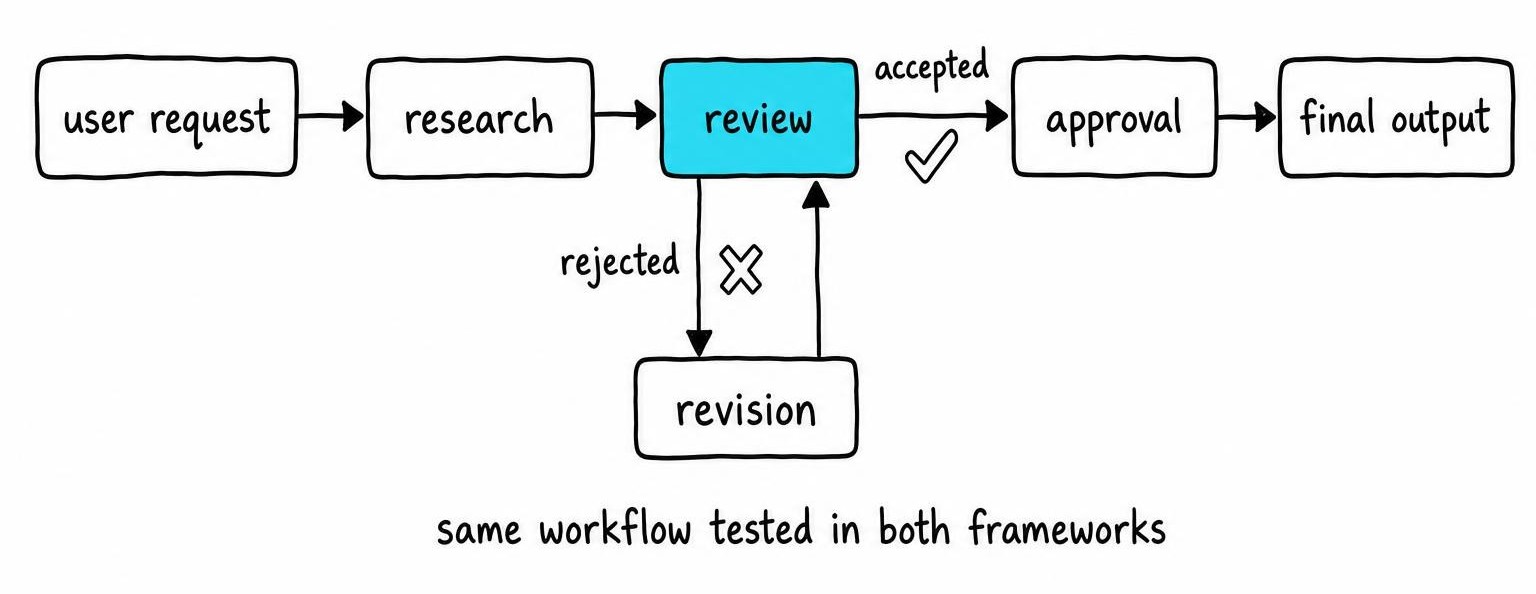
Both implementations use the same pipeline: a researcher agent queries a search tool, a reviewer accepts or rejects the draft, and a revision loop runs until approval produces structured JSON. Hold the model constant across both builds, gpt-4o in both, so what differs is orchestration rather than model quality. The comparison only gets useful past the happy path: tool timeout, malformed output, reviewer rejection, human pause, and resumed execution after a crash.
CrewAI Implementation: Agents, Tasks, and a Crew
from crewai import Agent, Task, Crew, Process

researcher = Agent(role="Researcher", goal="Find verified facts", tools=[search_tool])
reviewer = Agent(role="Reviewer", goal="Reject unsourced claims")

research_task = Task(description="Research {topic}", agent=researcher, expected_output="Draft report")
review_task = Task(description="Review draft for accuracy", agent=reviewer, expected_output="Approved JSON")

crew = Crew(agents=[researcher, reviewer], tasks=[research_task, review_task], process=Process.sequential)
result = crew.kickoff(inputs={"topic": "EU AI Act compliance"})
CrewAI walks the task list in order, passing each output as context to the next agent. Delegation between agents happens automatically when allow_delegation=True - convenient for prototyping, opaque once a rejection triggers unexpected delegation loops.
LangGraph Implementation: Nodes, Edges, and Shared State
from langgraph.graph import StateGraph, END
from typing import TypedDict

class State(TypedDict):
    topic: str
    draft: str
    approved: bool

def research(state: State) -> dict:
    return {"draft": search_tool.run(state["topic"])}

def review(state: State) -> dict:
    return {"approved": check_quality(state["draft"])}

graph = StateGraph(State)
graph.add_node("research", research)
graph.add_node("review", review)
graph.add_edge("research", "review")
graph.add_conditional_edges("review", lambda s: END if s["approved"] else "research")
app = graph.compile(checkpointer=memory_saver)
The revision loop is a conditional edge - visible in the graph definition, not buried in delegation logic. Changing the workflow means editing edges rather than guessing how the crew will re-delegate.
State and Memory: CrewAI Memory vs LangGraph State
Five concepts hide behind "memory": working state, conversation history, long-term recall, knowledge retrieval, and durable checkpoints. The two frameworks handle each differently.
CrewAI memory attaches to agents at three levels - short-term (current task), long-term (cross-run embeddings store), and entity memory (extracted facts about people and things). Recalled information gets injected into prompts automatically. You don't choose what gets injected, which means stale memories from earlier runs can resurface. On a long-running crew with several tasks, the injected context can grow large enough that the model starts truncating the actual task instructions, and the first visible symptom is a reviewer agent quietly dropping its formatting rules. Verbose logs are the only place that ballooned prompt, padded with recalled fragments from previous runs, is visible.
LangGraph state is a TypedDict updated explicitly by each node. Reducers control how updates merge. The checkpointer serializes full state after every node, so resuming a crashed run is deterministic. Storage backends range from in-memory to Postgres.
CrewAI memory has no built-in inspection API - you query the underlying vector store directly to see what's stored. LangGraph state is printable, diffable, and assertable, which matters when you need to evaluate multi-agent systems in CI.
Watch for two traps: changing your TypedDict schema in LangGraph can break existing checkpoints silently. And with CrewAI, test your namespace isolation - shared memory stores risk cross-session recall if you don't scope by user or tenant.
Agent Communication, Routing, and Human Interrupts
CrewAI agents communicate through task output chaining. Each result feeds the next agent's prompt. With allow_delegation=True, an agent can hand work to a peer mid-task through an LLM-driven decision - useful but unpredictable.
LangGraph agents share data through state field reads and writes. Conditional edges handle routing without any LLM deciding which node runs next (unless you wire one in deliberately). The difference matters for how agents exchange messages in structured patterns versus freeform delegation.
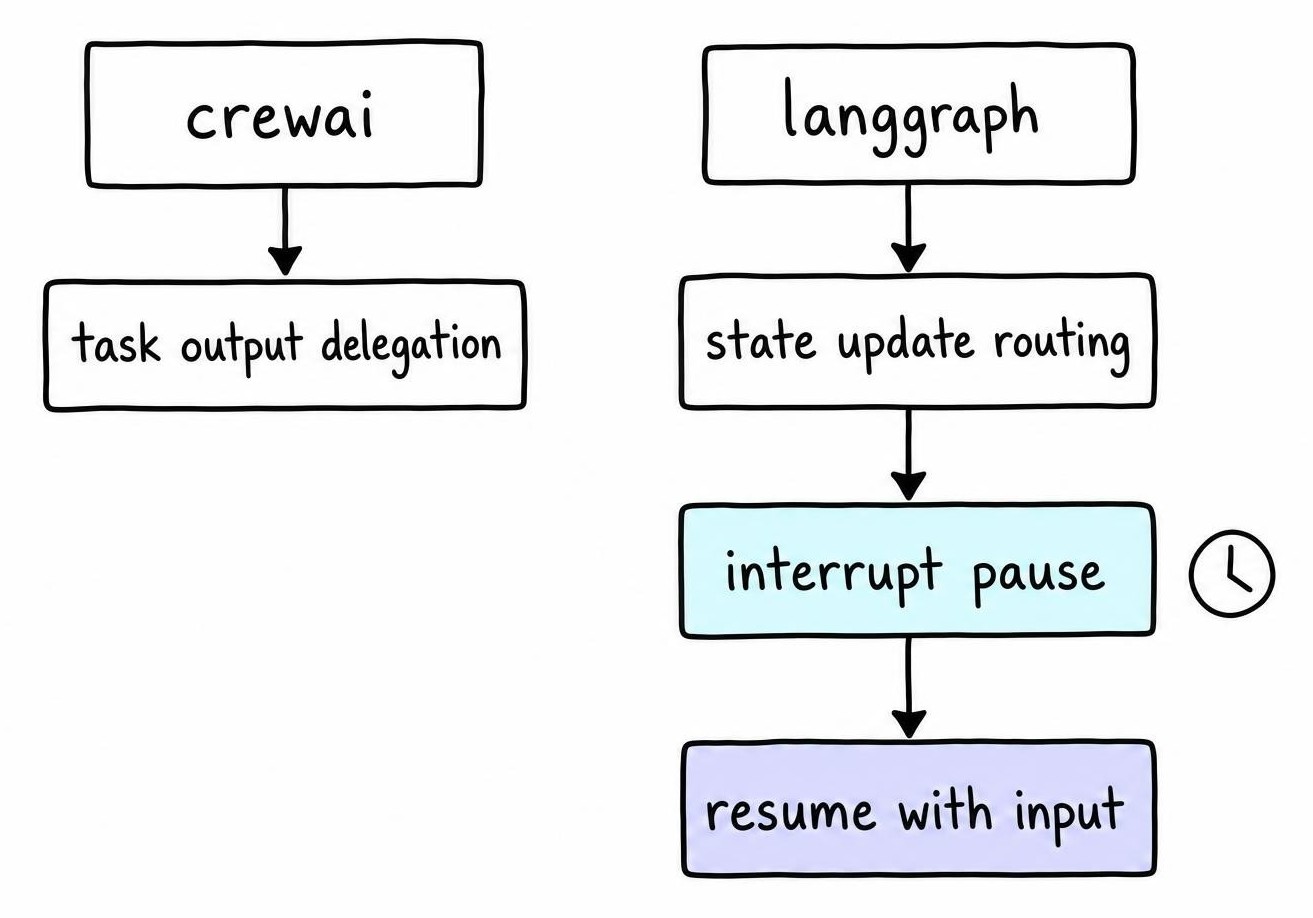
LangGraph's interrupt mechanism pauses at a designated node, persists the checkpoint, and waits. You resume by passing the human's response with the same thread_id [1]. This enables approval gates, edit-before-resume, and timeout escalation as testable graph edges.
CrewAI's human_input=True blocks execution via stdin. That works for demos. In production you need async approval queues, and CrewAI doesn't provide the persistence layer to hold a paused crew while a human reviews overnight.
Both frameworks leave authorization around human input to you.
What Each Run Looks Like: Traces and Observability
LangGraph renders a traversed graph with state diffs at every node. CrewAI logs a sequence of role-task pairs with tool calls and outputs.
The gap shows during failures. When a researcher node in LangGraph returns malformed JSON, the state diff carries the exact update with the bad payload, so the offending tool call is identifiable in seconds. The same failure in CrewAI surfaces as a downstream reviewer crash, which means re-running with verbose=True and reading the whole log to find the source.
Neither ships production telemetry out of the box. Both emit enough hooks for OpenTelemetry instrumentation. LangSmith provides deep tracing for LangGraph; CrewAI integrates with AgentOps. Audit retention, cost attribution, and alert thresholds all live in your instrumentation layer.
Failure Recovery, Testing, and Deployment Complexity
LangGraph's checkpointer gives node-level retry from persisted state. CrewAI retries at the task level, but without checkpoints a process crash means restarting the entire crew - every tool call and LLM inference repeated. A kernel SIGKILL is the harshest version of that, because a process the out-of-memory killer terminates never gets to run cleanup or log why it stopped.
Duplicate side effects are the real danger in both. A retried node that already sent an email will send it again unless you make tool calls idempotent.
LangGraph nodes are plain functions - pass a TypedDict, assert on the return. CrewAI tasks depend on prompt context injected by the crew, so integration tests require running the full crew. Set recursion_limit in LangGraph and max_iter in CrewAI, or a rejection cycle will drain your token budget. Wrap every tool call with a timeout, and encrypt persisted state at rest.
Deployment diverges: LangGraph needs a state backend and checkpoint migration strategy. CrewAI deploys as a single process with no external storage - simpler until you need durable execution or horizontal scaling.
Framework Boundaries: LangGraph, LangChain, CrewAI, and AutoGen
LangGraph handles orchestration; LangChain supplies model adapters, prompt templates, retrievers, and tool definitions. You can use LangGraph without LangChain, but most teams pull in LangChain's model wrappers. CrewAI prescribes roles, tasks, and delegation rather than offering generic building blocks. AutoGen occupies a third lane with conversation-driven multi-agent flows for debate-style reasoning and code generation [2].
LangGraph nodes are plain Python functions portable to any runner. CrewAI Agent and Task classes encode behavior in framework-specific configs that don't port. Persistence formats diverge too - LangGraph checkpoints use a documented schema; CrewAI's memory store uses internal formats. Factor migration cost into your framework decision.
CrewAI vs LangGraph: Which Is Better for Your Use Case?
| Criteria | CrewAI | LangGraph |
|---|---|---|
| Learning curve | Low - roles map to intuition | Moderate - graph design upfront |
| Prototyping speed | Fast | Slower |
| Orchestration model | Role-based delegation | Explicit graph with conditional edges |
| State control | Implicit context passing | TypedDict with reducers, inspectable |
| Memory | Built-in short/long/entity, opaque | External; you own the store |
| Agent communication | Task output chaining + delegation | State field reads/writes |
| Branching | Sequential or hierarchical | Arbitrary conditional edges and loops |
| Human interrupts | human_input=True (stdin) |
Checkpoint-based pause/resume |
| Durable recovery | Full replay on crash | Node-level retry from checkpoint |
| Observability | Verbose logs, AgentOps | State diffs per node, LangSmith |
| Testing | Full crew for integration tests | Nodes testable as plain functions |
| Deployment effort | Single process, no external storage | State backend + migration |
| Best-fit workload | Role-based prototypes, internal tools | Stateful production pipelines |
Scenario verdicts:
- Internal prototype (demo in days): CrewAI.
- Customer-facing approval workflow: LangGraph - durable interrupts and tenant-isolated state.
- Regulated process: LangGraph - checkpoint history and explicit edges give auditors something to inspect.
- High-volume background system: LangGraph - Postgres-backed state and node-level retry handle partial failures without full reruns.
Before committing, score four migration risks: can you export run state to a format you control, how much logic lives in framework-specific configs versus portable functions, can you unit-test orchestration in isolation, and does your monitoring stack integrate without vendor lock-in.
FAQ
How is CrewAI different from LangGraph?
CrewAI organizes workflows around roles and tasks with automatic delegation. LangGraph models workflows as explicit graphs where nodes are Python functions and edges define transitions. CrewAI prioritizes fast prototyping; LangGraph prioritizes runtime control, checkpointing, and inspectable state.
How does CrewAI memory work?
CrewAI provides short-term memory within task execution, long-term memory across runs via an embeddings store, and entity memory for extracted facts. The framework injects recalled memories into agent prompts automatically based on relevance, without explicit retrieval calls from your code.
How does LangGraph state work?
LangGraph passes a TypedDict through every node. Each node returns a partial update, reducers merge it, and a checkpointer serializes the result. Thread identifiers isolate state per conversation, enabling resume from any step.
How does LangGraph interrupt work?
LangGraph pauses execution at a designated node, persists the full state checkpoint, and halts. External code resumes by supplying the same thread_id with a human response payload. The graph continues from the exact serialized state.
How does CrewAI handle communication between agents?
CrewAI chains task outputs as context for subsequent agents' prompts. Enabling allow_delegation=True lets an agent hand work to a peer mid-task through an LLM-driven decision. Communication stays implicit through prompt injection rather than explicit state fields.
References
- Resume Means Resume: A Machine-Checked Conformance Contract for Checkpoint, Interrupt, and Resume Semantics in Workflow Persistence Layers - Sajjad Khan (2026)
- A Survey of Multi-Agent Deep Reinforcement Learning with Communication - Changxi Zhu, Mehdi Dastani, Shihan Wang (2022)