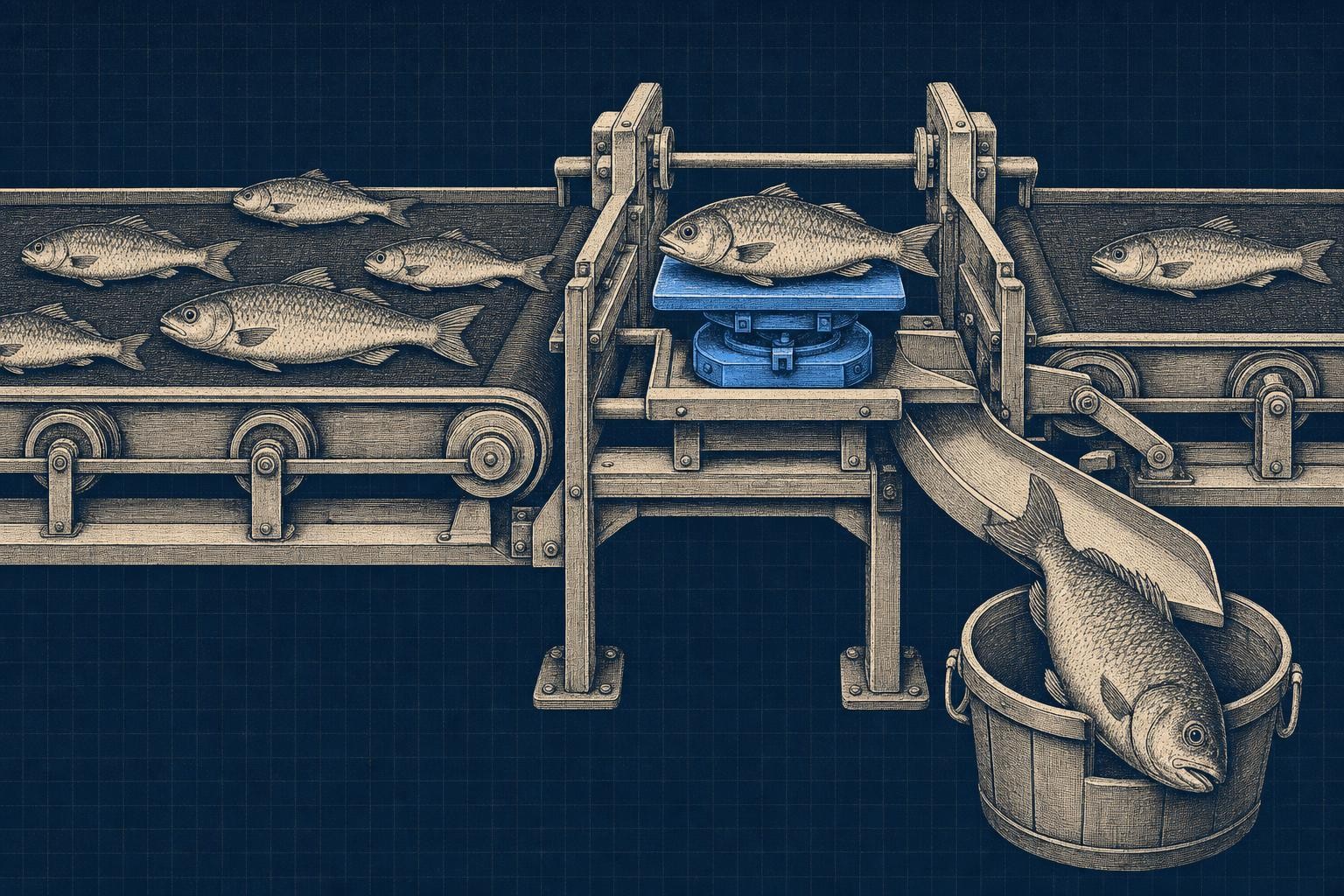
Is RAG Still Relevant in 2026? When to Use or Replace It
Swarnava Dutta10 min read
RAG vs Long ContextRAG vs Agentic Search
Contents
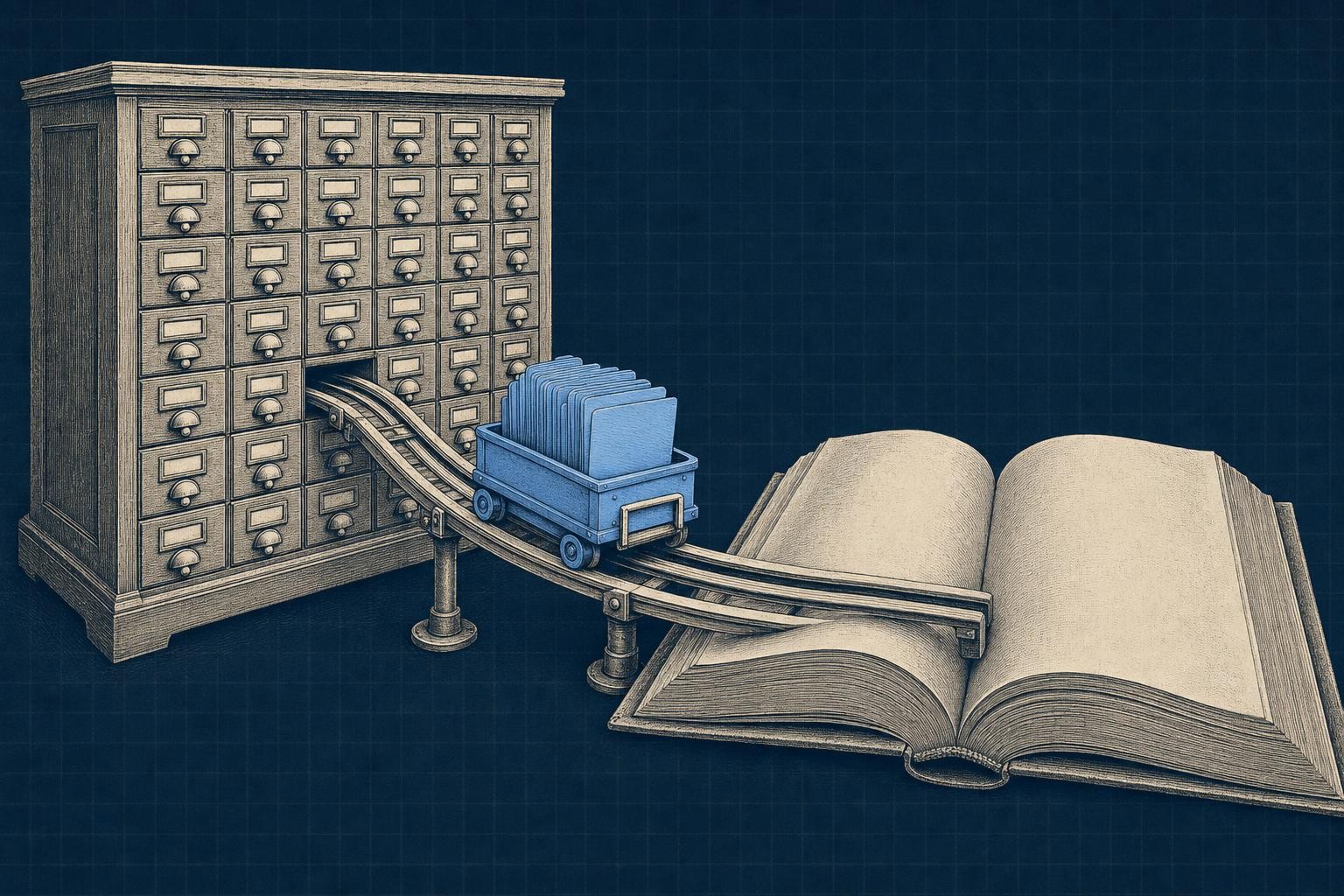
Teams rip out working RAG pipelines and replace them with a single long-context call, expecting to be free of chunking headaches and vector store bills. A common outcome is putting it back weeks later, after the long-context model invents a compliance clause that appears in none of the source documents and nobody catches it until a customer does.
That's the swing I keep seeing across teams asking the same question right now: is RAG still relevant, or did bigger context windows and agentic search quietly retire it? The honest answer is neither the eulogy crowd nor the retrieval purists are fully right. RAG isn't dead, but it's no longer the reflexive default for every knowledge-grounding problem you throw at an LLM.
In 2026 the real decision hinges on a handful of unglamorous variables: how fresh your data needs to be, how big your corpus actually is, how complex the queries are, whether you need citable evidence, and what your latency and cost budget will tolerate. This piece walks through where retrieval still wins, where long context or agentic search beats it outright, and how to decide for your own stack instead of guessing.
Quick answer
Yes, RAG is still relevant in 2026, but it is no longer the default way to ground an LLM. Retrieval still wins for data that changes daily, regulated or permissioned corpora, knowledge bases running into the millions of documents, and workflows that need exact source citations. Long context suits a bounded corpus or a static handbook of forty pages; agentic search suits ambiguous multi-hop questions.
Is RAG Still Relevant in 2026? The Short Verdict
Yes, RAG is still relevant, but it's no longer the default answer to "how do I ground an LLM." Is retrieval-augmented generation dead? No, it just stopped being mandatory for every project that touches a document.
The narrowing happened fast. Context windows stretched into the hundreds of thousands of tokens, tool-calling got reliable enough to trust in production, and agentic search learned to chase down facts across multiple hops instead of one static retrieval pass. Those three shifts ate the easy cases RAG used to own by default - small corpora, one-shot Q&A, "just paste the docs in."
What's left standing is the harder, more valuable core: knowledge that changes daily, data that's access-controlled per user, corpora too large to fit any context window, and any workflow where you need to point at the exact source sentence for an audit or a legal team. Relevance now is an architecture decision, measured against your data's freshness, scale, and evidentiary demands - not a referendum on whether retrieval as a category survived the long-context era.
What RAG Is: An LLM Example and Why Retrieval Matters
Strip away the acronym and retrieval-augmented generation is simple: before the model answers, a system fetches relevant external evidence and hands it to the LLM as context. The model isn't guessing from what it memorized during training - it's reading something you just handed it. That definition has barely moved since the 2020 paper that named the pattern.
Here's the example I use with new hires. An employee asks the internal assistant, "Can I expense a conference flight booked through a personal card?" The RAG pipeline retrieves the current travel policy (updated last week), pulls the specific reimbursement clause, checks it against the employee's department permissions, and passes those authorized passages to the LLM. The model answers and cites the exact section, not a hallucinated summary of a policy that changed six months ago.
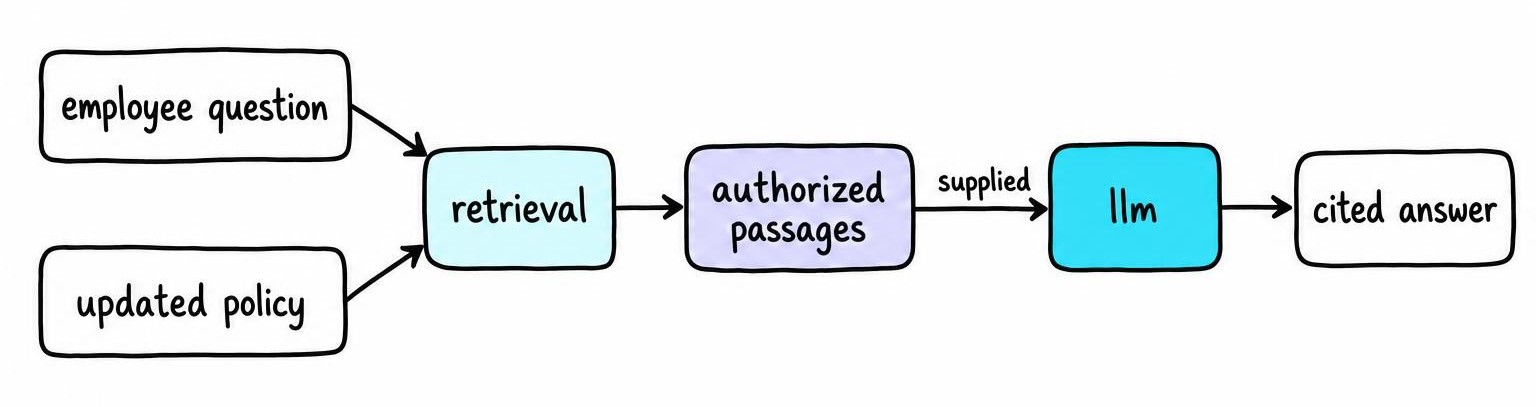
That's the core value: freshness, provenance, and access control that a frozen model's internal weights simply can't offer. Why retrieval-augmented generation still matters comes down to that gap between what a model "knows" and what's actually true right now, for this user, in this document set.
Is ChatGPT a RAG model? Not inherently - its core generation is a standard LLM call. But ChatGPT products layer in web search, file uploads, and connectors, which is retrieval bolted onto generation, functionally RAG for large language models even without the label.
The 7 Types of RAG and What Each Architecture Solves
Nobody ratified an official list of exactly seven RAG types - vendors and papers slice the taxonomy differently. Here's the breakdown that actually holds up in production:
- Naive RAG - embed, retrieve top-k, stuff into the prompt. Cheap, fast, breaks on ambiguous queries.
- Advanced RAG - adds query rewriting, reranking, and better chunking strategies before generation.
- Modular RAG - swappable retrieval/generation components you can A/B test independently.
- Corrective RAG - grades retrieved docs, discards weak ones, retries the search if confidence is low.
- Self-RAG - the model critiques its own output and decides whether to retrieve more.
- Graph RAG - traverses a knowledge graph for multi-hop, relationship-heavy questions.
- Agentic RAG - an agent plans, retrieves, calls tools, and iterates until satisfied.
Complexity climbs steeply from naive to agentic, and so does latency and debugging surface. The mistake I see constantly: teams reach for graph RAG or agentic RAG when their real problem is sloppy metadata or no reranking step. Fix indexing first - fancier architecture rarely rescues bad retrieval hygiene.
When to Use RAG: Five Cases Where Retrieval Still Wins
Five patterns keep showing up when I audit whether a team should keep RAG or rip it out.
- Fast-moving data. Pricing, inventory, policy updates, incident status - anything that changes faster than you can retrain or wait on a provider's next model drop needs live retrieval, not baked-in weights.
- Regulated or proprietary corpora. Legal, healthcare, and finance teams need per-user permissions, source attribution, and data isolation that a single frozen context blob can't enforce.
- Corpus bigger than the window. If your knowledge base runs into the millions of documents, no context window fits it all - you need a retriever that finds the handful of relevant passages per query.
- High-stakes, citation-required workflows. Auditors, compliance reviewers, and clinicians want to click through to the exact source sentence, not trust a paraphrase.
- Multi-tenant customer-facing apps. Each customer's knowledge base has to stay walled off from every other customer's, which retrieval with scoped indexes handles cleanly.
RAG only earns its complexity when the source material is actually retrievable, permissions are dependable, your test queries reflect real usage, and you've defined what "good answer" measurably means.
RAG vs Long Context: Compare Accuracy, Cost, and Latency
Long context and retrieval solve the same problem - getting relevant text in front of the model - with opposite economics. Retrieval fetches a handful of passages; long context loads the whole document set and lets attention sort it out.
For a bounded corpus, a one-off contract review, or a task that needs global synthesis across every page, long context is simpler and more reliable. There's no retrieval step to tune, no recall to worry about - the model just sees everything.
The failure modes aren't universal, but they're real. Stuffing a 200k-token window with mostly irrelevant material dilutes the signal, and models still show lost-in-the-middle behavior where facts buried mid-document get missed [1]. Cost compounds fast too: reprocessing the same 100-page manual on every query burns tokens you'd never pay for with a targeted retrieval call.
The pragmatic middle ground I use most: retrieve candidate documents first, then hand each one's full section - not a single chunk - to a long-context model for reasoning. You get retrieval's precision on scale and long context's synthesis on depth.
RAG vs Agentic Search: Fixed Pipelines or Adaptive Research?
Conventional RAG runs one shape every time: embed the query, retrieve top-k, generate. Agentic search throws that determinism out - the agent reformulates the query, picks tools, browses iteratively, inspects what came back, and decides whether it needs another pass.
Fixed RAG wins when you need predictable latency and cost, a bounded domain, and a strict source policy your compliance team signed off on. You know exactly what gets retrieved and can audit it.
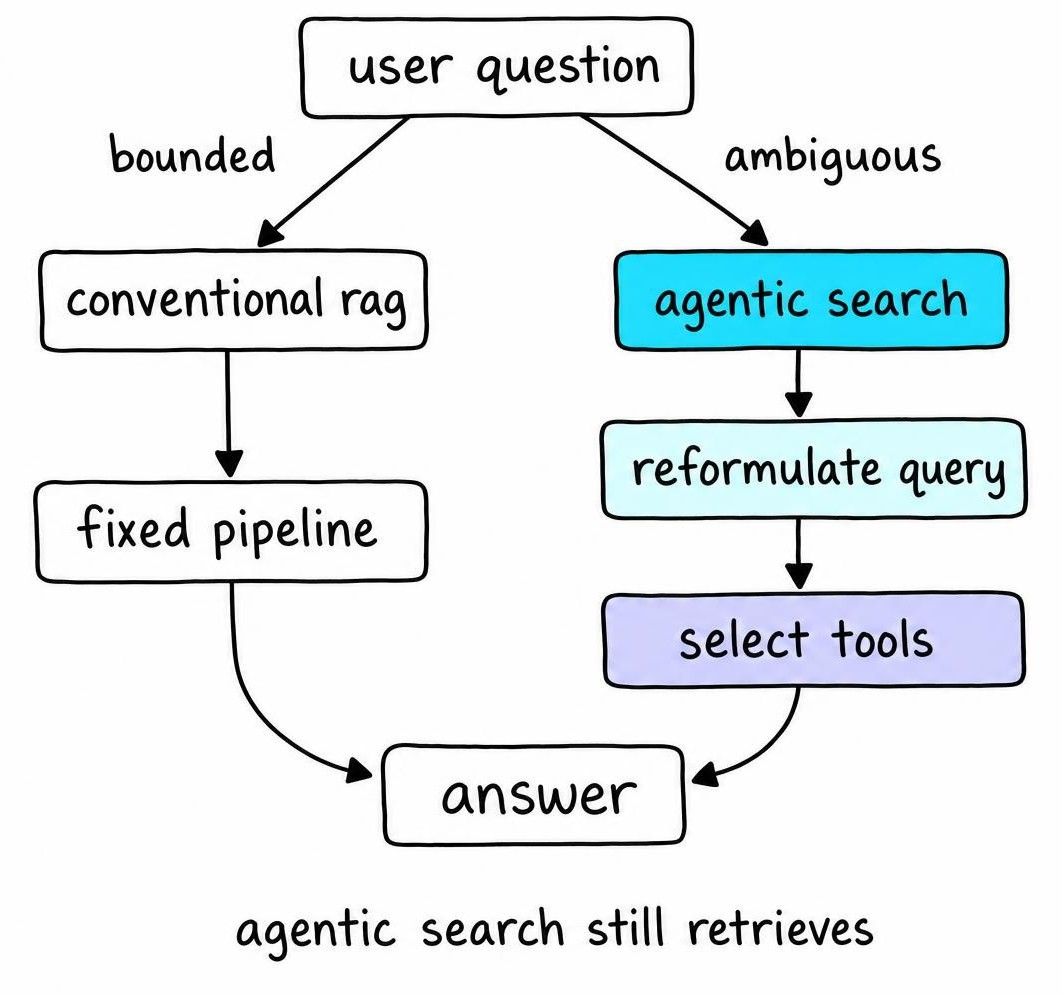
Agentic retrieval earns its overhead on ambiguous, multi-hop, or open-web questions where the information need shifts mid-research - "find me competitors, then check which raised funding this year" isn't a single retrieval call, it's a chain of them.
The risks are real: runaway tool calls that rack up costs, latency that swings wildly query to query, source quality drifting as the agent wanders off-domain, prompt injection from fetched pages, and evaluation that's far harder than checking one retrieval pass. Most AI search agents don't replace retrieval anyway - they wrap it, calling a retriever repeatedly as one tool among several.
When RAG Is Not the Right Architecture
If your entire knowledge base is forty pages and barely changes, skip retrieval - paste it into context and move on. Building a vector store, a chunker, and a reranker for a static handbook is solving a problem you don't have.
Retrieval also can't fix source data that's broken. If your documents are missing, contradictory, or locked in scanned PDFs with no OCR pass, retrieval just fetches broken text faster - you need data cleanup and a document parser that keeps tables and headings intact, not a fancier retriever.
For anything needing exact answers - running totals, transaction lookups, "what's the current stock price" - reach for a database or API, not generated synthesis. RAG hands the model prose to reason over; it's the wrong tool when the answer is a deterministic lookup.
When the real ask is behavior change - tone, output format, classification accuracy on a narrow task - fine-tuning beats retrieval every time; no amount of context fixes a model that answers in the wrong register.
And RAG's sticker price hides in the unglamorous parts: ingestion pipelines, embedding migrations when you swap models, metadata upkeep, permission filtering per query, and the ongoing eval loop nobody budgets for.
Build, Retain, or Replace RAG: A Production Checklist
Before you touch architecture, score your system on seven axes: freshness, corpus scale, query complexity, citation needs, access controls, latency target, and cost per successful answer - not cost per token.
If you already run a production RAG system, the checklist starts with a benchmark, not a rewrite. Wholesale replacement carries the same risk that incremental legacy modernization is designed to avoid. Take your real query set - not a toy eval - and run it through your current pipeline, a long-context baseline, an agentic setup, and a hybrid. Compare them on the same test bed.
Judge outcomes on more than answer similarity:
- retrieval recall against a labeled gold set
- citation correctness, not just presence of a citation
- groundedness (does the answer actually derive from retrieved text)
- completeness on multi-part questions
- security leakage across tenants or permission boundaries
- p95 latency
- total cost per resolved query
Five outcomes fall out of that data: retain and optimize your RAG, simplify to long context, extend RAG with agentic retrieval, land on a hybrid, or swap generation for a deterministic lookup entirely. Only migrate when the measured gain clears the cost of the rewrite, retraining your team, and the new failure modes you're signing up for.
FAQ
Is RAG still relevant?
Yes. It's still the right call for fast-changing data, regulated or permissioned corpora, and any workflow that needs exact source citations. What's changed is that it's no longer the default grounding method for every LLM project - long context and agentic search now cover the simpler cases.
What is RAG in LLM with example?
RAG is a pattern where a system retrieves relevant external text and feeds it to the model before it answers, instead of relying on what the model memorized during training. An internal HR bot that pulls the current leave policy, checks it against the employee's location, and cites the exact clause is a textbook example. Swap the underlying documents daily and the model's answers stay current without retraining.
What are the 7 types of RAG?
Naive, Advanced, Modular, Corrective, Self-RAG, Graph RAG, and Agentic RAG cover the taxonomy most teams reference, though the split varies by vendor and paper. Each adds a layer of correction, iteration, or graph reasoning on top of the basic embed-retrieve-generate loop. Most production systems land somewhere between Advanced and Modular before complexity is justified.
Is ChatGPT a RAG model?
Not by default - its core generation is a plain LLM call over its trained weights. But when it uses web search, file uploads, or connectors, that's retrieval layered onto generation, which is functionally RAG even without the label.
References
- Learning Long-Context Diffusion Policies via Past-Token Prediction - Marcel Torne, Andy Tang, Yuejiang Liu et al. (2025)