Are State Space Models Better Than Transformers? A Technical Comparison
Swarnava Dutta9 min read
Mamba Architecture
Contents

Quick answer
State space models beat transformers on linear O(N) scaling, inference speed, and memory efficiency, while transformer attention costs O(N²) as sequence length grows. Transformers still dominate in-context learning, precise retrieval, and complex reasoning. SSMs such as Mamba suit workloads where context consistently exceeds 32K tokens. Hybrid architectures including Jamba and Mamba-2 interleave attention and SSM layers to capture both throughput and recall.
Are State Space Models Better Than Transformers? It Depends on Your Workload
Mamba looks like a silver bullet for inference costs on paper: linear scaling, constant memory during generation, benchmarks showing 5x throughput improvements. The pull is strongest on a document processing pipeline that chokes on anything past 32K tokens, where the KV cache alone eats GPU memory alive.
Deployment splits that picture. The throughput gains are real. Retrieval accuracy drops on tasks that require precise recall from earlier in the document.
The honest answer to whether state space models beat transformers: they win on specific dimensions - linear scaling, inference speed, memory efficiency - but transformers still dominate in-context learning and complex reasoning. The question isn't "which is better" but "which is better for your use case."
Here's what the tradeoffs actually look like in production:
- Computational scaling: O(N) for SSMs vs O(N²) for attention
- Inference pattern: Recurrent (constant memory) vs KV cache (growing with context)
- Context handling: Fixed-size compressed state vs dynamic attention over all tokens
If you're hitting context-length walls or drowning in inference costs, SSMs deserve serious evaluation. If you need reliable retrieval or complex reasoning chains, attention mechanisms remain the safer bet.
How State Space Models Work: The Core Mechanics
State space models come from control theory, not NLP - which is why they feel alien to anyone who grew up on transformers. At their core, SSMs model sequences as continuous-time dynamical systems that get discretized for practical computation.
The fundamental equation looks like this:
h'(t) = Ah(t) + Bx(t) # state update
y(t) = Ch(t) + Dx(t) # output
The hidden state h compresses all history into a fixed-size representation. Information flows in through B, gets transformed by A, and flows out through C. The magic is in A - it determines how information persists or decays over time.
The key insight that makes SSMs practical: linear recurrence enables parallel training via convolution while maintaining O(1) inference per token. During training, you can unroll the entire recurrence as a single convolution operation (fast on GPUs), a step the walkthrough from the continuous equations to the discrete scan derives in full. During inference, you process tokens one at a time with constant memory - no KV cache explosion.
This is fundamentally different from attention, which needs to store and compare against all previous tokens. An SSM compresses history into that fixed state vector, trading perfect recall for computational efficiency .
From S4 to Mamba: The Evolution of Structured State Space Models
Vanilla S4 handles some long-range tasks beautifully and fails completely at others, which is confusing until you see why. The answer comes down to selectivity - or rather, the lack of it.
S4's breakthrough was HiPPO initialization: a mathematically principled way to set up the A matrix so it could retain information over thousands of timesteps. Before HiPPO, RNNs forgot everything beyond a few hundred tokens. S4 could model dependencies across 16K+ tokens, which felt revolutionary in 2021 .
But S4 had a critical limitation: its state transitions were input-independent. The matrices A, B, C were fixed after training. This meant S4 couldn't do what attention does naturally - dynamically decide which past information matters based on the current input.
Mamba's innovation was making these matrices input-dependent (selective). Instead of fixed transitions, Mamba computes B and C as functions of the current input. This lets the model choose what to remember and what to forget at each step, mimicking attention's dynamic behavior while keeping the linear recurrence structure.
The selectivity mechanism is why Mamba can handle content-based reasoning that stumped earlier SSMs. It's also why Mamba's parameter count and computational cost are higher than vanilla S4 - you're paying for that dynamic behavior.
Where SSMs Beat Transformers: Long Context and Inference Speed
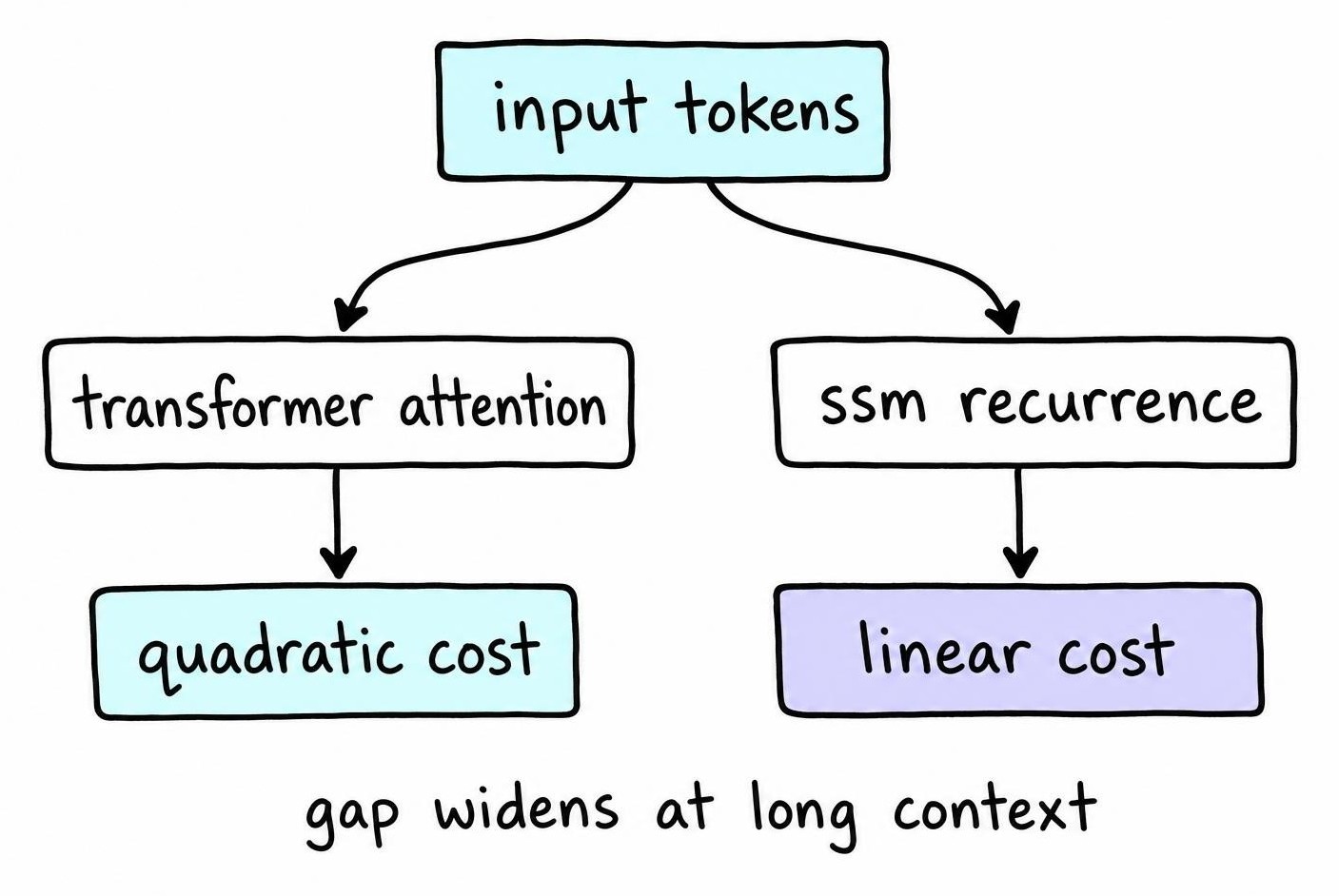
The numbers don't lie here. At 100K context length, a standard transformer's attention computation scales to roughly 10 billion operations. An SSM doing the same sequence? Still linear in N.
Audio spectrograms make this concrete. A transformer-based model hits an OOM wall around 60 seconds of audio (roughly 94K frames after tokenization), while an SSM variant processes multi-minute clips on the same hardware - not because the model is smarter, but because memory usage stays flat during generation.
The production wins cluster in specific domains:
- Audio processing: Where sequences routinely hit 100K+ tokens
- Genomics: DNA sequences can span millions of base pairs
- Time-series forecasting: Continuous streams without natural truncation points
- Document summarization: When you need to ingest entire reports before generating
Benchmark results back this up: Mamba achieves 3-5x higher throughput than comparably-sized transformers on sequences beyond 8K tokens [1]. The gap widens as context length increases.
But here's what the benchmarks don't show: throughput isn't everything. Teams optimize for tokens-per-second and then find the model can't actually use all that context effectively.
Where Transformers Still Win: In-Context Learning and Recall
Mamba on a "needle in haystack" retrieval task reads like a misconfiguration the first time you see the results. The model processes the full context. The answer sits explicitly in the text. And it still can't find it reliably.
This is the associative recall gap, and it's fundamental to how SSMs work. A transformer can directly attend to any previous token - it maintains explicit access to the full context through its KV cache. An SSM compresses everything into a fixed-size state vector. If the relevant information didn't get encoded prominently into that state, it's effectively lost.
The limitations show up most clearly in:
- In-context learning: SSMs can't dynamically attend to arbitrary past examples the way transformers do for few-shot prompting
- Precise retrieval: Tasks requiring exact recall of specific facts from long documents
- Complex reasoning chains: Multi-hop reasoning where attention routes information flexibly between distant concepts
There's an arxiv paper claiming SSMs are "provably comparable" to transformers in expressiveness. The important caveat: this holds for certain function classes under specific conditions. In practice, the fixed state size creates information bottlenecks that attention doesn't have [2].
I'm not saying SSMs can't do retrieval - they can, sometimes surprisingly well. But when retrieval accuracy is non-negotiable, transformers remain the safer choice.
Hybrid Architectures: Getting the Best of Both Worlds
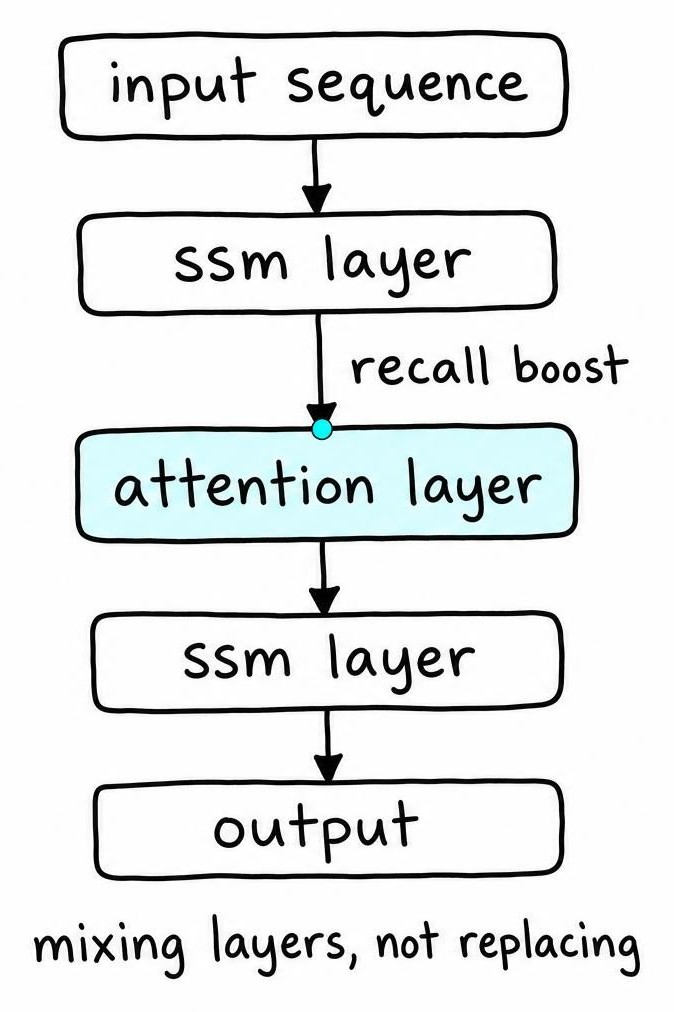
The most interesting development isn't pure SSMs replacing transformers - it's hybrids that interleave both. Jamba, Mamba-2, and several research architectures now mix attention and SSM layers strategically.
The intuition: use SSM layers where you need throughput (processing long sequences efficiently) and attention layers where you need recall (retrieving specific information). A typical pattern might be 6 SSM layers followed by 1 attention layer, repeated throughout the model.
Production tradeoffs to consider:
- Complexity: You're now maintaining two different layer types with different optimization characteristics
- Memory patterns: Attention layers still have KV caches, just smaller ones
- Debugging: When something goes wrong, you have twice as many places to look
The emerging consensus is that pure SSMs probably won't replace transformers, but hybrids might. The question is whether the complexity overhead is worth the performance gains for your specific workload.
SSMs for Machine Translation and NLP Tasks: Current Effectiveness
I have to be honest here: SSMs still lag behind transformers on standard machine translation benchmarks. The gap has narrowed with selective mechanisms, but it hasn't closed.
Why? Translation requires precise cross-sequence alignment - knowing exactly which source word corresponds to which target word. This is attention's home turf. The source sentence might have the subject at position 3 and the verb at position 15, while the target language needs them adjacent. Attention handles this naturally; SSMs have to encode that alignment information into their compressed state.
Where SSMs show more promise in NLP:
- Document summarization: Where you need to process long inputs but the output depends on overall themes rather than precise token-level recall
- Long-form generation: Continuing coherent narratives over thousands of tokens
- Streaming applications: Processing text in real-time without buffering full contexts
The practical reality: if machine translation is your primary use case, stick with transformers. If you're doing summarization of very long documents and hitting memory constraints, SSMs deserve evaluation.
Choosing Between SSMs and Transformers for Production
After burning more weekends than I'd like on architecture evaluations, here's my decision framework:
Choose SSMs when:
- Context lengths consistently exceed 32K tokens
- Inference latency matters more than perfect accuracy
- Memory budget is constrained (edge deployment, cost optimization)
- Your task is throughput-heavy: streaming, summarization, time-series
Stick with transformers when:
- Tasks require precise retrieval or in-context learning
- You need complex chain-of-thought reasoning
- The ecosystem matters (tooling, pretrained weights, community support)
- Context lengths stay under 16K tokens (attention's overhead is manageable)
My practical recommendation: Start with transformers. They're proven, well-tooled, and good enough for most workloads. Evaluate SSMs or hybrids when you hit specific bottlenecks - context length walls, inference cost explosions, memory constraints on target hardware.
Don't adopt SSMs because they're novel. Adopt them because they solve a concrete problem you actually have.
FAQ
How do state space models work?
State space models process sequences by maintaining a fixed-size hidden state that gets updated with each new input. The state equation h' = Ah + Bx governs how information flows and persists. Unlike attention, which compares all tokens pairwise, SSMs compress history into this state vector - enabling linear scaling but trading off perfect recall.
What are structured state space models?
Structured state space models (like S4) use mathematically principled initializations for their state matrices, particularly the HiPPO framework. This structure enables them to retain information over very long sequences - thousands of tokens - where vanilla RNNs would forget. The "structured" refers to specific constraints on the A matrix that enable both efficient computation and long-range memory.
How effective are state space models for machine translation?
Currently, SSMs underperform transformers on standard machine translation benchmarks. Translation requires precise token-level alignment between source and target sequences, which attention handles naturally. SSMs can translate, but the accuracy gap means transformers remain the practical choice for production MT systems.
Are state space models linear?
Yes, in terms of computational complexity - SSMs scale O(N) with sequence length, compared to O(N²) for standard attention. The underlying state transitions are also linear operations (matrix multiplications). However, modern variants like Mamba add input-dependent (selective) mechanisms that introduce nonlinearity in how the state matrices are computed, while preserving the linear recurrence structure.
What are state space models in AI?
In AI, state space models are sequence modeling architectures that process inputs through a compressed hidden state, inspired by control theory. They've emerged as alternatives to transformers for specific use cases - particularly long-context tasks and efficient inference. Key examples include S4, Mamba, and various hybrid architectures combining SSM and attention layers.
References
- Exploring the Limitations of Mamba in COPY and CoT Reasoning - Ruifeng Ren, Zhicong Li, Yong Liu (2024)
- On the Expressive Power and Limitations of Multi-Layer SSMs - Nikola Zubić, Qian Li, Yuyi Wang et al. (2026)