Is Flash Attention Stable? Production Guide 2026
Swarnava Dutta9 min read
Candle Flash Attention
Contents

Flash Attention promises significant speedups for transformer models, but benchmark gains mean nothing if your production pipeline crashes or produces inconsistent outputs. A sentence-transformer model that sails through validation can still produce slightly different embeddings once Flash Attention is swapped in, and small shifts in embedding values are enough to reorder nearest neighbours in an Elasticsearch-backed retrieval index. The speedup is real. So are the debugging sessions it can cost you.
Is Flash Attention stable enough for production? What follows is what ML engineers actually need to know about Flash Attention stability in 2026 - the parts the benchmarks don't tell you.
Quick answer
Flash Attention is stable enough for production. Its online softmax deviates from standard attention by 1e-3 to 1e-2 relative error in FP16/BF16, negligible for training loss, generation quality, and classification accuracy. Deviation grows with sequence length and shifts embedding similarity search results. PyTorch 2.0+ exposes Flash Attention through scaled_dot_product_attention. Flash Attention 2.x requires Ampere or newer GPUs and CUDA 11.8+ or 12.x. Standard attention remains necessary for bit-exact reproducibility.
What Is Flash Attention and Why Does Stability Matter?
Flash Attention is a memory-efficient attention algorithm that fundamentally changes how attention computation happens on GPUs. Instead of materializing the full N×N attention matrix in high-bandwidth memory (HBM), it tiles the computation and keeps intermediate results in faster SRAM. The result: dramatically lower memory footprint and faster wall-clock time for long sequences.
But stability matters because the algorithm trades exact computation order for efficiency. Standard attention computes softmax over the entire sequence at once. Flash Attention computes it incrementally, tile by tile, using an online softmax algorithm. Mathematically equivalent in infinite precision - but floating-point arithmetic doesn't work that way.
The production stakes are real:
- Training runs that diverge subtly over thousands of steps
- Inference outputs that differ between Flash and standard backends
- Debugging nightmares when you can't reproduce an issue because attention behavior varies by batch size
How Flash Attention Works Under the Hood
The core insight is memory hierarchy exploitation. GPUs have limited but fast SRAM and much larger but slower HBM. Standard attention writes the full attention matrix to HBM, reads it back for softmax, writes again, reads for the value multiplication.
That's a lot of memory traffic. Flash Attention never materializes the full matrix. It processes the attention computation in tiles that fit in SRAM, computing partial softmax results and accumulating them using a numerically stable online algorithm.
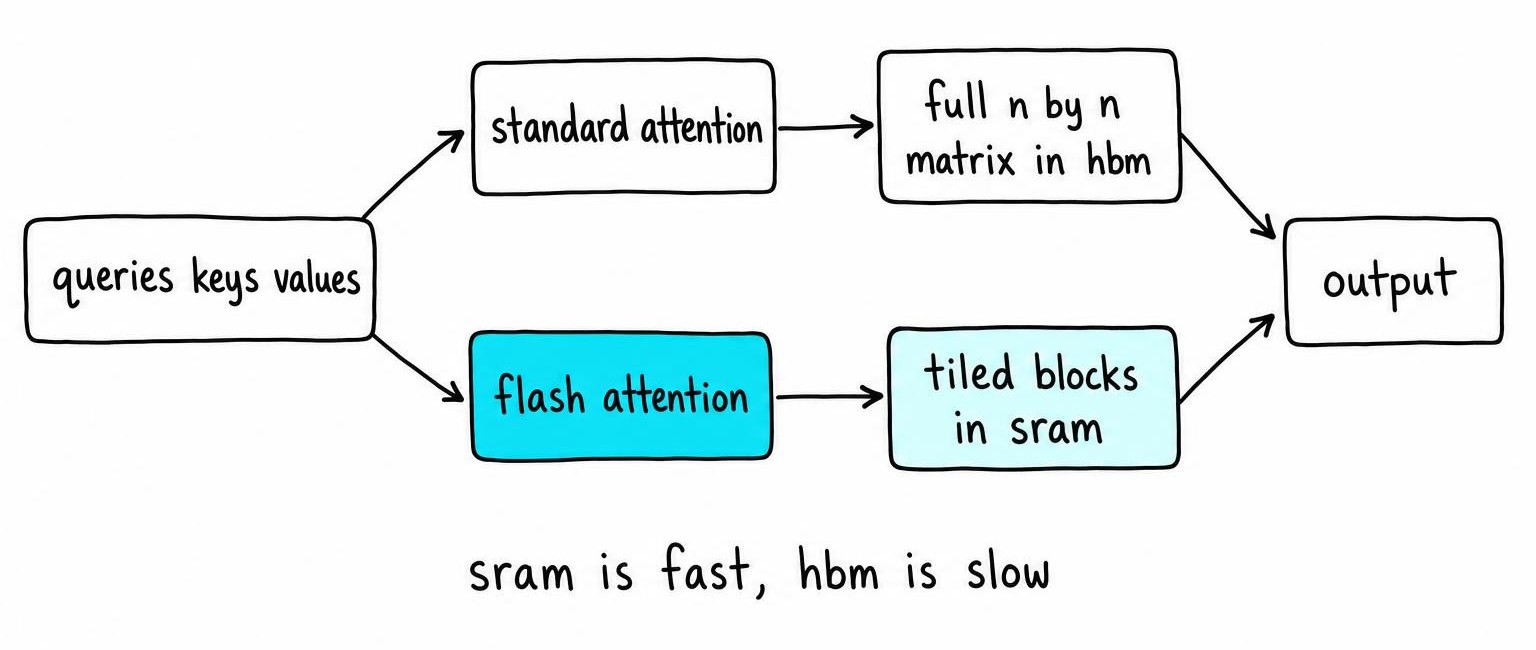
Each tile computes local attention scores, tracks running max values for numerical stability, and accumulates weighted outputs. The recomputation strategy is equally important. During backpropagation, instead of storing attention weights (which would defeat the memory savings), Flash Attention recomputes them from Q, K, V.
This trades compute for memory - usually a good trade on modern GPUs where memory bandwidth is the bottleneck. Why does this differ mathematically? Standard softmax computes exp(x - max(x)) where max(x) is known globally.
Online softmax must correct for discovering new maximum values as it processes tiles. The correction is mathematically exact, but floating-point rounding accumulates differently.
Is Flash Attention Numerically Stable? Research Findings
The short answer: yes, but with caveats you need to understand.
Dao et al.'s Flash Attention 2 paper and subsequent analyses have quantified the numerical deviation between Flash Attention and standard attention. The differences exist but are typically small - on the order of 1e-3 to 1e-2 in relative error for FP16/BF16. For most applications, this falls well within acceptable tolerance.
When do these differences actually matter?
- Long sequence lengths: Deviation grows with sequence length because more tiles mean more accumulated rounding error
- Precision-sensitive downstream tasks: Embedding similarity search, where small differences compound across millions of comparisons
- Exact reproducibility requirements: Scientific computing, model auditing, or debugging specific behaviors
When are they negligible? Training loss, generation quality, classification accuracy - I've never seen a case where Flash Attention's numerical differences affected these metrics in a statistically significant way.
Numerical Precision Across Data Types
BF16 and FP16 behave differently under Flash Attention, and the choice matters more than most engineers realize.
BF16 has the same exponent range as FP32 but reduced mantissa precision. Flash Attention's online softmax handles BF16 well because the algorithm's numerical stability comes from tracking maximum values (exponent-dependent), not from mantissa precision.
FP16 has a narrower exponent range, making overflow more likely with large attention scores. Flash Attention implementations typically handle this, but edge cases remain at very long sequences, where FP16 can produce NaN outputs on inputs BF16 handles fine.
For training, BF16 is almost always the right choice - it's what the algorithm was optimized for. For inference, FP16 works if you're memory-constrained, but test your specific sequence lengths. FP32 eliminates numerical concerns entirely but sacrifices most of the speed benefits.
Is Flash Attention Linear in Complexity?
No. This is the most persistent misconception I encounter.
Flash Attention is still O(n²) in computation - it computes the same number of operations as standard attention. What's linear is memory: O(n) instead of O(n²). You're not doing less math. You're doing the same math while moving less data through the memory bus.
Actual linear attention variants like Linformer, Performer, and Linear Transformers approximate the attention mechanism to achieve O(n) computation. They trade accuracy for speed in a fundamentally different way than Flash Attention, which is exact (within floating-point limits).
Why does memory efficiency matter more for most use cases? Because modern GPUs are memory-bandwidth-bound for attention. The GPU can compute far more FLOPs than it can feed data to. Flash Attention's memory reduction translates directly to wall-clock speedup even though computational complexity is unchanged.
For a deeper comparison of attention alternatives, state space models offer a different architectural approach that achieves true linear scaling - but with different tradeoffs.
Platform Compatibility: Why Flash Attention Fails to Install
"flash attention is not a supported wheel on this platform" - if you've hit this error, you're not alone. The flash-attn library has notoriously strict compatibility requirements.
GPU architecture requirements: Flash Attention requires Ampere (A100, RTX 30xx), Ada Lovelace (RTX 40xx), or Hopper (H100) GPUs. Older architectures like Volta (V100) lack the necessary tensor core capabilities. No combination of build flags gets Flash Attention running on a V100 cluster, because the limitation is architectural rather than a packaging problem.
CUDA version dependencies: Flash Attention 2.x typically requires CUDA 11.8+ or 12.x. The prebuilt wheels are compiled against specific CUDA versions - a CUDA 11.7 environment won't load a wheel built for 11.8.
Python version constraints: Most wheels target Python 3.8-3.11. Python 3.12 support arrived later and may require building from source.
Troubleshooting Flash Attention Installation Errors
When prebuilt wheels fail, follow this systematic approach:
Verify GPU compatibility:
nvidia-smishows your GPU. Check it's Ampere or newer.Match CUDA versions exactly:
nvcc --versionandpython -c "import torch; print(torch.version.cuda)"should match what the wheel expects.Building from source when wheels aren't available:
pip install packaging ninja
pip install flash-attn --no-build-isolation
The --no-build-isolation flag is critical - it lets the build process use your existing PyTorch installation to detect CUDA configuration.
Docker for consistency: The
nvcr.io/nvidia/pytorchcontainers ship with compatible environments. When I'm fighting installation issues, starting from an official container eliminates most variables.Common pip conflicts: Uninstall and reinstall in order:
pip uninstall flash-attn torchthenpip install torchthenpip install flash-attn. Order matters because flash-attn builds against your installed PyTorch.
Flash Attention in PyTorch: Implementation Examples
PyTorch 2.0+ includes Flash Attention as a backend for scaled_dot_product_attention. This is the cleanest integration path:
import torch
import torch.nn.functional as F

# Context manager forces a specific backend; default behavior auto-selects
with torch.backends.cuda.sdp_kernel(
 enable_flash=True,
 enable_math=False,
 enable_mem_efficient=False
):
 output = F.scaled_dot_product_attention(query, key, value)

# Verify which backend was used
print(torch.backends.cuda.flash_sdp_enabled())
The native integration handles dtype conversion and falls back gracefully when Flash Attention isn't available. For production, I prefer this over the standalone flash-attn library unless I need features like ALiBi or sliding window attention that the library implements but PyTorch doesn't expose.
To verify Flash Attention is actually running, profile with torch.profiler. Look for kernels with "flash" in the name rather than "mem_efficient" or "math".
Candle and Alternative Flash Attention Implementations
Hugging Face's Candle framework provides a Rust-based Flash Attention implementation. It's worth considering if you're deploying outside Python or need tighter control over the inference runtime.
Stability characteristics differ across implementations. The PyTorch native backend and the flash-attn library share underlying CUDA kernels, so their numerical behavior is identical.
Candle's implementation may show slightly different rounding behavior - I haven't tested exhaustively, but assume you'll need validation if switching between them. Similar validation applies when moving between different model architectures entirely, such as text-to-video systems that may use attention variants optimized for their specific workloads.
When to Use Flash Attention vs Standard Attention in Production
Use Flash Attention when:
- Sequence length exceeds 512 tokens (benefits scale with length)
- GPU memory is your bottleneck
- You're on Ampere+ hardware with compatible CUDA
- Numerical differences of 1e-3 relative error are acceptable
Stick with standard attention when:
- You need bit-exact reproducibility
- Running on older GPU architectures
- Debugging attention behavior (standard attention is easier to inspect)
- Sequence lengths are short and memory isn't constrained
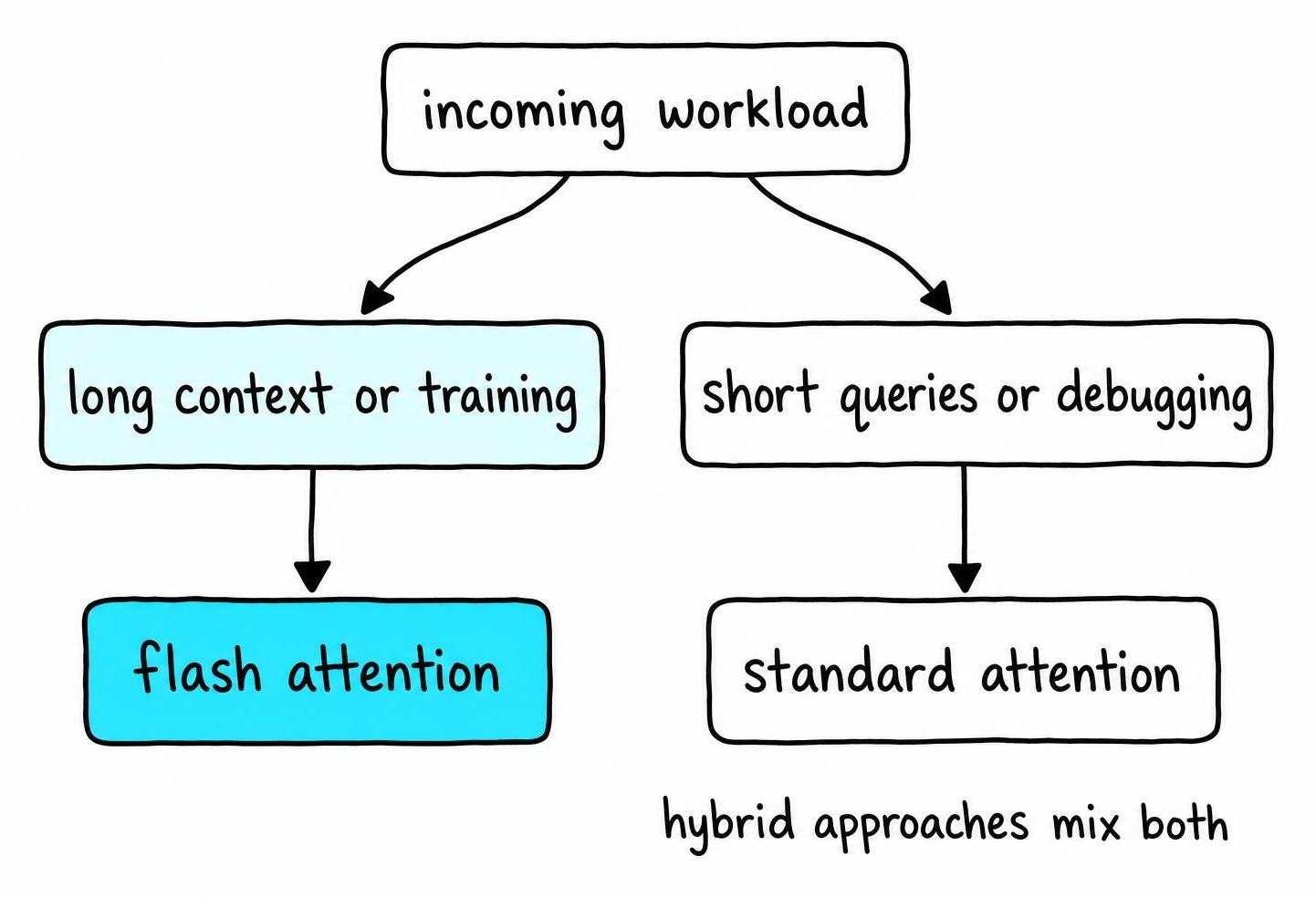
Hybrid approaches work well. Use Flash Attention for training and long-context inference, standard attention for short queries or when troubleshooting. PyTorch's automatic backend selection makes this nearly seamless.
For monitoring, log attention output norms periodically. A sudden change in distribution can indicate numerical issues before they cascade to model quality degradation.
Flash Attention Stability Checklist for Production Deployment
Before deploying Flash Attention to production:
- Validate numerical consistency: Run 1000+ samples through both Flash and standard attention, compare output distributions
- Test at maximum sequence length: Numerical deviation grows with length - test your worst case
- Pin versions explicitly:
flash-attn==2.x.x,torch==2.x.x, CUDA version in your container - Implement fallback: Catch Flash Attention failures and fall back to standard attention rather than crashing
- Monitor inference latency variance: Flash Attention should reduce variance; increased variance suggests configuration issues
For reproducibility, set torch.backends.cudnn.deterministic = True. Be aware this may disable some Flash Attention optimizations - test the performance impact.
FAQ
What is Flash Attention?
Flash Attention is a memory-efficient algorithm for computing transformer attention that tiles the computation to minimize GPU memory bandwidth usage. It achieves significant speedups over standard attention by keeping intermediate results in fast SRAM rather than slower HBM, without approximating the attention computation.
Is Flash Attention numerically stable compared to standard attention?
Yes, with small caveats. Flash Attention uses an online softmax algorithm that's mathematically equivalent to standard attention but accumulates floating-point rounding errors differently. Typical deviations are on the order of 1e-3 to 1e-2 relative error in FP16/BF16 [1]. For most applications, this is negligible.
Is Flash Attention linear in complexity?
No. Flash Attention is O(n²) in computation but O(n) in memory. It computes the same operations as standard attention while dramatically reducing memory traffic. True linear attention variants like Linformer achieve O(n) computation through approximation, which is a different tradeoff.
Why is Flash Attention not a supported wheel on some platforms?
Flash Attention requires Ampere or newer GPU architectures (A100, RTX 30xx/40xx, H100) and specific CUDA versions. Prebuilt wheels are compiled for limited Python/CUDA combinations. If your environment doesn't match, you'll need to build from source or use a compatible container image.
When should you use Flash Attention vs standard attention in production?
Use Flash Attention when handling sequences over 512 tokens on compatible hardware where small numerical differences are acceptable. Use standard attention when you need bit-exact reproducibility, run on older GPUs, or need to debug attention behavior directly. Hybrid approaches - Flash for training, standard for debugging - work well in practice.
References
- Block Sparse Flash Attention - Daniel Ohayon, Itay Lamprecht, Itay Hubara et al. (2025)