SGLang vs vLLM Deployment for Production LLM Serving
Swarnava Dutta8 min read
Sglang vs VllmTensorrt LLMLlama Cpp
Contents
You benchmark SGLang against vLLM on a single A100, watch SGLang win on throughput, then deploy it - and your agent pipeline stalls because the model you need lacks support. This comparison tests both engines under production-relevant workloads and maps results to RAG, agents, and high-volume serving.
Quick answer
SGLang optimizes for workloads with shared prefixes and structured generation, using RadixAttention to reuse KV cache across requests. vLLM provides broader model coverage, mature PagedAttention-based memory management, and a wider ecosystem of integrations. Choose SGLang when multi-turn or constrained-decoding throughput dominates; choose vLLM when model compatibility and operational tooling matter more than peak speed.
SGLang vs vLLM at a glance: strengths and tradeoffs
SGLang and vLLM are open-source LLM inference engines - they serve models, not train them. SGLang (UC Berkeley) builds around RadixAttention and a compiler-style frontend that fuses structured-output constraints into the decode loop. vLLM (also Berkeley-originated) centers on PagedAttention for near-zero-waste KV cache management and ships with broader model support across Hugging Face architectures.
Their serving interfaces converge on an OpenAI-compatible API, but deployment patterns diverge. SGLang exposes a Python DSL for chaining constrained calls; vLLM leans on a standalone server with Ray, Kubernetes health probes, and LoRA hot-swapping.
Directional picks by workload:
- Prefix-heavy RAG - SGLang, because RadixAttention avoids recomputing shared system prompts.
- Latency-sensitive agents with constrained JSON output - SGLang, for fused structured generation.
- General-purpose serving across dozens of architectures - vLLM, for model coverage and ecosystem tooling.
- Teams prioritizing operational maturity - vLLM, given its larger contributor base and integration surface.
Reproducible benchmark setup for production inference
Pin versions or the numbers mean nothing. A representative setup: SGLang 0.4.x and vLLM 0.6.x, both on PyTorch 2.4, CUDA 12.4, NVIDIA driver 550+, on a single A100-80GB. Use identical Llama 3.1 8B weights in BF16, tensor parallelism 1, max context 4096 tokens, 512 output tokens.
Five workloads cover production-relevant axes: single request (raw TTFT and decode speed), 64 concurrent clients via aiohttp, shared-prefix prompts (32 requests sharing a 2048-token system prompt), JSON-constrained structured generation at 32 concurrent requests, and sustained Poisson-distributed arrivals at 4 req/s for 5 minutes capturing p50/p95/p99 latency. Both engines get three warm-up requests before measurement, with CUDA Graphs enabled. Measure server-side latency to isolate engine performance from network jitter.
Throughput, time to first token, and memory results
The SGLang project's published benchmarks show SGLang achieving higher output tokens per second than vLLM on Llama-family models at high concurrency. vLLM holds comparable single-request TTFT because PagedAttention's scheduler carries less coordination overhead at concurrency 1.
Under sustained parallel load, SGLang's RadixAttention keeps decode latency flatter when prompts share prefixes. vLLM's inter-token latency climbs faster as concurrency rises past the mid-40s. Both engines consume similar VRAM after model load; long-context requests above 8K tokens require quantized weights on a single 80 GB card to avoid OOM on either engine.
Structured generation and shared-prefix performance
SGLang fuses JSON schema constraints into its decode kernel, so constrained decoding adds materially less overhead than vLLM's Outlines-based token masking at each step [1]. The SGLang team reports minimal throughput loss; independent reproduction on your own schemas is essential since overhead scales with schema complexity.
For shared-prefix workloads, RadixAttention eliminates redundant prefill across requests sharing a system prompt. vLLM's PagedAttention recomputes each prompt independently unless you enable --enable-prefix-caching (off by default in 0.6.x). Multi-turn chat with cached conversation history shows the same pattern: SGLang reuses the KV cache for prior turns automatically.
Performance under parallel and long-context requests
Continuous batching in both engines lets short requests finish without waiting for long ones. vLLM's scheduler prioritizes FCFS within each iteration, so a burst of long outputs can increase tail latency for short completions. SGLang's radix-tree scheduler groups prefix-matched requests, reducing head-of-line blocking when prompts cluster. Extending input length to 8192+ tokens pushes both engines toward queuing, with vLLM's conservative page allocation triggering backpressure earlier.
RadixAttention vs PagedAttention and scheduling behavior
RadixAttention stores KV cache segments in a radix tree keyed by token sequences. When a new request shares a prefix with an existing entry, SGLang traverses the tree and reuses the matching segment. Eviction follows LRU on tree nodes, so frequently hit prefixes (system prompts, few-shot examples) persist. This pays off in RAG pipelines where dozens of requests share a retrieval preamble, and in agent loops where tool-calling prefixes repeat.
PagedAttention maps KV cache to fixed-size virtual pages, reducing the internal fragmentation that plagues contiguous-allocation schemes. The paging model packs more sequences into memory simultaneously, boosting dynamic batching on heterogeneous prompt lengths.
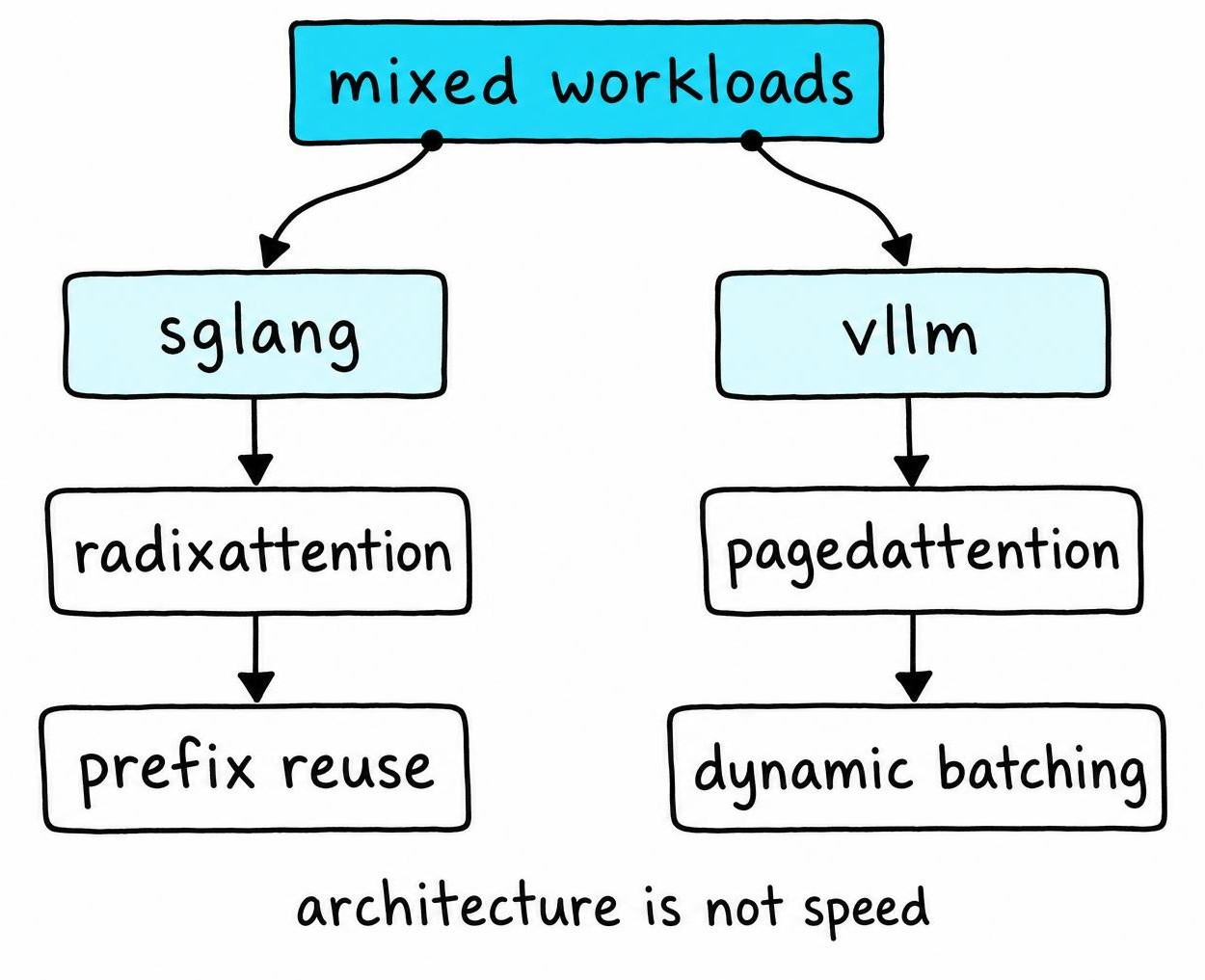
Both engines support chunked prefill and CUDA Graphs for decode acceleration. vLLM's speculative decoding covers more model families; SGLang supports speculative decoding for a narrower set but couples it with its radix cache so draft tokens benefit from prefix reuse. In mixed workloads, vLLM's page-based scheduler handles size variance more uniformly, while SGLang's tree-based scheduler rewards prompt clustering with lower aggregate prefill cost.
Model compatibility, Qwen support, GGUF, and serving APIs
vLLM supports more architectures out of the box - Llama, Mistral, Mixtral, Falcon, GPT-NeoX, StarCoder, and the full Qwen2/Qwen2.5 family including Qwen2-VL for multimodal. SGLang covers Llama, Mistral, Mixtral, and added Qwen2 support in 0.4.x, but multimodal Qwen variants require manual kernel integration. Both run AWQ, GPTQ, and FP8 quantization; vLLM additionally supports bitsandbytes and SqueezeLLM.
Neither engine loads GGUF files directly. GGUF is native to llama.cpp. Converting GGUF back to safetensors loses metadata and degrades quality if weights were quantized at creation time. Start from original unquantized weights and apply the target engine's own quantization.
Both expose an OpenAI-compatible API covering /v1/chat/completions, /v1/completions, and SSE streaming. vLLM adds /v1/embeddings for encoder models and ships token-based auth middleware. SGLang supports tool calling and structured JSON output natively; vLLM routes tool calling through Outlines. Model-specific fused attention kernels (like vLLM's Flashinfer path for GQA architectures) can shift throughput rankings on the same weights, so benchmark your exact model.
Open-source licensing, deployment, and production operations
SGLang is open source under Apache 2.0, hosted at sgl-project/sglang. vLLM ships under the same license. Both permit commercial use - but model weights carry their own licenses (Llama 3.1's community license, Qwen2's Apache 2.0), so verify those separately.
vLLM has the smoother deployment path: official Docker images, Helm charts, Ray-based tensor-parallel launcher, liveness/readiness probes, Prometheus /metrics, and structured JSON logs. SGLang provides Docker images and multi-GPU launch scripts, but Helm charts and health probes remain community-maintained. A pod restart cold-starts SGLang's in-process radix cache.
vLLM releases biweekly point releases; SGLang ships less frequently. Both carry regression risk on version bumps - pin your container digest. For admission control, vLLM exposes --max-num-seqs; SGLang supports --max-running-reqs but lacks built-in rate limiting. Autoscaling works best with GPU-utilization and queue-depth signals exported to Prometheus/KEDA.
Choosing SGLang or vLLM for RAG, agents, and scale
| Decision criterion | SGLang | vLLM |
|---|---|---|
| Throughput (high concurrency) | Higher output tokens/s | Lower at prefix-heavy loads |
| Time to first token (single) | Comparable | Slight edge |
| Structured generation | Fused, low overhead | Outlines-based, higher overhead |
| Shared-prefix caching | Automatic (RadixAttention) | Opt-in flag required |
| Memory efficiency | Tighter reuse at long context | Conservative page allocation |
| Model coverage | Narrower | Broader, including multimodal |
| OpenAI-compatible API | Chat, completions, tool calling | Chat, completions, embeddings |
| Deployment effort | Community Helm, manual probes | Official Helm, Prometheus, Ray |
| Ecosystem maturity | Smaller contributor base | Larger, biweekly releases |
RAG with repeated prefixes - Deploy SGLang. RadixAttention eliminates redundant prefill for retrieval preambles shared across queries.
Tool-using agents needing structured JSON - Deploy SGLang. Fused constrained decoding keeps multi-step latency low, and the radix cache preserves tool-calling prefixes across chained calls.
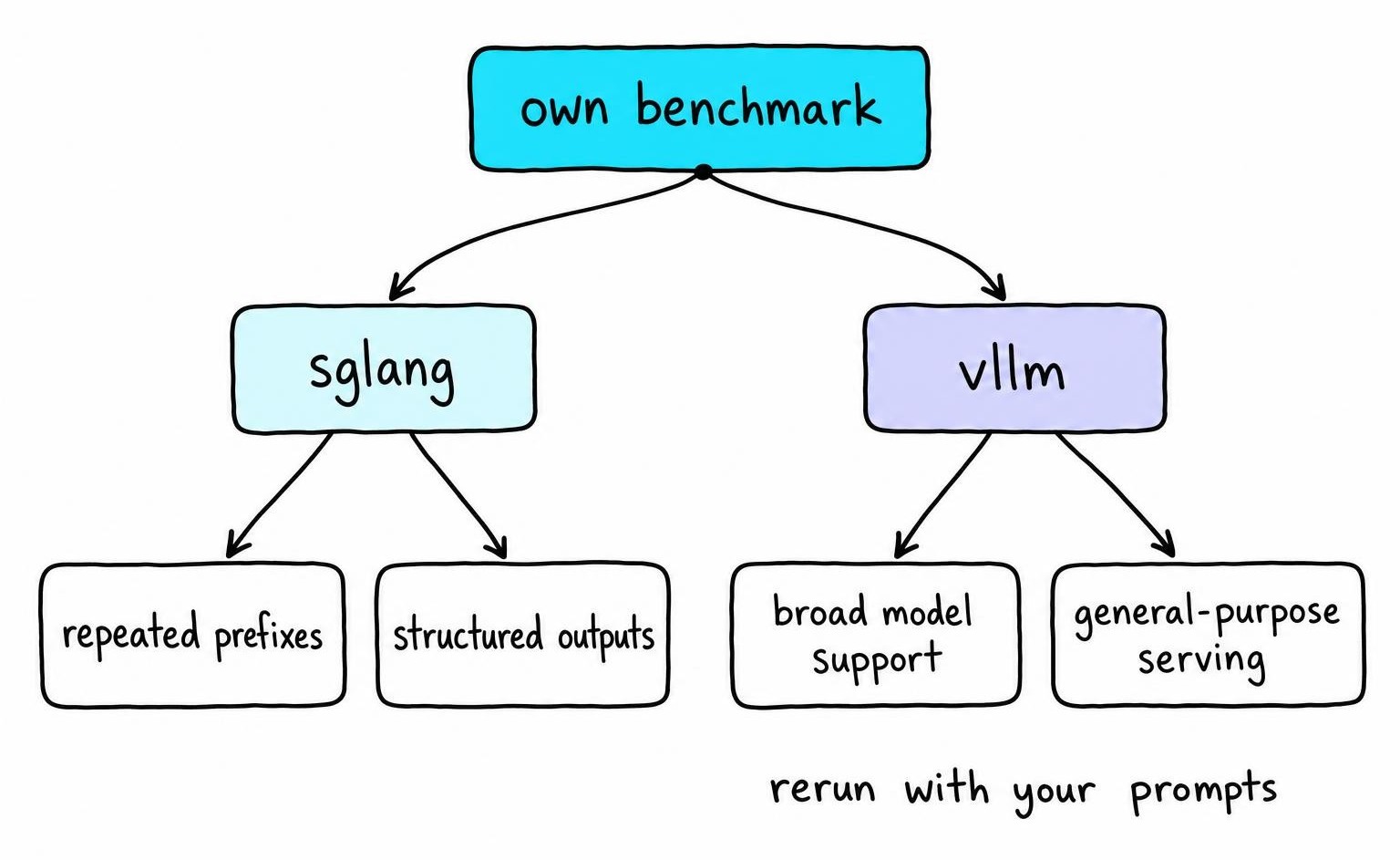
High-volume, mixed-model OpenAI-compatible serving - Deploy vLLM. Broader architecture support, production Kubernetes tooling, and LoRA hot-swapping reduce operational overhead across multiple models behind one gateway.
Before committing, replay the benchmark suite using your actual prompts, target GPU, and SLO thresholds - swap in your production schema and set arrival rate to your measured p95 traffic.
When TensorRT-LLM or llama.cpp is the better fit
TensorRT-LLM compiles models into fused NVIDIA kernels that squeeze every cycle out of A100/H100 hardware. It outperforms both SGLang and vLLM on raw decode throughput for supported architectures - but the compilation step locks you into specific model-format exports and longer build-deploy cycles. Choose it when you control the hardware fleet, run a single model family at scale, and can absorb integration cost.
llama.cpp serves the opposite end. It runs GGUF models on CPU, Apple Silicon, and commodity GPUs with no CUDA dependency. For local development or edge deployment without datacenter GPUs, llama.cpp is the only practical option.
Switch triggers:
- No NVIDIA GPU - llama.cpp.
- Single architecture at >100 req/s on H100s - evaluate TensorRT-LLM.
- Need GGUF weights without reconversion - llama.cpp loads them natively.
- Rapid model iteration across architectures - stay on vLLM or SGLang; TensorRT-LLM's recompilation cost per model change runs hours.
FAQ
What is SGLang vs vLLM?
SGLang and vLLM are open-source LLM inference engines for serving pretrained models. SGLang uses RadixAttention for automatic prefix caching and fused structured generation. vLLM uses PagedAttention for memory-efficient KV cache management and supports a broader set of model architectures with more mature deployment tooling.
Is SGLang faster than vLLM?
SGLang produces higher output tokens per second at high concurrency with shared-prefix workloads, and its fused structured generation adds less overhead than vLLM's Outlines-based approach. vLLM holds a slight edge on single-request TTFT. The faster engine depends on concurrency, prefix reuse, and whether you need constrained decoding.
Can SGLang run GGUF?
No. SGLang expects Hugging Face safetensors or PyTorch checkpoints. GGUF is native to llama.cpp. Converting GGUF back to safetensors degrades quality if weights were quantized at creation. Start from original unquantized weights instead.
Is SGLang open source?
Yes. SGLang uses the Apache 2.0 license, hosted at sgl-project/sglang on GitHub. Apache 2.0 permits commercial use, modification, and redistribution. Model weights served through SGLang carry their own separate licenses.
References
- Structured Information for Improving Spatial Relationships in Text-to-Image Generation - Sander Schildermans, Chang Tian, Ying Jiao et al. (2025)