Flash Attention vs Sage Attention: Kernel Comparison
Swarnava Dutta11 min read
Flash Attention Alternative
Contents
Chasing a benchmark number from a GitHub discussion thread is how most attention-kernel swaps start, and on a video-generation fine-tune the swap can look safe on paper - same architecture, same GPU family - while throughput barely moves and precision on long sequences gets noticeably worse. The flash attention vs sage attention debate isn't about picking a winner; it's about knowing which bottleneck you're actually fighting.
Both kernels attack the same problem: the quadratic memory and compute cost of standard attention. But they attack it differently, and that difference determines whether swapping one for the other helps your workload or introduces a new failure mode you haven't debugged yet.
FlashAttention rewrites the memory access pattern to avoid ever materializing the full attention matrix. SageAttention takes a different bet, using quantization to cut compute at the cost of some numerical fidelity. Neither is universally "faster" - it depends on your GPU, your sequence lengths, whether you're training or serving, and how much precision loss your model can absorb.
This guide breaks down what each kernel actually changes under the hood, what the benchmarks really show once you control variables, and when a kernel swap is worth the risk to a working pipeline.
Quick answer
FlashAttention is an exact, full-precision attention kernel for both training and inference on Ampere and newer GPUs, while SageAttention quantizes queries and keys to INT8 or FP8 for higher tensor-core throughput. FlashAttention tiling keeps the full attention matrix out of slow memory; SageAttention adds quantization error. When attention is 15% of forward-pass time, a 2x kernel speedup cuts total wall-clock time by roughly 7%.
FlashAttention vs SageAttention at a glance
Before the deep dive, here's the shape of the trade-off:
| Dimension | FlashAttention | SageAttention |
|---|---|---|
| Algorithm | Tiled, IO-aware exact attention | Quantized attention (INT8/FP8 paths) |
| Precision strategy | Full precision (FP16/BF16 compute) | Reduced precision with error compensation |
| Speed potential | Strong, especially at long sequences | Can be faster on supported ops, workload-dependent |
| Memory use | Low - avoids materializing full attention matrix | Low, plus reduced bandwidth from quantized tensors |
| Training support | Mature, widely integrated | Limited, less battle-tested |
| Inference support | Strong | Strong, especially generation workloads |
| GPU requirements | Ampere and newer, best on Hopper | Newer architectures with quantization support |
| OS support | Linux-first, Windows workable | Linux-first, Windows rougher |
| Maturity | Production-proven across frameworks | Younger, faster-moving |
Neither kernel wins outright. Results swing with GPU architecture, tensor shapes, sequence length, the attention pattern (causal versus bidirectional), and even minor version bumps in your CUDA toolkit.
My rule of thumb: reach for FlashAttention when you need a mature, drop-in kernel for training, and treat SageAttention as a targeted upgrade for inference or generation workloads where a quantized approach has actually been benchmarked on your hardware - not assumed.
What FlashAttention and SageAttention actually change
Neither kernel changes what attention computes in a theoretical sense - the softmax-weighted sum over queries, keys, and values stays the same. What changes is execution: how the GPU moves data and which arithmetic precision it uses to get there.
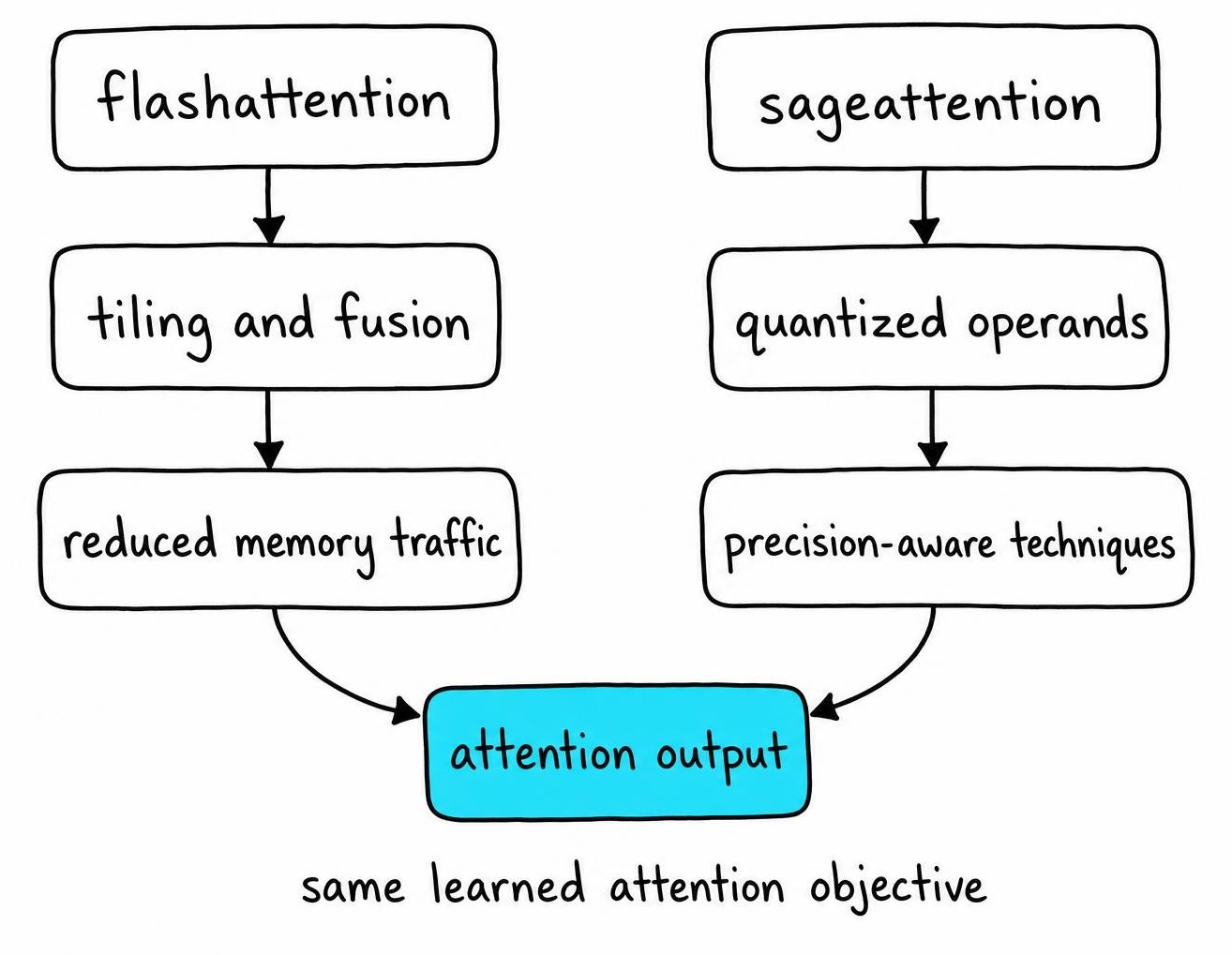
FlashAttention aims for IO-aware, numerically equivalent computation - same result, far less memory traffic [1]. SageAttention takes the quantized route, accepting small precision losses in exchange for higher tensor-core throughput. Implementation details shift across versions of both, so don't assume the behavior you read about last year still holds today.
How FlashAttention reduces memory traffic
FlashAttention never materializes the full attention matrix in high-bandwidth memory. Instead, it tiles queries, keys, and values into blocks that fit in fast on-chip SRAM, computing partial attention scores block by block and updating results with an online softmax that avoids a separate normalization pass. Kernel fusion keeps intermediate results local to the GPU core, and recomputation during the backward pass trades a bit of extra compute for a much smaller memory footprint.
That's the core reason FlashAttention memory usage stays flat as sequence length grows, rather than scaling quadratically. Generations differ meaningfully - later versions restructure work partitioning and parallelism - so compare specific version numbers, not just the name.
How SageAttention uses quantization for more throughput
SageAttention quantizes attention operands - typically queries and keys - into INT8 or FP8 representations before the matrix multiply, then applies precision-aware scaling to limit error accumulation. Lower-precision arithmetic lets tensor cores push more operations per cycle than tiling alone achieves. Supported data types and fallback paths vary by release, so check your target GPU's compatibility before assuming a given precision mode works out of the box.
Attention kernel benchmarks: speed and memory use
Vendor and repo benchmarks for both kernels get quoted constantly, but each number comes from one workload, one GPU, one sequence length. Change any of those and the ranking can flip.
Real comparisons need more than a raw microbenchmark of the attention op in isolation. Track latency percentiles, tokens per second, peak VRAM, and end-to-end runtime, because attention is only part of your forward pass. As a worked example: assume attention accounts for 15% of total forward-pass time in a given model - even a 2x kernel-level speedup on that slice only cuts total wall-clock time by roughly 7%, arithmetically, since the rest of the pipeline stays fixed.
A handful of variables swing rankings hard:
- Sequence length and batch size determine whether tiling or quantized throughput dominates, and how well quantization amortizes its overhead
- Causal masking versus bidirectional attention changes which blocks get skipped, while grouped-query attention reshapes the KV tensor SageAttention quantizes
- Diffusion and video shapes (large spatial dims, small batch) behave nothing like LLM decode shapes, and graph-compilation overhead can dwarf the kernel gap entirely
Treat any published speedup as a data point about that specific workload, not a promise about yours.
A reproducible benchmark checklist
Hold everything constant except the kernel - same model, inputs, dtype, GPU clocks, CUDA/driver stack, and output length - then run several warm-up iterations, synchronize the GPU explicitly, and repeat enough times to report p50/p95 latency and peak allocated memory, not just an average. Confirm the backend you requested is the one that actually ran, since frameworks fall back silently and you'll otherwise benchmark the wrong kernel without realizing it.
Numerical precision and output quality trade-offs
FlashAttention's error comes purely from floating-point rounding - reordering additions and softmax normalization steps. It's exact to the precision of the arithmetic you already chose, FP16 or BF16, nothing extra.
SageAttention stacks quantization error on top of that math. Casting queries and keys to INT8 or FP8 introduces a discretization step FlashAttention never touches, and while scaling schemes try to bound it, the error doesn't vanish - it just gets managed. This is the crux of any flash attention vs sage attention decision: you're choosing between exact-but-slower and approximate-but-faster.
Whether that matters depends entirely on your workload. A chatbot generating open-ended text might never show a visible difference; a retrieval system scoring near-duplicate candidates, or a video model needing frame-to-frame consistency, can amplify tiny logit shifts into a visibly wrong output.
Match validation to what you're shipping instead of trusting task-level "it looks fine":
- LLM inference: logit or hidden-state error, plus perplexity delta
- Classification or retrieval: task accuracy against a held-out set
- Image and video generation: similarity metrics and seed-matched visual inspection for temporal consistency
None of these guarantee bit-identical outputs from a faster kernel - that's a determinism bar, separate from quality, and conflating the two is how a quiet regression turns into a surprise three weeks later.
GPU support, CUDA requirements, and Windows installation
GPU support shifts faster than most model release cycles, so treat any matrix as a snapshot, not gospel - check the current SageAttention and FlashAttention repository documentation for the exact supported compute capabilities and data types before committing.
| GPU architecture | FlashAttention | Native Windows | WSL2 |
|---|---|---|---|
| Ampere (A100, 3090) | Supported | Workable, source build common | Solid |
| Ada (4090) | Supported | Common failure point | Recommended |
| Hopper (H100) | Generally strongest per vendor documentation [2] | Rare setup | Recommended |
| Pre-Ampere | Unsupported | N/A | N/A |
SageAttention's supported architectures and precision paths (INT8, FP8) vary by release far more than FlashAttention's do, so its speed claim lives or dies on whether your specific GPU exposes the low-precision tensor-core path that release targets.
Installation failures cluster around a few repeat offenders: mismatched CUDA toolkit versus PyTorch build, missing prebuilt wheels forcing a source compile, an unsupported compute capability, or a missing C++ compiler toolchain. Building an attention kernel from source on a Windows box with a mismatched CUDA toolkit fails halfway through with an obscure compiler error, and the cause is usually a PyTorch wheel compiled against a different CUDA minor version than the toolkit on PATH. WSL2 removes that whole class of failure in minutes; if you've fought vLLM for Windows setups, this will feel familiar - same category of pain, different kernel.
How to verify installation instead of trusting a successful import
A clean import proves nothing. Log the backend PyTorch's scaled-dot-product-attention dispatcher actually selects, check installed package versions against what your GPU requires, and run a profiler trace to confirm the kernel name appearing in the timeline matches what you intended.
That's exactly how a silent fallback surfaces: the profiler timeline shows a generic CUDA attention kernel running instead of the one just installed, even though the import succeeded without a single warning. Before a full run, do a quick correctness-and-timing smoke test on a small batch - silent fallback is the single most common reason people report "no speedup" after installing a faster kernel.
FlashAttention for training and inference: where SageAttention fits
FlashAttention earned its spot in nearly every serious training stack because it does both jobs well: a forward pass for inference, and a matching backward pass for training, when your framework, model shape, and GPU line up.
That backward pass is the part people forget to check. Training needs gradient computation through the attention operation, activation memory management across the whole graph, dropout applied consistently between forward and backward, and compatibility with distributed strategies like tensor or pipeline parallelism. A kernel that only optimizes the forward path solves half the problem.
SageAttention's maturity varies release to release - some versions target inference-only forward passes, others add broader support. Don't assume a fast forward kernel is training-ready; check the specific release's stated backward support before wiring it into a fine-tuning run.
Inference itself splits further. Prefill processes a full sequence at once, so tiling and quantization both have real work to speed up. Autoregressive decode processes one token at a time against a growing KV cache, and that's frequently bottlenecked by KV cache reads rather than the attention math itself - a faster kernel there can be nearly invisible in wall-clock terms.
When switching kernels is - and is not - worthwhile
Profile before you touch anything. If attention is a small fraction of your forward pass, even a large kernel-level speedup barely moves wall-clock time, and switching costs more than the install command suggests: a new pinned dependency, rebuilt CI images, regression tests to catch silent fallback, and a maintained fallback path for when the fancy kernel misbehaves on a new driver.
Often the easier win is staying inside your framework. PyTorch's scaled-dot-product-attention dispatcher, cuDNN's attention backend, or xFormers already pick a fast, well-tested kernel for common shapes without you touching a new codebase. Specialized inference engines bundle attention optimization alongside batching and caching, which usually beats a manual kernel swap.
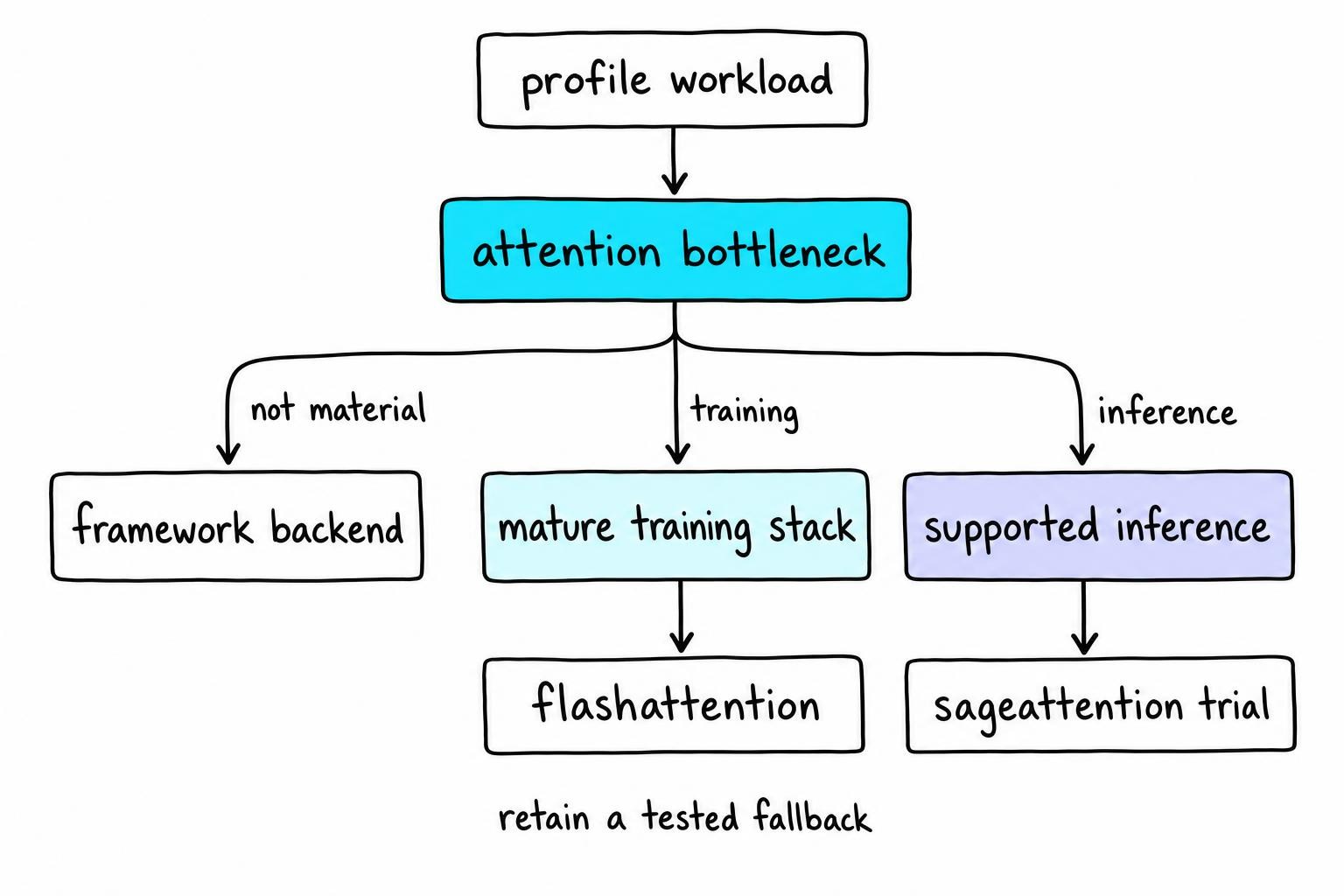
Decision matrix by GPU and workload
| Workload | Recommended kernel | Precondition |
|---|---|---|
| Mature training on Ampere/Hopper | FlashAttention or framework's selected backend | Confirmed by profiling, not assumed |
| Long-context, diffusion, image, or video inference on supported newer GPUs | SageAttention trial | Only after profiling shows attention dominates runtime |
| Short contexts, CPU-bound pipelines, unsupported GPUs, unstable builds, or strict reproducibility needs | Neither - keep current backend | Benchmark your actual production model, not a headline claim |
FAQ
What is Flash Attention?
FlashAttention is an exact attention algorithm that reorganizes computation into tiled blocks so the GPU never has to write the full attention matrix to slow memory. It uses an online softmax to compute results incrementally, which cuts memory traffic and lets you run longer sequences without running out of VRAM. The math stays exact - you're not trading accuracy for speed, just changing how the GPU moves data.
What is SageAttention, and how does it differ from FlashAttention?
SageAttention quantizes queries and keys to INT8 or FP8 before the matrix multiply, trading some numerical precision for higher tensor-core throughput. FlashAttention stays in full precision and saves memory through tiling; SageAttention saves compute through reduced precision. That difference means SageAttention can be faster on supported hardware but introduces quantization error FlashAttention simply doesn't have.
Is FlashAttention faster?
Not universally - it depends on GPU architecture, sequence length, and whether attention actually dominates your runtime. On short sequences or non-attention-bound pipelines, the speedup barely registers, so always profile your actual workload before trusting a headline benchmark.
Is FlashAttention for inference or training?
Both. It supports a full backward pass, which makes it usable for training as well as inference, unlike some SageAttention releases that lean inference-only. Check your framework's specific version for backward-pass support before assuming full training compatibility.
Which attention kernel should you choose for your GPU and workload?
For mature training stacks on Ampere or Hopper GPUs, default to FlashAttention or your framework's built-in dispatcher. For inference-heavy, long-context, or generation workloads on newer GPUs, benchmark SageAttention against your specific model before switching, and keep a tested fallback ready either way.
References
- FlashAttention: Fast and Memory-Efficient Exact Attention with IO-Awareness - Tri Dao, Daniel Y. Fu, Stefano Ermon et al. (2022)
- A Case Study in CUDA Kernel Fusion: Implementing FlashAttention-2 on NVIDIA Hopper Architecture using the CUTLASS Library - Ganesh Bikshandi, Jay Shah (2023)