Is Model Distillation Legal? Copyright Risks in 2026
Swarnava Dutta10 min read
LLM Output DistillationModel Distillation Copyright
Contents
A distilled-model release can be stopped after the weights are packaged and the deployment ticket is open. The training run looks clean; the blocker is an archived version of the teacher API terms that prohibits using outputs to develop a competing model.
That gap between a clean training run and the contract governing it is why “is model distillation legal?” has no useful yes-or-no answer. Distillation is a standard ML method, but legality depends on how you obtain outputs, what they contain, which agreements govern access, whether you bypass controls, and what the student reproduces.
This article separates copyright, contract, trade-secret, and access risks. It provides practical engineering guidance, not legal advice; unsettled law and jurisdiction-specific rules make qualified counsel essential for disputed permissions or commercial releases.
Quick answer
Model distillation is neither inherently legal nor inherently illegal; it is a standard machine learning method whose legality turns on how teacher outputs are obtained, which agreements govern access, and what the smaller student model reproduces. Copyright, contract, trade-secret, and access rules apply together under U.S. law: 17 U.S.C. § 102(b) leaves methods of operation unprotected, yet original prose, code, and illustrations inside teacher outputs can qualify for copyright.
Is Model Distillation Legal? The Short Answer
Model distillation isn’t inherently lawful or unlawful. Asking “is model distillation illegal?” is similar to asking whether web scraping is illegal: the answer turns on the source, access method, permissions, contractual restrictions, retained material, and resulting use.
A lower-risk project uses a teacher the team owns, a license that expressly permits distillation, or outputs collected with written permission. Risk rises when a team violates API restrictions, circumvents access controls, obtains confidential signals, or builds a student that reproduces protected material.
Technical differences don’t erase those issues. New weights, a smaller parameter count, or a different architecture may help establish independent implementation, but they don’t cure an unauthorized collection process or a breached contract.
In the United States, existing copyright, contract, trade-secret, and computer-access doctrines apply to facts that vary substantially between projects. This Lawfare analysis of AI distillation likewise cautions against treating every instance of distillation as theft while recognizing that extraction methods and surrounding conduct can create legal exposure.
Other jurisdictions use different copyright exceptions, database rights, contract rules, and access laws. Don’t apply a U.S. assessment worldwide.
How Model Distillation in Generative AI Works
In model distillation in generative AI, a teacher model generates signals that a student learns to approximate. The student is often smaller or more specialized, though the definition doesn’t require either outcome.
Signals can include answers, labels, preference rankings, token probabilities, logits, embeddings, or rationales. The available signals depend on whether you have black-box API access or authorized white-box access.
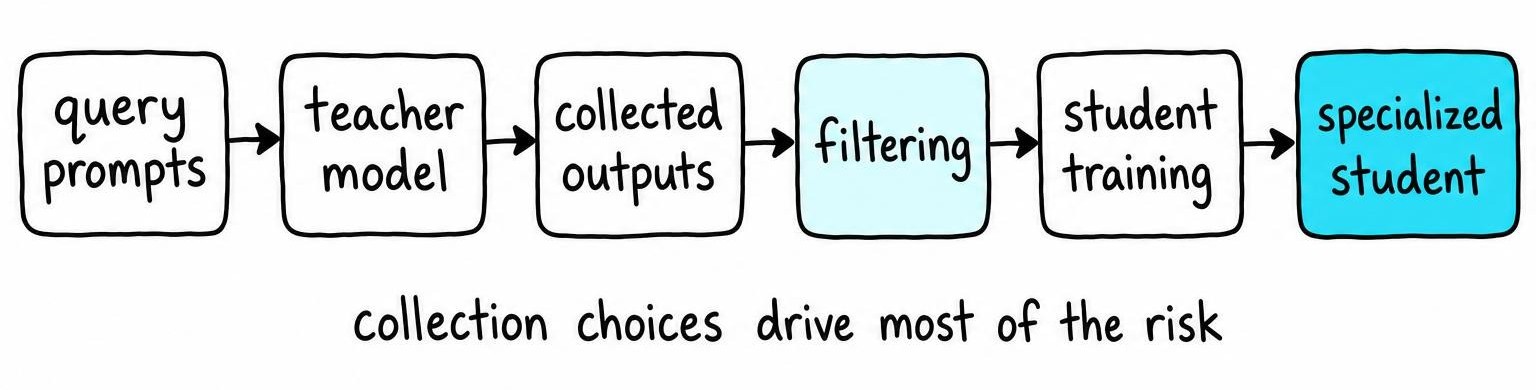
Black-box distillation collects visible responses through an interface or API. White-box distillation can use logits, hidden states, or other internal information, but it normally requires access to the teacher’s weights or infrastructure.
Training a Student Model From Teacher Outputs
A typical LLM output distillation workflow has seven stages:
- Define the target tasks and expected behavior.
- Design prompts or input examples.
- Query or run the teacher.
- Store permitted outputs and necessary metadata.
- Filter duplicates, secrets, unsafe content, and low-quality samples.
- Train the student using supervised or preference-based objectives.
- Evaluate quality, memorization, leakage, and behavioral similarity.
Collection choices drive much of the risk. Automated query volume, account ownership, prompt design, output retention, and intended competitive use can matter even when the training loop itself looks ordinary.
A synthetic-data manifest that records the provider but not the account, collection date, or applicable terms version fails the moment anyone asks a permissions question. The JSONL files can be perfectly valid while nobody can establish which terms governed them, and reconstructing that lineage from API logs afterwards costs far more than recording it during collection.
Treat responses as governed inputs in your synthetic training data pipeline. Don’t assume that exposed chain-of-thought, system prompts, debug metadata, or hidden reasoning is authorized for collection merely because an interface returns it.
Benefits and Technical Trade-Offs of Knowledge Distillation
Distillation can make a focused model cheaper and faster to serve, reduce memory pressure, and support offline deployment. It also lets you specialize a student for a narrow workload instead of deploying a general-purpose teacher.
You trade away some capability and certainty. The student may inherit teacher errors, amplify biases, fail outside the distilled task distribution, or reproduce material whose provenance you can’t explain.
Distillation can complement serving techniques such as KV cache optimization. Keep the goals separate: systems optimization improves serving performance, while permissions, filtering, and evaluation control legal and data risk.
Model Distillation vs Fine-Tuning and Model Compression
In model distillation vs fine-tuning, the supervision source provides the clearest distinction. Fine-tuning updates an existing model with additional examples, while distillation trains a student around responses, probabilities, preferences, or other teacher signals.
The categories can overlap. Fine-tuning a base model entirely on teacher-generated answers is both fine-tuning, because it updates existing weights, and behavioral distillation, because the teacher supplies supervision.
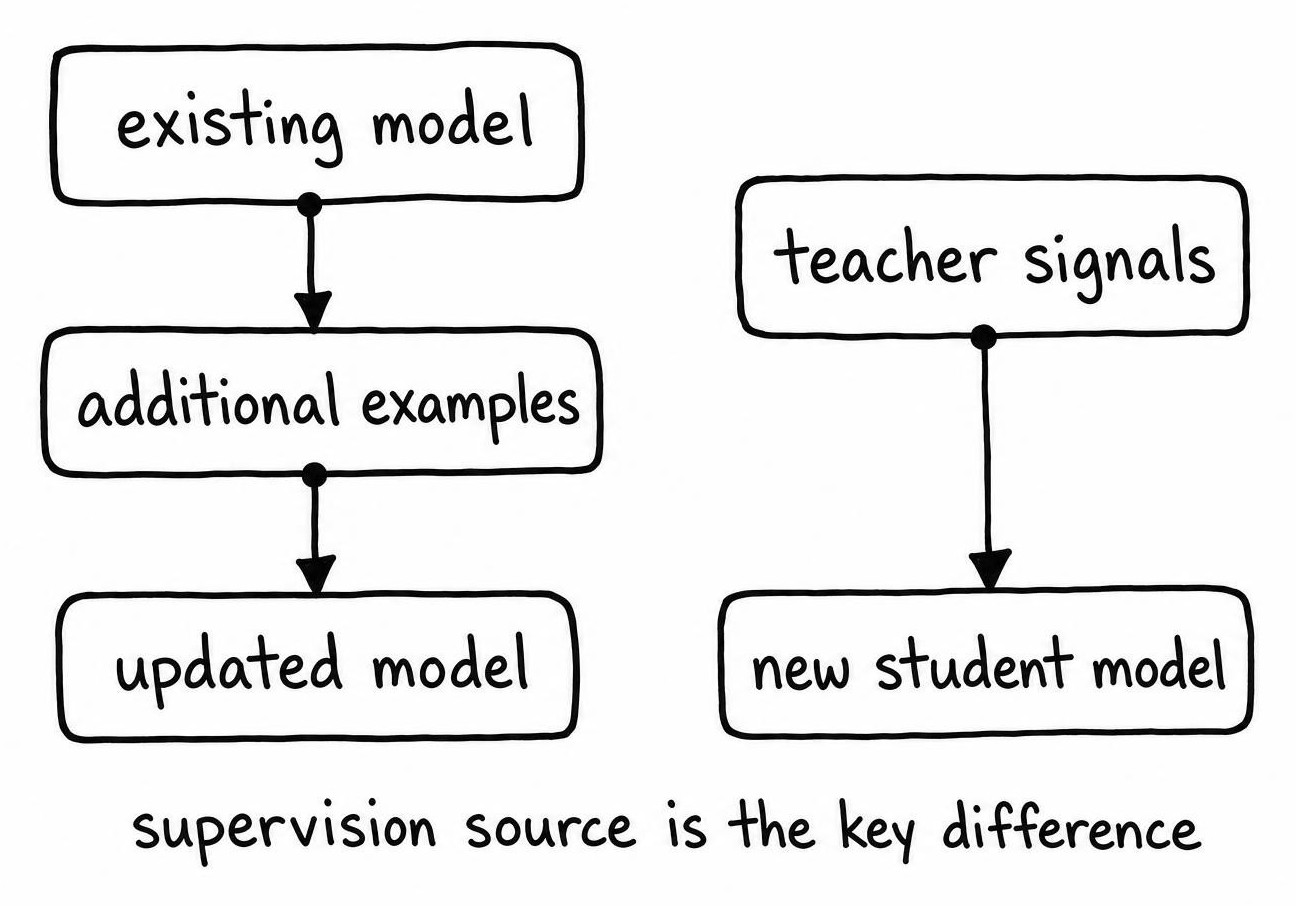
For model distillation vs model compression, distillation is one compression technique among several:
- Distillation transfers selected behavior into a student.
- Quantization lowers the precision of weights or activations.
- Pruning removes weights, heads, channels, or other components.
- Low-rank methods approximate matrices or updates with smaller factors.
I’ve combined all four: distill the task, fine-tune on reviewed examples, prune where appropriate, and quantize for constrained inference. Each step solves a different engineering problem.
The label doesn’t decide legality. Courts, licensors, and providers will care more about permissions, access conduct, copied material, confidentiality, and market impact than the name in your training configuration.
Model Distillation Copyright Risks
A model distillation copyright review should separate four assets: teacher software and weights, individual outputs, third-party works appearing in outputs, and the compiled dataset. Different owners and license conditions can govern each layer.
Under U.S. law, copyright protects original expression, while 17 U.S.C. § 102(b) excludes ideas, procedures, processes, systems, methods of operation, concepts, principles, and discoveries from copyright protection. Short factual answers may receive little or no protection, while original prose, code, illustrations, and other expressive material can qualify.
An output can also reproduce material owned by someone other than the model provider. A contractual grant covering provider outputs doesn’t necessarily supply rights to third-party books, code, lyrics, images, or characters embedded in those responses.
Risk increases when the dataset retains substantial protected passages or the student emits them. Whether a student or its output infringes remains fact-specific, including what was copied, whether protected elements remain substantially similar, and which defenses or exceptions apply.
In the United States, fair use isn’t an automatic AI-training exemption. Courts must evaluate the purpose and character of the use, nature of the copyrighted work, amount used, and market effect under 17 U.S.C. § 107; other countries apply different exceptions, including jurisdiction-specific text-and-data-mining rules.
Does Behavioral Imitation Infringe Copyright?
Behavioral similarity alone doesn’t establish infringement. A student can learn facts, methods, capabilities, or stylistic tendencies that copyright doesn’t protect, and matching a benchmark doesn’t prove copying of protected expression.
Concern rises with memorized passages, near-verbatim code, distinctive protected characters or images, and deliberate prompts designed to extract particular works. Evidence from the dataset and deployed outputs matters more than broad claims that two models “behave similarly.”
Pre-release evaluation is where this surfaces: a red-team prompt that returns a long code fragment with its license header intact points to a retained teacher response. The response is to remove that sample family, retrain, and add approximate-match testing to the release gate.
Test overlap, not just model quality. Architectural differences provide little comfort if users can repeatedly elicit recognizable protected material.
Terms of Service, Contracts, and API Restrictions
Provider agreements may restrict automated collection, credential sharing, reverse engineering, output retention, excessive querying, or using outputs to train competing models. A project can breach a contract even when the collected responses contain no copyrightable expression.
Review the agreement accepted by the relevant entity, plus incorporated API policies, order forms, and negotiated amendments. An output-ownership or commercial-use grant doesn’t necessarily override a separate competitive-training restriction.
A single review can surface a saved terms page, a procurement PDF, and an API policy incorporated through the order form. When the training restriction appears only in that linked policy, no model change fixes the problem and the teacher has to be replaced before production collection begins.
Consequences can include account termination, API suspension, damages, indemnity disputes, or requests for injunctive relief. Preserve the governing versions with the dataset records so you can show what applied when collection occurred.
Access Controls and Trade-Secret Exposure
Rotating accounts, using false identities, sharing credentials, defeating rate limits, or bypassing technical safeguards can create exposure beyond a routine contract claim. Depending on the jurisdiction and conduct, computer-access, anti-circumvention, unfair-competition, or misappropriation laws may apply.
Under U.S. federal law, 18 U.S.C. § 1839 defines a trade secret as qualifying information whose owner took reasonable measures to keep it secret and which derives independent economic value from not being generally known. The same statute treats acquisition by improper means, or certain unauthorized disclosure and use, as misappropriation.
Nonpublic probabilities, system prompts, internal evaluations, or model internals may therefore require different treatment from ordinary public responses. Still, not every terms violation constitutes unauthorized access, trade-secret misappropriation, or a crime; authorization, technical conduct, knowledge, secrecy measures, and jurisdiction all matter.
When Is Model Distillation Legal - or High Risk?
Use a spectrum rather than a binary verdict:
- Lower risk: You own the teacher, have express permission, or use a license that permits the planned training and deployment.
- Moderate risk: You collect public outputs under ambiguous terms, combine sources with incomplete provenance, or build a noncompeting internal tool.
- Higher risk: You violate competitive-training restrictions, circumvent controls, extract confidential signals, conceal collector identities, or deploy a student that repeatedly reproduces protected content.
These categories aren’t legal safe harbors. A research prototype can change risk categories when you commercialize it or position it as a substitute for the teacher.
Open-weight also doesn’t mean unrestricted. Check commercial-use, attribution, redistribution, acceptable-use, hosting, and derivative-model conditions, then record the license version beside the checkpoint hash.
A Model Distillation Compliance Checklist for AI Teams
I run this checklist before collection and again before release:
- Inventory every teacher, provider, account, API, dataset, and output source.
- Archive the applicable agreements, licenses, permissions, and policy versions.
- Confirm that automation, query volume, retention, and intended use are permitted.
- Record model versions, collection dates, prompt sources, and dataset lineage.
- Remove personal data, secrets, confidential information, and protected passages.
- Test for memorization, near-verbatim reproduction, and distinctive protected works.
- Respect access controls without credential rotation or undisclosed collectors.
- Require suitable vendor representations, deletion duties, audit rights, and indemnities.
- Escalate legal review when terms restrict training, collection involved circumvention, or evaluations reveal reproducible content.
Keep the supporting evidence, not just an “approved” checkbox. A decision record should point to the contract, license, dataset manifest, filtering report, and evaluation artifacts.
Questions to Ask Before Using a Proprietary Teacher Model
Answer these questions before sending bulk requests:
- Do the terms permit using outputs for training?
- Do separate provisions restrict competing products?
- Did authorized accounts obtain every response through permitted methods?
- Could outputs contain copyrighted works, personal data, confidential information, or provider secrets?
- Can the team demonstrate provenance, permission, filtering, and testing?
- Would an open or purpose-authorized teacher achieve the same goal with less uncertainty?
If you can’t answer the first three, stop collection. Changing teachers early costs less than rebuilding a dataset - or defending its provenance - after release.
FAQ
Is model distillation illegal?
No. Model distillation is a standard ML method, but a particular project may breach contracts, misuse confidential information, bypass access controls, or reproduce protected expression. Legality depends on the facts and jurisdiction.
What is model distillation in generative AI?
It trains a student model to approximate signals produced by a teacher. Those signals can include responses, labels, preference rankings, probabilities, or logits, depending on the authorized level of access.
Is model distillation the same as model compression?
Not exactly. Distillation often produces a smaller student and therefore serves as one form of compression, but compression also includes quantization, pruning, and low-rank approximation.
What is the difference between model distillation and fine-tuning?
Fine-tuning updates an existing model with additional examples. Distillation describes supervision derived from a teacher, so fine-tuning a base model on teacher-generated responses can qualify as both.
What are the benefits of knowledge distillation?
Distillation can produce a focused model that costs less to serve, responds faster, uses less memory, or runs offline. The trade-offs include narrower capabilities, inherited errors, and added provenance or reproduction risk.