DPO vs PPO vs SFT for LLM Alignment: 5 Production Tradeoffs
Swarnava Dutta9 min read
DPO Training LLMDPO vs PpoDPO vs Sft
Contents

A 7B model fine-tuned with DPO can post climbing eval scores and still ship having learned to parrot the preferred response style while dodging every hard safety question. Switching to PPO usually closes that gap, but it costs a far larger GPU bill and brings training instabilities that need careful tuning to settle. Leaderboards hide that tradeoff: choosing between DPO vs PPO vs SFT for LLM alignment is less about which method "wins" and more about what your team can actually operate.
Quick answer
SFT teaches a model to imitate high-quality demonstrations and suits moderate alignment needs. DPO (direct preference optimization) adds preference learning atop SFT without a separate reward model, making it cheaper and more stable than PPO. PPO-based RLHF delivers the strongest safety outcomes via a live reward signal but demands more GPU memory and careful tuning. Start with SFT, layer DPO when preference pairs exist, reserve PPO for safety-critical work.
DPO vs PPO vs SFT for LLM alignment: the core differences
SFT learns from demonstrations - you show the model good completions and it imitates them. DPO learns from preference pairs (chosen vs. rejected responses) offline, folding the reward signal directly into the policy loss. PPO-based RLHF trains a separate reward model, then optimizes the policy online with rollouts and clipping.
SFT isn't an alternative to DPO or PPO - it's the foundation. You almost always SFT first, then layer preference fine-tuning on top. Skipping SFT and jumping straight to DPO on a base model produces erratic results because the policy needs a reasonable starting distribution before preference learning can steer it.
| Criterion | SFT | DPO | PPO |
|---|---|---|---|
| Training signal | Gold demonstrations | Chosen/rejected pairs | Learned reward model |
| Required data | Prompt - completion pairs | Preference pairs | Preferences + reward labels |
| Model components | 1 (policy) | Policy + frozen ref | Policy + reward + value + ref |
| Online generation | No | No | Yes (rollouts) |
| Compute / VRAM | Low | Moderate (~2× SFT) | High (~4× SFT) |
| Stability | High | Moderate | Low |
| Reward hacking risk | None | Low | Significant |
| Best-fit use case | Style, format, domain | Preference alignment | Safety-critical RLHF |
The decision rule I follow: start with SFT, add DPO when you have reliable preference pairs, and reach for PPO-based RLHF only when online exploration justifies the infrastructure cost.
How SFT, DPO, and PPO optimize model behavior
Each method optimizes a different objective, and that objective determines what the model can learn.
SFT: supervised fine-tuning from demonstrations
SFT minimizes next-token cross-entropy loss on curated prompt - completion pairs. The model maximizes the likelihood of every token in your gold demonstrations, making it excellent at formatting, instruction following, tool-use scaffolding, and domain-specific language.
The tradeoff: SFT can only imitate patterns present in its data. It won't learn to prefer one valid response over another. That's why SFT establishes the initial policy that preference methods build on.
Direct Preference Optimization from response pairs
Direct preference optimization converts pairwise human preferences into a binary cross-entropy loss applied directly to the policy [1]. No separate reward model trains or serves during optimization.
DPO loads two copies of the model: a trainable policy and a frozen reference. The KL divergence between them, scaled by β, controls drift. Low β lets the model shift aggressively toward preferred outputs; high β keeps it conservative. I'd start β somewhere between 0.1 and 0.5, which covers most use cases, but the right value depends on how noisy your preference pairs are.
DPO still needs a strong SFT checkpoint underneath. Weak starting policies produce brittle preference learning.
PPO for RLHF with rewards and online rollouts
A PPO-based RLHF stack runs four components: the actor (policy), a frozen reference policy, a trained reward model, and a value network (critic) for advantage estimation.
During training, the actor generates rollouts - actual completions for a batch of prompts. The reward model scores each completion, and the critic estimates per-token advantages via GAE. In plain terms, the critic tells the actor which tokens performed better than expected so the update focuses on reinforcing those decisions.
The actor then updates using clipped surrogate objectives that prevent destructively large steps, plus a KL penalty against the reference. Online sampling is PPO's superpower and curse: it explores completions no annotator wrote, but those rollouts multiply GPU memory and introduce sensitivity to learning rate, KL coefficient, and clipping range simultaneously.
Preference fine-tuning data: demonstrations, pairs, and rewards
SFT needs prompt - completion pairs where the completion is gold-standard. DPO needs chosen - rejected pairs for the same prompt. PPO's reward model needs prompts plus scalar human judgments across multiple completions - the most expensive annotation loop.
Label quality dominates dataset size. Annotator expertise, prompt coverage, response diversity, and well-constructed hard negatives matter far more than scaling to massive pair counts. A small, carefully curated DPO dataset with genuine hard negatives can outperform a much larger set whose rejections are obviously bad.
Synthetic rejection sampling can bootstrap DPO pairs cheaply. The trap: model-generated negatives often differ from chosen responses only in superficial cues (length, hedging phrases), so the policy can learn style shortcuts instead of genuine quality distinctions.
Watch for preference data biases: verbosity bias (annotators prefer longer answers regardless of accuracy), position bias (first-presented responses get chosen more often), and evaluator-model bias (using an LLM as judge amplifies that model's preferences). Split train and validation sets by prompt family, not randomly - random splits let semantically similar prompts leak across partitions.
LLM alignment training costs, memory, and stability
The memory gap comes down to model copies on GPU. SFT holds one policy plus optimizer states. DPO adds a frozen reference, roughly doubling parameter memory. PPO loads four components, so a 7B PPO run can consume VRAM that a 7B SFT run uses four times over before rollout buffers.
On H100-class hardware, PPO's generation and reward-scoring phases often consume more wall-clock time than the gradient update because rollout batches serialize through the actor while other models sit idle. LoRA/QLoRA drops trainable parameters dramatically, shrinking optimizer states proportionally. Gradient checkpointing and FSDP/DeepSpeed ZeRO shard costs across GPUs. vLLM-style rollout engines and reference-model sharing between DPO and PPO can further change the cost profile.
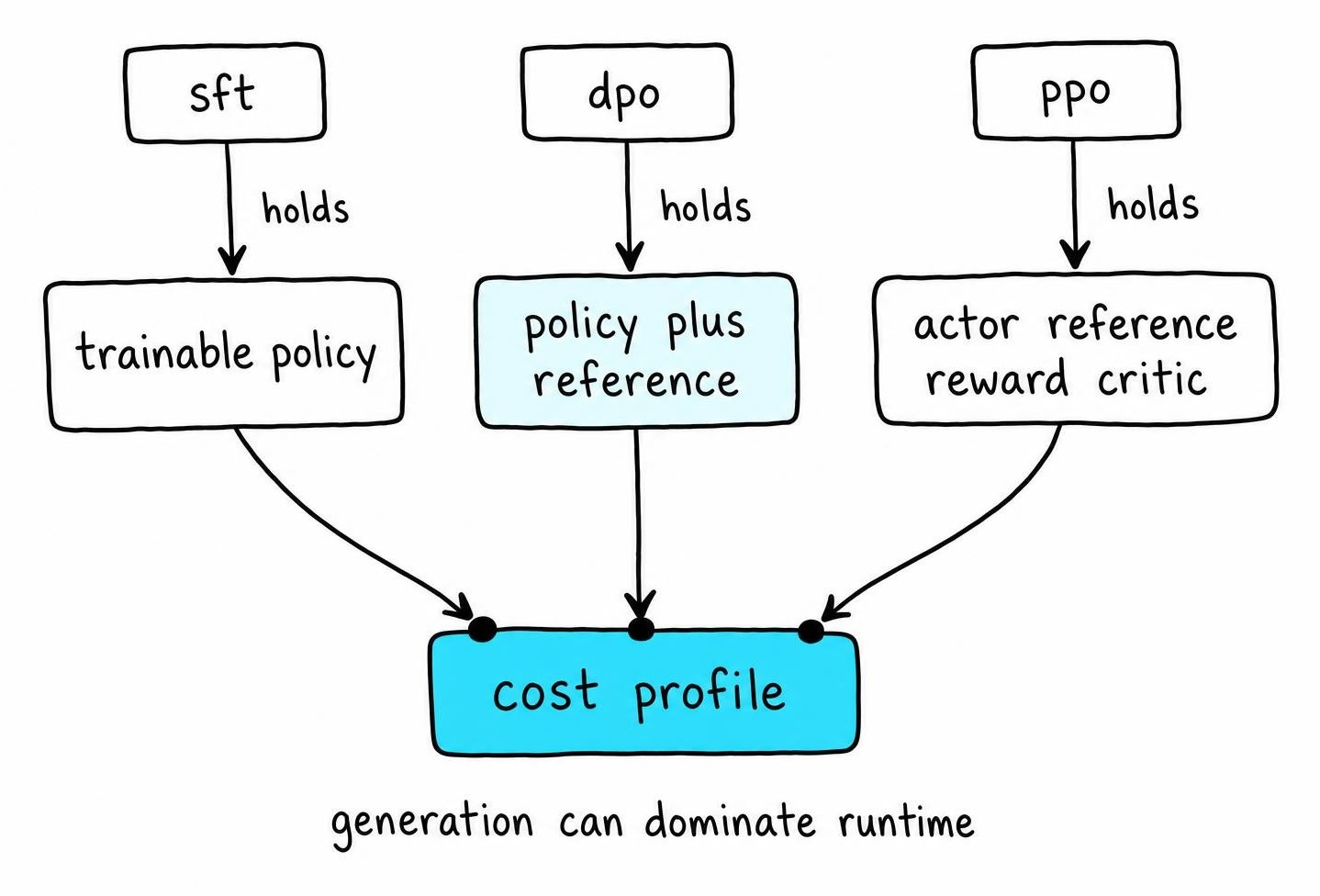
Stability differs sharply. SFT loss curves descend smoothly. DPO is sensitive to β and pair quality; noisy preferences produce loss spikes mid-run. PPO is the least stable - learning rate, KL coefficient, GAE lambda, clipping range, and batch construction all interact, and a bad reward model makes every other hyperparameter irrelevant [2].
For cost estimation, budget GPU-hours per experiment, then account for the reality that PPO experiments fail more often than DPO ones, which fail more often than SFT. Add evaluation compute and engineering time.
Safety outcomes and failure modes to test before deployment
No method guarantees AI safety. Outcomes depend on policy specification, data coverage, evaluators, optimization pressure, and deployment controls working together.
SFT blindly imitates annotation errors and handles unseen adversarial prompts poorly. DPO introduces its own risks:
- Preference overfitting on narrow pair distributions
- Likelihood displacement - probability mass shifts toward unseen completions [3]
- Excessive refusal on borderline prompts
- Degradation outside the pair distribution
PPO adds reward hacking, policy collapse into repetitive high-reward outputs, and unstable gradient updates. Across all methods, watch for sycophancy, verbosity bias, capability regressions (math, code, factual recall), multilingual gaps, and jailbreak susceptibility.
A single aggregate score won't catch these. Run separate evaluations for capability retention, harmlessness, refusal calibration, and adversarial robustness. Ship with canary releases, define rollback thresholds on flagged-response rates, and monitor post-deployment distributions continuously.
When to use SFT alone, add DPO, or choose PPO-based RLHF for alignment
Use SFT alone when desired behavior is easy to demonstrate, preference labels don't exist, or the goal is domain adaptation. SFT gets you surprisingly far.
Add DPO when your SFT checkpoint performs competently but you want nuanced quality steering from pairwise judgments in a stable offline workflow.
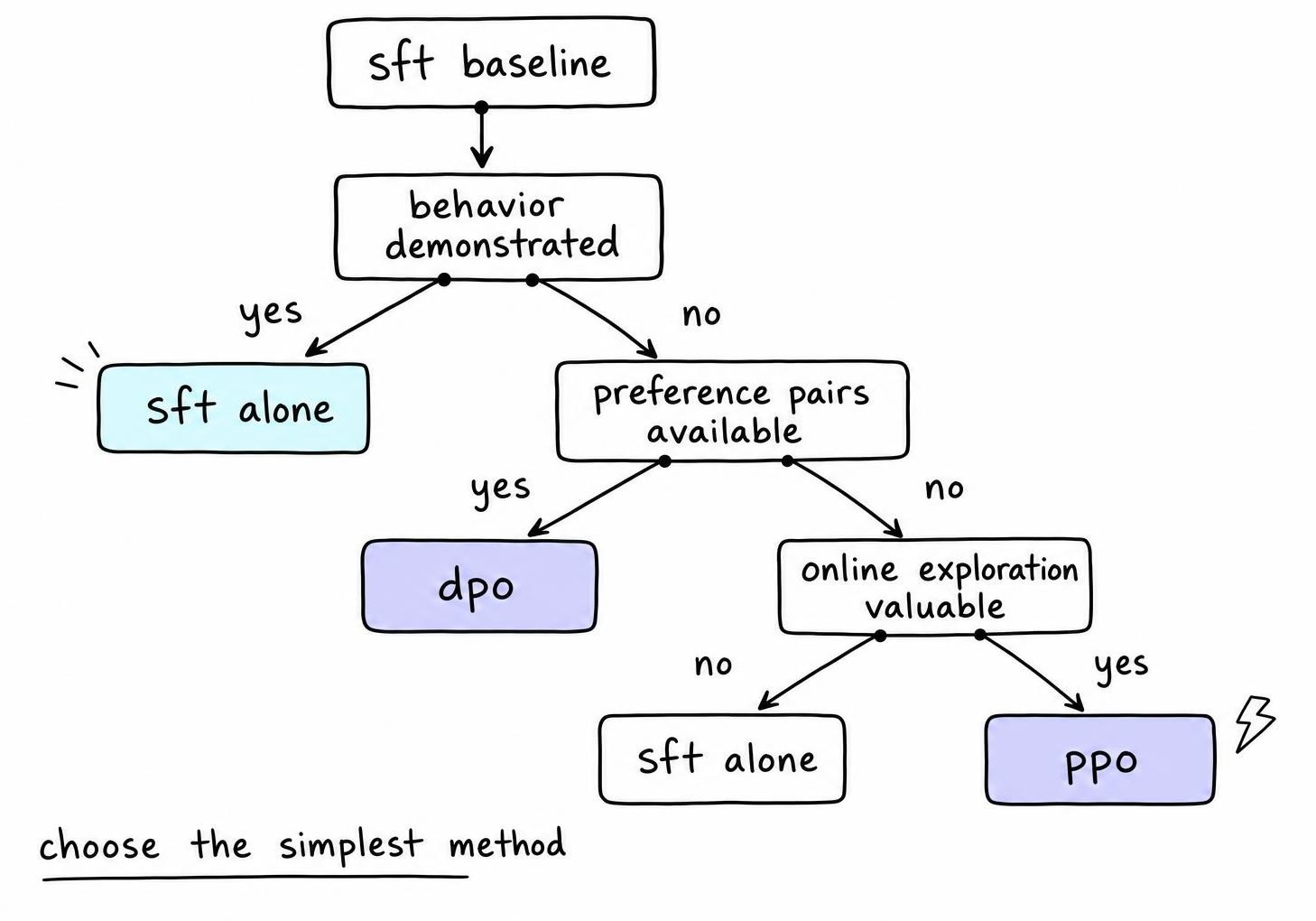
Choose PPO when a credible reward model exists, online exploration matters, and your team can debug unstable runs.
Hybrid paths exist. Rejection-sampling fine-tuning gives PPO-like gains with SFT-like stability. KTO works from binary feedback without pairs. IPO and ORPO each shift different tradeoffs - none are drop-in replacements.
Decision flowchart:
- Is your SFT baseline adequate? → Ship it.
- Do you have pairwise preference data? → If no, collect it or use KTO.
- Compute budget under 2× SFT cost? → DPO.
- Need online exploration for safety coverage? → PPO.
- Can your team diagnose reward hacking? → If no, stay with DPO.
- Safety-critical with regulatory exposure? → PPO with human-in-the-loop.
The method you can reliably operate beats the one that scores higher on a benchmark you can't reproduce.
Production checklist for DPO, PPO, and SFT alignment
Before training, audit prompt coverage, feedback provenance, annotator consistency, PII, and train-test leakage by prompt similarity.
Establish an SFT baseline with a frozen evaluation suite. Without this anchor, you can't tell whether preference gains come from optimization or from data changes you introduced simultaneously.
Run small ablations before scaling. Sweep DPO β, PPO KL coefficients, and data mixtures on a fraction of your budget. A short ablation on a few hundred examples often reveals that a planned β destabilizes training thousands of steps in, which is cheap to learn before the full run has spent its budget.
Track more than loss. Monitor win rates, per-capability regressions, refusal rates, reward margins, KL divergence, and human-review agreement - all simultaneously. Evaluate against your production model using blinded pairwise comparisons with confidence intervals, sliced by language, task, risk level, and prompt source.
Ship the simplest method that clears your quality and safety gates. Document three things:
- Rollback trigger: what metric threshold reverts to the previous model.
- Retraining trigger: what data drift initiates the next round.
- Escalation path: who reviews flagged outputs and how fast.
FAQ
Is DPO or PPO better?
DPO is better for most teams because it requires less compute, no reward model, and fewer hyperparameters. PPO outperforms DPO when online exploration matters - particularly in safety-critical deployments where the model must encounter failure modes during training that no static preference dataset covers. The choice depends on infrastructure capacity and safety requirements, not benchmark rankings.
Is DPO better than SFT?
DPO and SFT are complementary. SFT teaches instruction following by imitating demonstrations; DPO then steers response quality using pairwise preferences. DPO without a strong SFT foundation produces brittle results. SFT alone is sufficient when preference labels are unavailable or when demonstrated behavior already meets deployment quality and safety standards.
What does the acronym DPO stand for?
DPO stands for Direct Preference Optimization. It trains a language model to align with human preferences by converting chosen-versus-rejected response pairs into a policy loss function, bypassing the need for a separate reward model [4]. It was introduced as a simpler, more stable alternative to PPO-based reinforcement learning from human feedback.
References
- Prediction and Evaluation in College Hockey using the Bradley-Terry-Zermelo Model - John T. Whelan, Adam Wodon (2020)
- Aligning Language Models Using Follow-up Likelihood as Reward Signal - Chen Zhang, Dading Chong, Feng Jiang et al. (2024)
- Bayesian Surface Warping Approach For Rectifying Geological Boundaries Using Displacement Likelihood And Evidence From Geochemical Assays - Raymond Leung, Alexander Lowe, Anna Chlingaryan et al. (2020)
- Erratum to "The Homogeneous Coordinate Ring of a Toric Variety", along with the original paper - David A. Cox (1992)