GraphRAG vs RAG in 2026: 6 Production Tradeoffs That Matter
Swarnava Dutta10 min read
Graphrag vs RAGGraphrag EvaluationGraphrag vs Vector RAG
Contents
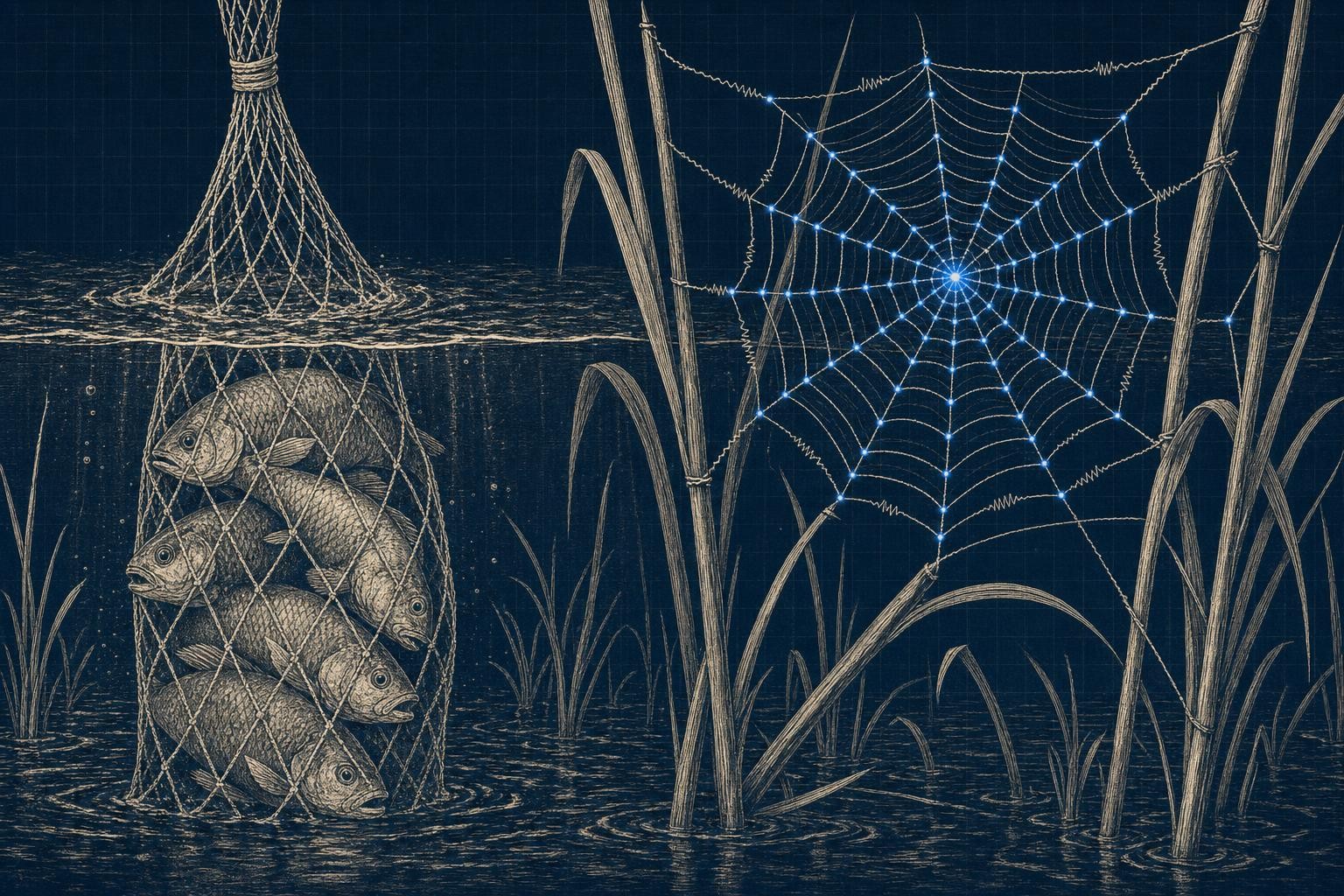
The graphrag vs rag question usually surfaces the same way: someone insists a vector RAG pipeline "doesn't understand" how an org chart connects to a set of compliance policies, and rebuilding the whole thing as an entity graph gets floated as the fix. That complaint is half right. Vector search keeps nailing single-document lookups and completely whiffs on anything that needs synthesis across dozens of scattered files.
That gap is why the graphrag vs rag question isn't academic. GraphRAG can genuinely outperform standard vector retrieval on connected, corpus-spanning questions - the kind where the answer lives in the relationships between documents, not inside any single chunk. But that capability isn't free: it costs more to index, adds latency at query time, and drags in a graph database you now have to babysit in production. The decision comes down to your query mix, not which architecture sounds more sophisticated in a vendor blog post.
Quick answer
GraphRAG improves on vector RAG for queries requiring multi-hop reasoning or corpus-wide summarization, because it retrieves connected entities and relationships instead of isolated text chunks. Vector RAG remains faster, cheaper to index, and equally accurate for direct fact-lookup queries against a single document or narrow context window. Choose GraphRAG when your workload leans heavily on "how do these things relate" questions across many documents; choose vector RAG, or a hybrid, when most queries are local lookups and you can't absorb the added indexing cost and query latency.
GraphRAG vs RAG: How the Retrieval Architectures Differ
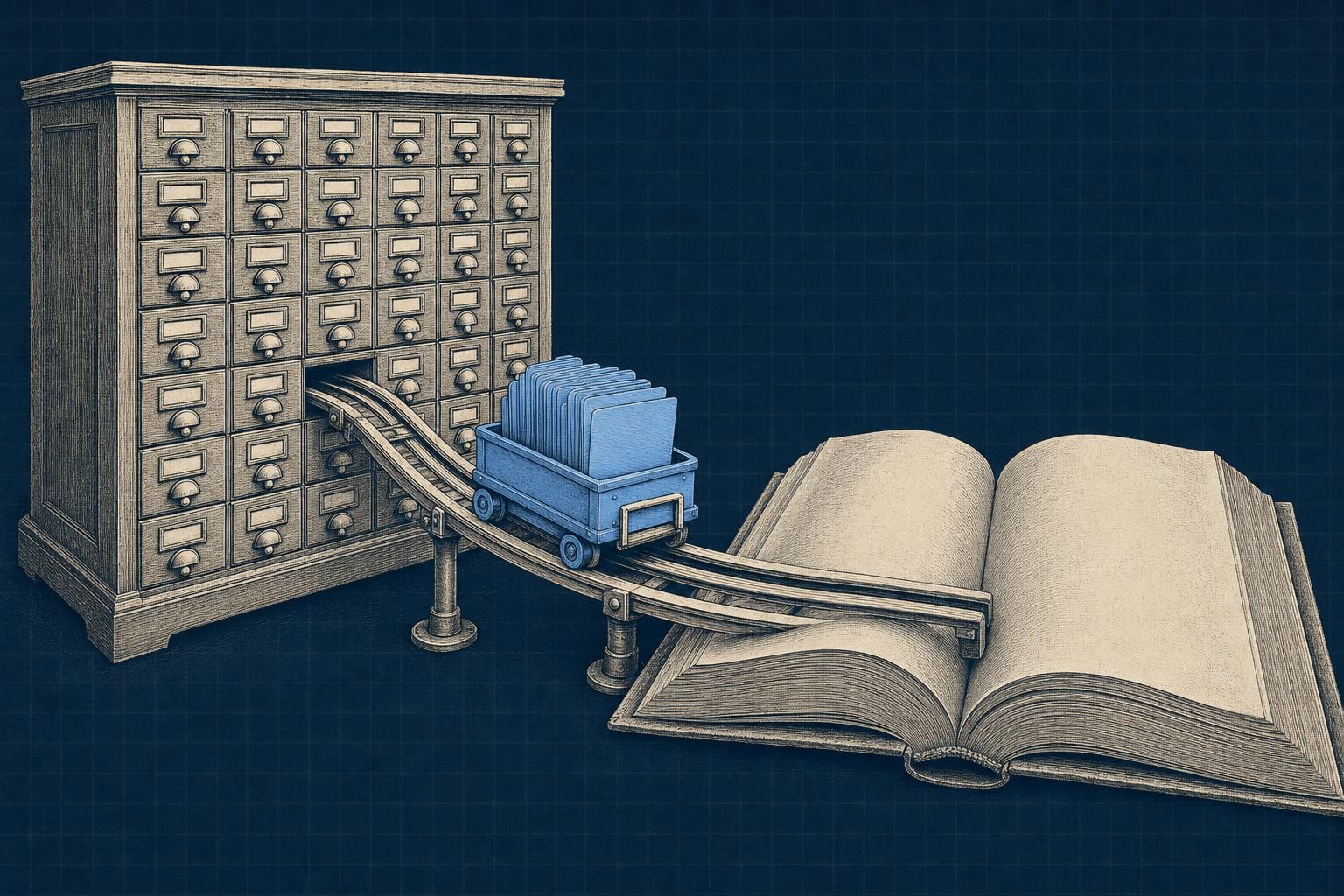
Conventional vector RAG follows a pipeline you've probably built yourself: chunk documents, embed the chunks, run similarity search at query time, optionally rerank the candidates, and stuff the survivors into a context window for generation. It's simple, fast, and treats every chunk as an independent unit of meaning. That independence is also its weakness - nothing in the pipeline knows that chunk 12 in file A relates to chunk 47 in file C.
GraphRAG adds a step before retrieval even happens. An LLM pass extracts entities and relationships from your corpus, builds a knowledge graph, and often clusters that graph into communities with generated summaries. Retrieval then walks the graph - traversing relationships or pulling community summaries - instead of just ranking chunks by cosine similarity.
Here's the part people miss: GraphRAG usually still embeds things. Entity nodes, relationship descriptions, and community summaries all get vectorized, so you're layering a graph on top of vector search, not replacing it. Microsoft's GraphRAG implementation is one specific recipe for this - entity extraction, hierarchical community detection, summarization - but it's become shorthand for a broader category of graph-enhanced RAG systems that vary widely in how they build and traverse the graph. The core tradeoff stays constant: simplicity and direct semantic matching versus structured relationships and corpus-level representation.
How GraphRAG Works Step by Step, From Documents to Answers
The indexing pipeline is where GraphRAG earns its cost. After chunking the corpus the same way any RAG system would, an LLM makes a pass over every chunk pulling out entities and the relationships between them - "Company X acquired Company Y in 2019," turned into nodes and an edge. Those extractions get merged into a graph, deduplicated, and run through community detection to group tightly connected nodes into clusters. Each cluster then gets its own LLM-generated summary describing what that neighborhood of the graph is "about."
That's three separate LLM call stages before you've answered a single query - extraction, merging/dedup, summarization - versus vector RAG's one-shot embed-and-store step. Extraction quality caps everything downstream: miss a relationship at ingestion time and no amount of clever traversal recovers it later.
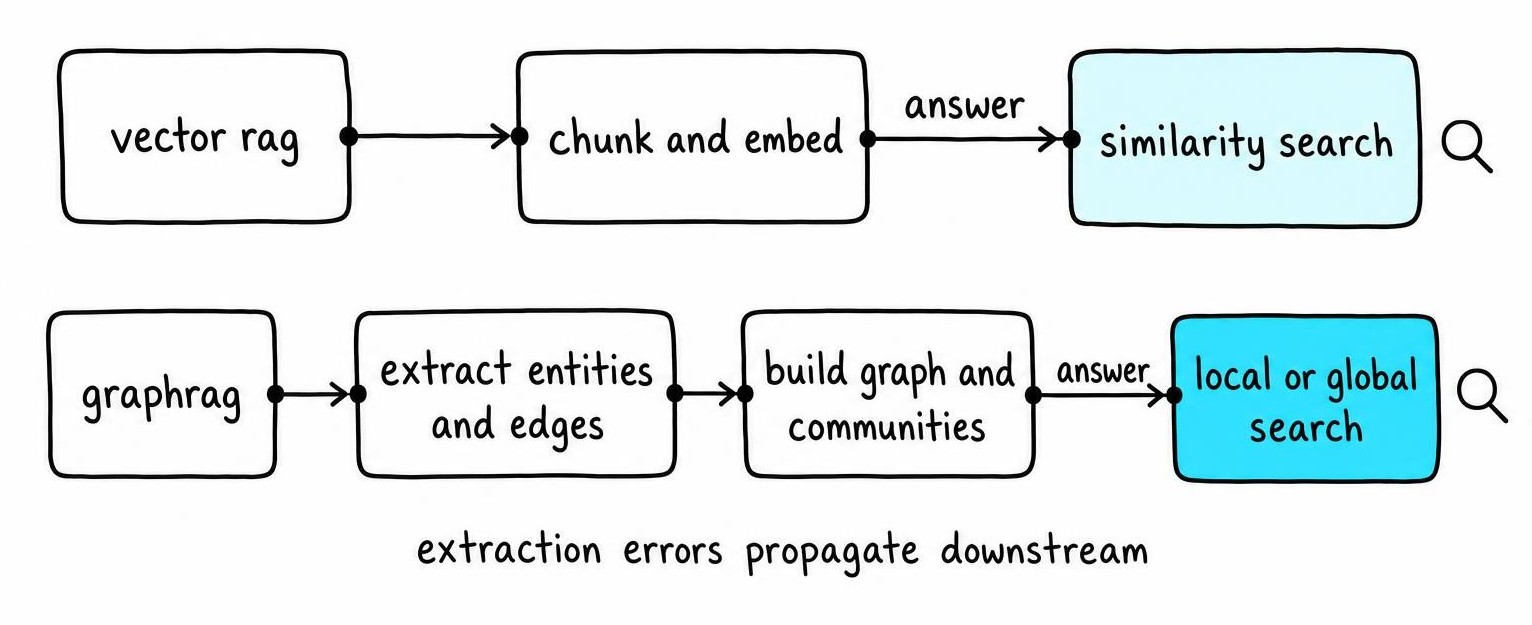
At query time, most implementations branch into two modes. Local search anchors on specific entities mentioned in the question and walks nearby relationships, good for "who reports to whom." Global search reasons over community summaries for corpus-wide themes, like "what are the recurring risks across all these contracts."
Implementation varies - some teams use full graph databases, others a lighter property-graph-plus-vector-index hybrid, and Microsoft's approach leans hardest into hierarchical community summarization.
Retrieval Quality: Local Facts vs Global Reasoning
On straightforward fact lookup - "what's the termination clause in this contract" - vector RAG and GraphRAG land in roughly the same place, and vector RAG often wins on latency. If your chunking strategy already keeps semantically related passages together, nearest-neighbor search finds the answer without any graph overhead at all.
Where GraphRAG earns its keep is multi-hop and relationship-heavy questions: "which vendors share a subcontractor with our flagged supplier." Nearest-neighbor search fails here for a structural reason, not a tuning one - the query embedding doesn't resemble either document individually, so both get scored low even though together they answer the question. Graph traversal doesn't care about embedding similarity; it follows the edge.
Corpus-wide synthesis - "summarize the recurring risks across all forty contracts" - is GraphRAG's clearest win, since community summaries already aggregate what individual chunk retrieval would need dozens of lucky hits to reconstruct.
But graph quality has its own failure modes: missed entities during extraction, hallucinated edges, two "John Smith"s merged into one node, relationships that go stale the moment a document updates. Better evidence coverage isn't the same as a better final answer - a well-built graph can still feed a model into a confident, wrong synthesis.
GraphRAG Benchmarks and Evaluation That Reflect Production
Most public QA benchmarks are built from single-passage lookup questions, which is exactly the query type where vector RAG already wins. Run GraphRAG through one of those and it looks like an expensive way to match a baseline - not because the architecture is weak, but because the benchmark never asks a question that needs graph traversal.
Build your own eval set segmented by query type: direct lookup, relationship traversal, cross-document synthesis, temporal questions ("what changed between the 2022 and 2024 filing"), and deliberately unanswerable requests. Score each segment separately instead of blending them into one average that hides where each system actually wins.
For metrics, track retrieval recall and context precision as usual, but add path correctness for graph traversal and community-summary faithfulness for synthesis tasks. Answer faithfulness and citation coverage still matter - a graph-backed answer that cites the wrong node is as useless as a hallucinated chunk.
Pair every quality metric with an operational one: p50/p95 latency, indexing time, token spend, storage growth, and cost per successful answer. Run paired tests - same corpus, same model, same prompt - against your existing vector RAG baseline, add human review for synthesis quality, and once you ship, keep watching user feedback and escalation rates by query type.
GraphRAG Indexing Cost, Query Latency, and Total Cost
Indexing is where GraphRAG's bill actually lands. Every chunk gets an LLM pass for entity and relationship extraction, then another pass for merging and dedup, then a third for community summarization - three rounds of token spend before you've stored a single embedding. Add graph storage costs on top of your existing vector index, and a corpus that cost a few dollars to embed for vector RAG can run into real ingestion budgets for GraphRAG.
Query time flips the comparison somewhat. Vector RAG spends its time on similarity search plus optional reranking - consistently fast. GraphRAG's local search adds graph traversal hops; global search means pulling and reasoning over multiple community summaries, often assembling a larger context window than a chunk-based retriever would ever need. Deeper traversal means slower answers, plain and simple.
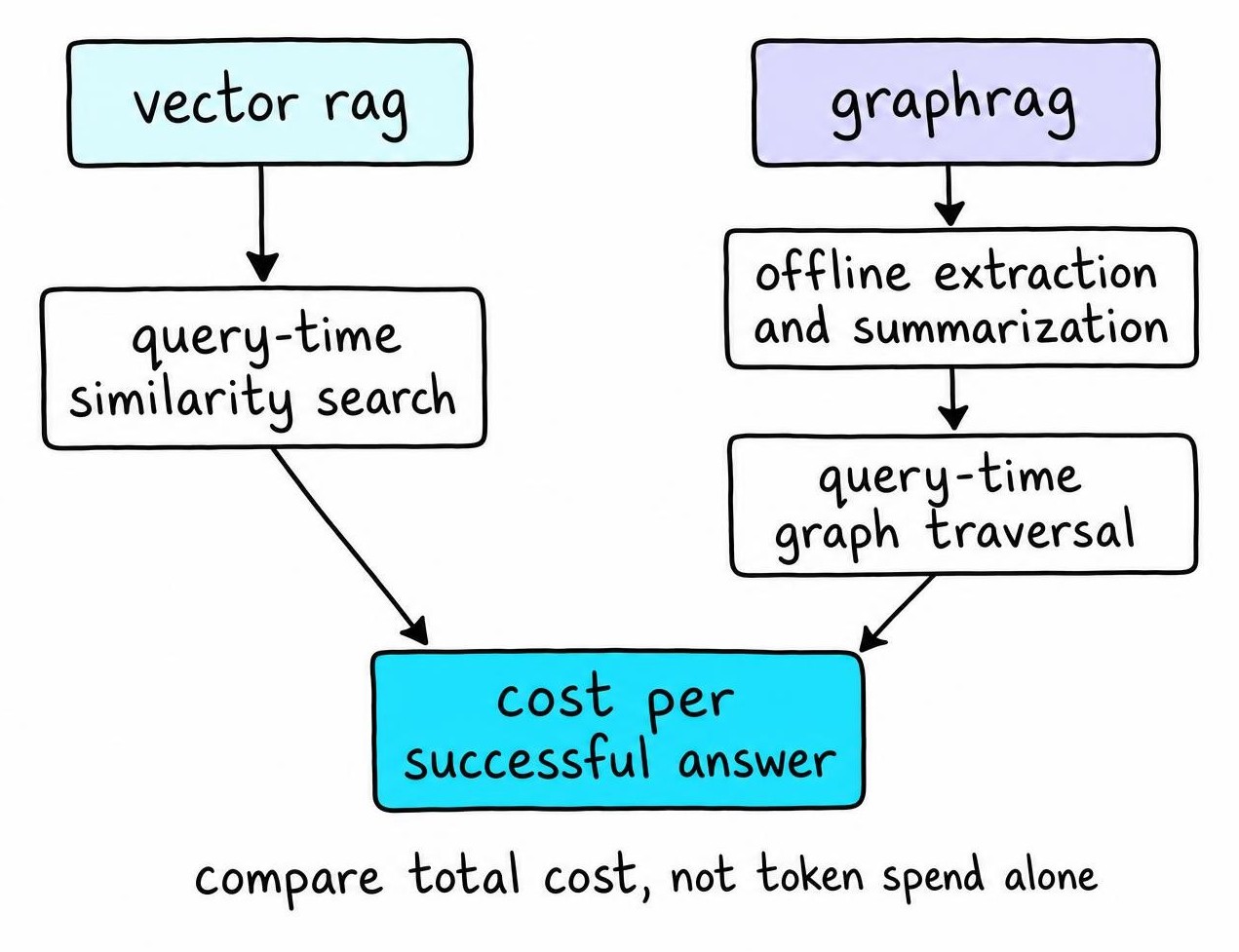
Control costs with incremental indexing that only reprocesses changed documents, caching stable community summaries, using a cheaper model for extraction than for generation, and scoping graph construction to entity types that actually matter for your queries. Judge everything by cost per successful answer, not infrastructure spend in isolation - a slower, pricier system that finally answers the synthesis questions correctly can still win.
Production Failure Modes and Maintenance Burden
The graph rots the moment you stop watching it. Entity resolution is the first crack: "J. Smith," "John Smith," and "Smith, John" become three nodes instead of one, and every relationship attached to that person gets split with them. Extraction runs also invent edges that never existed in the source text, and contradictory relationships pile up when two documents disagree - nothing forces reconciliation.
Schema drift compounds this over time as new entity types show up in newer documents but never get backfilled into older graph nodes, leaving the graph fragmented into disconnected clusters that traversal can't bridge. Deleted source documents are worse than stale ones - the extracted entities and edges they produced often persist in the graph long after the source is gone, with no clean cascade to remove them. Permissions and tenant isolation get even messier: a community summary can quietly blend facts from documents two different users were never supposed to see together.
Observability has to go deeper than a similarity score. You need graph path traces, extraction confidence, summary freshness, and routing decisions logged per query, plus a way to trace any answer back through node, edge, and source document. Ship confidence thresholds, extraction validation, versioned indexes, fallback to vector retrieval, and human review for high-stakes domains.
When to Use GraphRAG, Vector RAG, or a Hybrid
Skip the philosophy and match architecture to query mix.
| Decision criteria | Vector RAG | GraphRAG | Hybrid |
|---|---|---|---|
| Query type | Direct lookup | Multi-hop, relational | Mixed |
| Relationship density | Low | High | Medium-high |
| Corpus size | Any | Large, interconnected | Large |
| Update frequency | Frequent | Infrequent | Frequent, with graph refresh jobs |
| Quality ceiling | Good on facts | Higher on synthesis | Best of both, if routed well |
| Indexing budget | Low | High | Medium-high |
| Latency target | Sub-second | Seconds | Depends on route |
| Operational skills | Standard RAG stack | Graph DB, entity resolution | Both |
| Explainability | Chunk citations | Path traces | Both, per route |
| Best-fit workloads | Support docs, FAQs | Investigations, compliance mapping | Enterprise knowledge bases |
Vector RAG wins outright when the corpus churns daily, latency budgets are tight, and your team wants one moving part, not two. GraphRAG earns its keep when users routinely ask "how does this connect to that" across dozens of documents. Most production systems land on hybrid: a router classifies queries and only relationship-heavy ones touch the graph.
Adopt in stages: build a solid vector baseline first, tag a sample of real user queries as graph-suitable or not, pilot GraphRAG offline against that labeled set, compare quality-adjusted cost against your baseline, then ship with guarded routing and a vector fallback.
FAQ
How is GraphRAG better than RAG?
GraphRAG outperforms standard vector RAG on questions that need multi-hop reasoning or corpus-wide synthesis, because it retrieves connected entities and relationship paths instead of isolated chunks. It doesn't beat vector RAG on direct fact lookup, where nearest-neighbor search is faster and equally accurate, so the advantage only applies to relationship-heavy or summarization-style queries.
How does GraphRAG work?
GraphRAG extracts entities and relationships from a document corpus using an LLM, builds a knowledge graph from those extractions, and clusters the graph into communities with generated summaries. At query time it traverses relationships or pulls community summaries instead of ranking chunks by embedding similarity alone, though entities and summaries typically still get embedded for search.
How does GraphRAG work step by step?
The pipeline runs: chunk the corpus, extract entities and relationships per chunk via LLM, merge and deduplicate extractions into a unified graph, run community detection to cluster related nodes, and generate a summary per community. At query time, local search traverses entity neighborhoods while global search reasons over community summaries for corpus-wide questions.
How do you evaluate GraphRAG?
Build a labeled query set segmented by type - direct lookup, relationship traversal, cross-document synthesis, temporal questions - and score each segment separately rather than blending into one average. Track retrieval recall, path correctness, and summary faithfulness alongside operational metrics like indexing time, latency, and token cost, then compare paired results against a vector RAG baseline on the same corpus.
Further Reading
- AI Agent-Driven Framework for Automated Product Knowledge Graph Construction in E-Commerce - Dimitar Peshevski, Riste Stojanov, Dimitar Trajanov (2025)
- Do We Still Need GraphRAG? Benchmarking RAG and GraphRAG for Agentic Search Systems - Dongzhe Fan, Zheyi Xue, Siyuan Liu et al. (2026)
- Tree of Reviews: A Tree-based Dynamic Iterative Retrieval Framework for Multi-hop Question Answering - Li Jiapeng, Liu Runze, Li Yabo et al. (2024)